Instructors:
Spring Session I
8 Weekends (Time: 6:00 – 8:00 pm), Total: 16 Hours
3/13, 3/20, 3/27, 4/3 (Monthly Mock Test/Review
4/10, 4/17, 4/24, 5/1 (Monthly Mock Test/Review)
Spring Session II
7 Weekends (Time: 6:00 – 8:00 pm), Total: 14 Hours
5/8, 5/15, 5/22, 5/29 (Monthly Mock Test/Review)
6/5, 6/12, 6/19 (Final Mock Exam/Review)
Tuition for Session I: $640 (including all materials). We offer discounts of $15 for returning students.
Tuition for Session II: $560 (including all materials). We offer discounts of $15 for returning students.
There are 2 tuition payment options. In the first option, students may choose to pay on session-by-session basis. That is, choosing to pay for Session I, only, and then, if they decide to continue, pay for Session II. Note that Session I and Session II have different tuition fees because Session I has 8 classes and Session II only has 7. In the second option, students may pay for the whole 2 sessions at a discounted price of $1,180. Returning students only need to pay $1,160.
Payment Policy
- Full payment must be received on or before the day of first class.
Refund Policy
- Withdrawal before the first class: Full Refund
- Withdrawal after the first class: $95 deduction
- No refund after the second class
A late fee of $50 will be added to the tuition for payment after the first class.
Online Registration is now open! Click HERE to register.
A commitment to the whole course can maximize the benefit of learning all the math ideas, methods, strategies, tactics, skills, and techniques.
Although the 2016 AMC 10/12 contests have just finished, we must prepare in advance for the 2017 AMC 10/12 contests. As the great scientist Louis Pasteur said, “Chance favors only the prepared mind.” Those who strive to prepare early, and work hard are the ones who achieve the best results. The AMC is a complex math competition that requires dedication and focus. Therefore, the earlier our students start preparing, the better their scores will be. Read more at:
- 116 Full-length Real AMC Problems Sets are a Golden Resource to Our AMC 10/12 Prep Program
- 365-hour Project to Qualify for the AIME through the AMC 10/12 Contests
- The Big Value of Middle School Math Competitions
- Great Benefits of Math Competitions
- A Little Competition Can Inspire Math Students to Greater Achievement
- Mathematics competitions are NOT mysterious, and every student can attend them! — 数学竞赛绝非神秘,每个学生都可参加!
- Girls should attend math competitions — 女生更应参加数学竞赛
- Small-sized Class Instruction-focused Model
Locations:
13902 Bromfield Road, Germantown, MD 20874
18206 Endora Cir, Germantown, MD 20841
Contact Information:
Ivy League Education Center
Tel: 301-922-9508 or 240-780-8828
Email: chiefmathtutor@gmail.com

Purpose: To prepare for the AMC 10/12 A — Tuesday, February 7, 2017 and/or AMC 10/12 B — Wednesday, February 15, 2017.
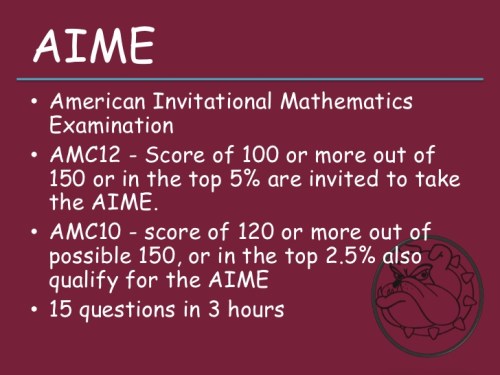
 Specific Goal: To earn a score of 120 or more out of 150 on the American Mathematics Contest 10 (AMC 10), or a score of 100 or more out of 150 on the American Mathematics Contest 12 (AMC 12), and then qualify for the American Invitational Mathematics Examination (AIME), which is used to determine qualification for the United States of America Mathematical Olympiad (USAMO). See for more details: Optimal Strategies to Solve Hard AMC Problems
There are many math competitions in the United States. Of those, only AMC → AIME → USAMO sequence would take you to the IMO (International Math Olympiad), the highest level math competition for high school students in the world.

Who should take this class: This class is very appropriate for 6th-11th grade students who are hoping to qualify for the AIME.
Benefits:
- 15 tutorial handouts (>300 pages) developed by Dr. Henry Wan and 400 new problems similar to AMC 10/12 level from the licensed AMC Database
- 4 FREE mock tests that are intended to mimic an actual math competition exam, each of which has 25 questions similar to AMC 10/12 level taken from the licensed AMC Database. These simulated tests help students assess their level of preparation for the Math Competitions. After attempting the test, students get answers, explanations, and a detailed score report and wise performance summary.
- FREE registration for the AMC 10/12 A — Tuesday, February 7, 2017 and/or AMC 10/12 B — Wednesday, February 22, 2017. Please see: The AMC 10/12 Contest at Montgomery College on February 2, and February 17, 2016
Weekly Homework: At least 5 hours per week. Each week, we will carefully review and check 2 students’ homework, and correct any mistakes. The next week, we will check another 2 students’ homework, and this will continue on a rotational basis until all students have had their homework checked at least once and the cycle will start again. Based on the work of the 2 students that week, we will provide the those 2 students with individualized proposal and support.

Class Outline:
In our high school competitive math class, we will focus on efficient tricks, shortcuts, and strategies to solve AMC problems as well as test-taking tactics. The emphasis of this class will be on fundamental geometry and discrete math which are very common in competitive math. We will also help students develop quick problem solving strategies and effective time management skills.
AMC 10 Prep Class Spring I
| Class | Date | Topic | Homework | Tutorial Handouts |
| 1 | 3/13, Sun | Using the Pythagorean theorem and sophisticated algebra to solve geometry problems on the AMC | AMC 10/12 Problem Set, Plus some new problems with similar difficulty and style from the licensed AMC Database | Yes |
| 2 | 3/20, Sun | Triangle geometry: common base theorem of triangles, triangle inequality, angle bisector theorem, Heron’s formula | AMC 10/12 Problem Set, Plus some new problems from the licensed AMC Database | Yes |
| 3 | 3/27, Sun | Special triangles I (30o-60o-90o triangles, 45o-45o-90o triangles) and hexagon/octagon geometry | AMC 10/12 Problem Set, Plus some new problems from the licensed AMC Database | Yes |
| 4 | 4/3, Sun | Circle geometry: intersecting chords theorem, Ptolemy’s theorem, Ceva’s theorem, | AMC 10 Problem Set on Counting, Plus some new problems from the licensed AMC Database | Yes |
| 5 | 4/10, Sun | Special triangles II(15o-75o-90o triangles, 18o-72o-90o triangles, and golden triangle) and pentagon/decagon geometry | AMC 10/12 Problem Set, Plus some new problems from the licensed AMC Database | Yes |
| 6 | 4/17, Sun | Analytic geometry approach to AMC problems | AMC 10/12 Problem Set, Plus some new problems from the licensed AMC Database | Yes |
| 7 | 4/24, Sun | Using trigonometry to solve AMC problems | AMC 10/12 Problem Set, Plus some new problems from the licensed AMC Database | Yes |
| 8 | 5/1, Sun | Most commonly used methods to draw auxiliary lines and applications of the ruler, protractor, and compass to solve hard AMC geometry problems (See more at: Optimal Strategies to Solve Hard AMC Geometry Problems) | AMC 10/12 Problem Set, Plus some new problems from the licensed AMC Database | Yes |
AMC 10 Prep Class Spring II (Continuation of Session I)
| Class | Date | Topic | Homework | Tutorial Handouts |
| 1 | 5/8 | Efficient strategies for solving AMC geometry problems associated with counting/combinatorics, probability, number theory, and algebra | AMC 10/12 Problem Set, Plus some new problems from the licensed AMC Database | Yes |
| 2 | 5/15 | Special Factoring Trick –– Completing the Rectangle | AMC 10/12 Problem Set, Plus some new problems from the licensed AMC Database | Yes |
| 3 | 5/22 | Finding the hundreds, tens, and units digits of a number | AMC 10/12 Problem Set, Plus some new problems from the licensed AMC Database | Yes |
| 4 | 5/29 | Number bases, modular arithmetic, integer divisions, and linear congruences at the heart of a great many AMC problems | AMC 10/12 Problem Set, Plus some new problems from the licensed AMC Database | Yes |
| 5 | 6/5 | Integer equations and Diophantine equations | AMC 10/12 Problem Set, Plus some new problems from the licensed AMC Database | Yes |
| 6 | 6/12 | Systems of Linear Congruences and the Chinese Remainder Theorem | AMC 10/12 Problem Set, Plus some new problems from the licensed AMC Database | Yes |
| 7 | 6/19 | Using the stars and bars method to solve AMC problems associated with number theory, counting, combinatorics, and probability | AMC 10/12 Problem Set, Plus some new problems from the licensed AMC Database | Yes |
Small-sized Class Teaching Model: We utilize the highly effective small-sized class teaching model. Smaller classes lead to pupils receiving more individual attention from teachers, and having more active interactions with them. We focus on every individual, not the whole class. Students will thrive from the smaller class sizes that allow them to reach their full potential. Particularly, students can benefit tremendously from high-frequent individualized student-teacher interactions leading to establishment of a stronger foundation for lifelong learning.
Our main purpose is to help our students gain deeper understanding of the fundamental math concepts, build a solid foundation in math, and develop the critical thinking and problem-solving skills that are so valuable to success in any career. We are big believers in the FUNDAMENTALS! Our students will receive the LIFELONG BENEFITS from learning math.

Regardless of his/her math level, each student will have the opportunity to learn math in a fun, friendly, cooperative, supportive learning environment. The most important thing is to have fun.

Our Students
In 2016, we have 36 students who are qualified to take AIME either through AMC 10A/12A or AMC 10B/12B. One of our students was among the 23 Perfect Scorers worldwide on the AMC 10A: Joel (Junyao) T. Particularly, seven middle schoolers and one elementary schooler qualified for the AIME, which is geared toward high school students. Pravalika P., a 6th grader, got a 115.5 out of 150 on the AMC10B, which is very impressive. Read more at: 2016 AIME Qualifiers Announced — 36 Students Qualified for AIME
From 2011 to 2015, in total, 37 students scored above 120 on the American Mathematics Contest 10 (AMC 10) and qualified for the American Invitational Mathematics Examination (AIME); 26 students scored above 100 on the American Mathematics Contest 12 (AMC 12) and qualified for the American Invitational Mathematics Examination (AIME); 3 students qualified for the USA Mathematical Olympiad (USAMO), the highest level of math competition for high school students in the USA. Read more at: Notable Achievements of Our Students

Our Uniqueness
We have a long history of close collaboration with the MAA‘s American Mathematics Competitions (AMC), which are dedicated to strengthening the mathematical capabilities of our nation’s youth, and are the first of a series of competitions in high school mathematics that determine the United States team for the International Mathematical Olympiad (IMO).
We are only one in the Washington DC metropolitan area to offer elementary, middle, and high-school level competition math courses. Our students have received top scores and awards at prestigious national and math competitions. We have collected 116 full-length real AMC 10/12 problems sets containing 2,960 problems, as described in the article “116 Full-length Real AMC Problems Sets are a Golden Resource to Our AMC 10/12 Prep Program.” Particularly, we have extracted additional 3,000 brand new problems at the level of the AMC 10/12, from the licensed AMC Database. In addition, we have also collected all AMC8/10/12 and AIME Official Solutions as shown in the article “American Mathematics Competitions (AMC) Materials.” All these materials have formed a golden resource for our students, who are the ultimate beneficiaries.
Click HERE find out more about Math Competitions!





 The 2016 AIME I was held on March 3, 2016. 2,855 students from US and Canadian schools participated in this contest. The AIME is taken by students who achieved a score in the top 5%









 Purpose: