
 Henry Wan, Ph.D.
Abstract
This article analyzes the geometry problems appearing on the 2026 AMC 8 contest organized by the Mathematical Association of America. By comparing these problems with earlier contests and widely circulated training materials, we demonstrate that several of the geometry problems are either identical to or strongly derived from previously published problems. The analysis highlights how recognizing common problem templates can significantly improve contest preparation strategies.
Sections
- Introduction
- Overview of Corresponding Problems
- Historical Timeline of Related Problems
- Problem-by-Problem Analysis
- Evidence from Our 2025 Courses
- Problem Lineage
- Conclusion
Introduction
The 2026 AMC 8, organized by the Mathematical Association of America, contained five pure geometry problems:
- Problem #6
- Problem #11
- Problem #13
- Problem #15
- Problem #23
A careful comparison with earlier contests and training materials shows that none of these problems are truly original. In each case, the problem is either identical to, or strongly derived from, a previously published contest problem.
This article documents those correspondences and discusses their implications for contest preparation.
Overview of Corresponding Problems
| 2026 AMC 8 Problem | Earlier Source | Relationship |
| #6 | 2017 AMC 10A Problem #3 | Similar |
| #11 | 2021 MathCounts Problem #8 | Identical |
| #13 | 2004 MathCounts Problem #20 | Identical |
| #15 | 2003 AMC 8 Problem #15 and 2005 AIME I Problem #9 | Similar |
| #23 | Japanese Junior High School Entrance Exam training problem 1-2 | Identical |
| #23 | 2022 Ivy League Education Center AMC 8 Mock Test 1 #25 | Similar |
Historical Timeline of Related Problems
| Year | Contest | Problem |
|---|---|---|
| 2003 | AMC 8 | Problem #15 |
| 2004 | MathCounts State Sprint | Problem #20 |
| 2005 | AIME I | Problem #9 |
| 2017 | AMC 10A | Problem #3 |
| 2021 | MathCounts Chapter Target | Problem #8 |
| 2022 | Ivy League Education Center AMC 8 Mock Test 1 | Problem #25 |
| 2026 | AMC 8 | Problems #6, #11, #13, #15, #23 |
This visually demonstrates problem lineage.
Problem-by-Problem Analysis
1. Problem #6
Peter lives near a rectangular field that is filled with blackberry bushes. The field is 10 meters long and 8 meters wide, and Peter can reach any blackberries that are within 1 meter of an edge of the field. The portion of the field he can reach is shaded in the figure below. What fraction of the area of the field can Peter reach?


This problem concerns the region within 1 meter of the boundary of a rectangle.
Its structure closely resembles 2017 AMC 10A Problem #3, which asks for the area of walkways surrounding several rectangular garden beds.

2017 AMC 10A #3
Tamara has three rows of two 6-feet by 2-feet flower beds in her garden. The beds are separated and also surrounded by 1-foot-wide walkways, as shown on the diagram. What is the total area of the walkways, in square feet?
![[asy]
unitsize(0.7cm);
path p1 = (0,0)--(15,0)--(15,10)--(0,10)--cycle;
fill(p1,lightgray);
draw(p1);
for (int i = 1; i <= 8; i += 7) {
for (int j = 1; j <= 7; j += 3 ) {
path p2 = (i,j)--(i+6,j)--(i+6,j+2)--(i,j+2)--cycle;
draw(p2);
fill(p2,white);
}
}
draw((0,8)--(1,8),Arrows);
label("1",(0.5,8),S);
draw((7,8)--(8,8),Arrows);
label("1",(7.5,8),S);
draw((14,8)--(15,8),Arrows);
label("1",(14.5,8),S);
draw((11,0)--(11,1),Arrows);
label("1",(11,0.5),W);
draw((11,3)--(11,4),Arrows);
label("1",(11,3.5),W);
draw((11,6)--(11,7),Arrows);
label("1",(11,6.5),W);
draw((11,9)--(11,10),Arrows);
label("1",(11,9.5),W);
label("6",(4,1),N);
label("2",(1,2),E);
[/asy]](https://latex.artofproblemsolving.com/d/8/4/d8413e83a8be21764277aaf7081a3a395aa9fb5e.png)

Both problems require the same geometric decomposition strategy:
- partitioning a region into rectangles and quarter-circles
- subtracting overlapping areas
Although the surface story differs, the core geometric technique is essentially identical.
2. Problem #11
Squares of side length 1, 1, 2, 3, and 5 are arranged to form the rectangle shown below. A curve is drawn by inscribing a quarter circle in each square and joining the quarter circles in order, from shortest to longest. What is the length of the curve?


Problem #11 asks for the length of a curve formed by connecting quarter circles inscribed in squares whose side lengths follow the Fibonacci sequence.
This problem is identical to 2021 MathCounts Chapter Target Round Problem #8.
2021 MathCounts Chapter Target #8
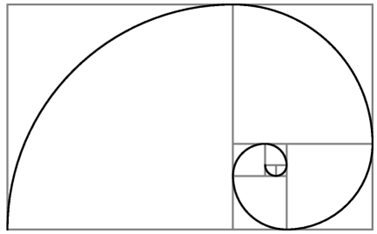
Tim has a collection of square tiles of various sizes, each of which has an etched quarter circle with radius equal to the side length of the tile. Tim arranges eight tiles as shown. If the two smallest tiles each have side length 10 cm, what is the length of the resulting spiral formed by the tiles’ etchings? Express your answer in terms of .
The only difference is contextual wording; the geometric configuration and required reasoning are the same.
Students familiar with the earlier MathCounts problem could immediately recognize the pattern and compute the length without additional insight.
3. Problem #13
The figure below shows a tiling of  unit squares. Each row of unit squares is shifted horizontally by half a unit relative to the row above it. A shaded square is drawn on top of the tiling. Each vertex of the shaded square is a vertex of one of the unit squares. In square units, what is the area of the shaded square?


Problem #13 presents a tiling of unit squares shifted by half a unit between rows and asks for the area of a square whose vertices lie on the lattice.
This problem is identical to 2004 MathCounts State Sprint Problem #20.
2004 MathCounts State Sprint #20
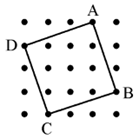
On the 5 by 5 square grid below, each dot is 1 cm from its nearest horizontal and vertical neighbors. What is the product of the value of the area of square (in cm2) and the value of the perimeter of square (in cm)? Express your answer in simplest radical form.
Again, the geometry, diagram, and reasoning are effectively unchanged.
4. Problem #15
Elijah has a large collection of identical wooden cubes which are white on 4 faces and gray on 2 faces that share an edge. He glues some cubes together face-to-face. The figure below shows 2 cubes being glued together, leaving 3 gray faces visible. What is the fewest number of cubes that he could glue together to ensure that no gray faces are visible, no matter how he rotates the figure?


Problem #15 involves cubes painted on certain faces and glued together so that no gray faces remain visible.
While not identical to a single earlier problem, it closely resembles the structure of:
- 2003 AMC 8 Problem #15, involving cube arrangements and projections
- 2005 AIME I Problem #9, which also concerns painted cubes and probabilistic arrangements
2003 AMC 8 #15
A figure is constructed from unit cubes. Each cube shares at least one face with another cube. What is the minimum number of cubes needed to build a figure with the front and side views shown?
![[asy] defaultpen(linewidth(0.8)); path p=unitsquare; draw(p^^shift(0,1)*p^^shift(1,0)*p); draw(shift(4,0)*p^^shift(5,0)*p^^shift(5,1)*p); label("FRONT", (1,0), S); label("SIDE", (5,0), S); [/asy]](https://latex.artofproblemsolving.com/e/6/d/e6d30f2f3ae60f8b661b55b5a6167693d0ecc30b.png)

2005 AIME I #9
Twenty-seven unit cubes are painted orange on four faces so that two unpainted faces share an edge. The cubes are randomly arranged to form a cube. What is the probability that the entire outer surface of the large cube is orange?
The underlying combinatorial geometry reasoning is essentially the same.
5. Problem #23
Lakshmi has 5 round coins of diameter 4 centimeters. She arranges the coins in 2 rows on a table top, as shown below, and wraps an elastic band tightly around them. In centimeters, what will be the length of the band?
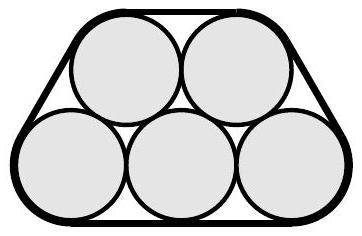

Problem #23 asks for the length of an elastic band wrapped tightly around five coins arranged in two rows.
This problem is particularly noteworthy because it is identical to a previously published problem used in Japanese middle-school entrance exam preparation materials.
Specifically, the problem matches a problem labeled:
“Junior High School Entrance Exam Mathematics (Basic) — Problem 1-2.”
The original Japanese statement reads:
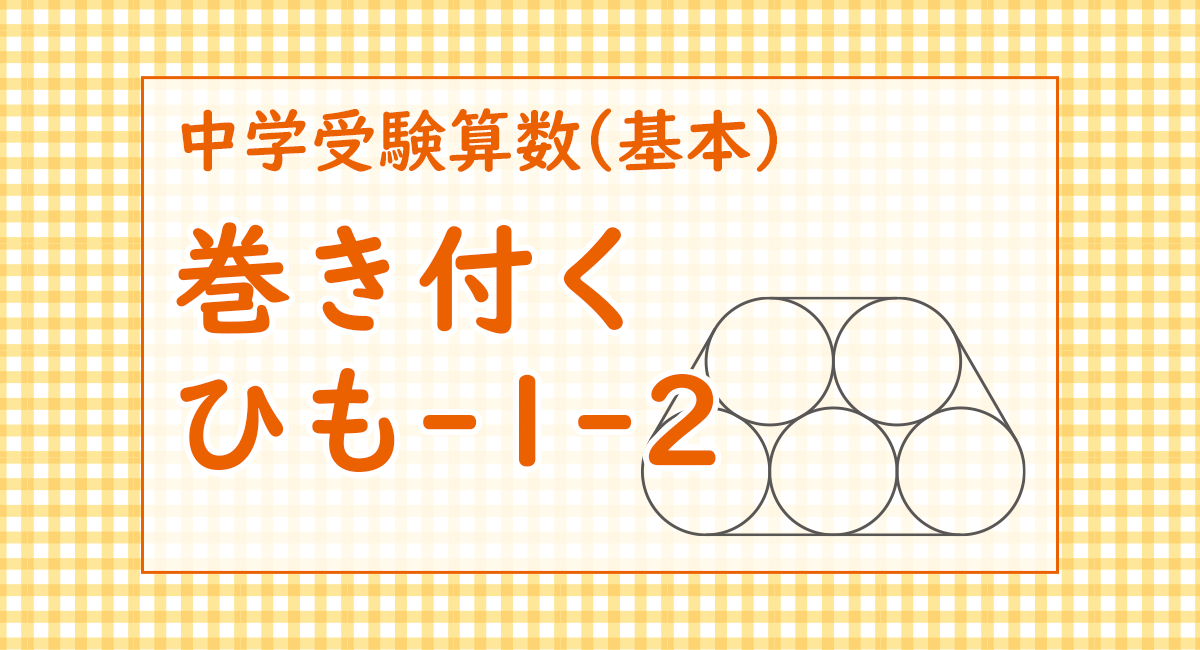
図の様な半径1cmの円が5つ互いにピッタリとついています。この周りにヒモを巻いてピンと張ると、ヒモの長さは何cmになるでしょうか。ただし、円周率は3.14とします。
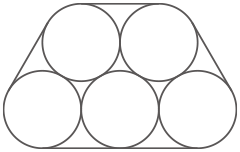
Translated:
Five circles with radius 1 cm are arranged so that they touch one another exactly as shown.
A string is wrapped tightly around the circles.
What is the length of the string? (Use π=3.14.)
The diagram and geometry are identical to the AMC 8 problem.
In addition, a very similar configuration appeared earlier in a 2022 AMC 8 mock test used in contest preparation courses.
2022 Ivy League Education Center AMC 8 Mock Test 1 #25
A belt is drawn tightly around three circles of radius 10 units each, as shown above. The length of the belt, in units, can be written in the form . What is the value of ?
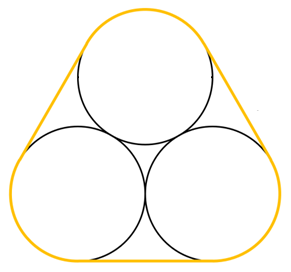
(A) 68 (B) 72 (C) 74 (D) 78 (E) 80
Implications for Contest Preparation
The presence of these correspondences highlights an important reality of math competitions:
Many contest problems follow recognizable templates rather than being entirely new inventions.
In our 2025 AMC 8 / MathCounts preparation courses, we deliberately taught these classic geometric templates.
Students practiced problems involving:
- boundary regions around rectangles
- quarter-circle spiral constructions
- lattice-based square geometry
- painted-cube counting
- strings wrapped around circles
Evidence from Our 2025 Courses
In our 2025 AMC 8/MathCounts Prep Spring Geometry Course and AMC 8/MathCounts Prep Winter Comprehensive Problem-Solving Course, we used the following problems as classic examples to teach students a powerful geometry problem-solving strategy:
- 2017 AMC 10A #3
- 2021 MathCounts Chapter Target #8
- 2004 MathCounts State Sprint #20
- 2003 AMC 8 #15 and 2005 AIME I #9
- Ivy League Education Center 2022 AMC 8 Mock Test 1 #25
- Japan Junior High School Entrance Exam Mathematics (Basic) #1-2
By practicing these templates, my students were able to instantly recognize and solve the same types of problems on the 2026 AMC 8, held on January 22, 2026.
When they encountered these geometry questions, instead of solving them from scratch, they applied the strategies they had already mastered, answered them quickly and confidently, and secured five easy points.
This experience demonstrates how learning the right problem templates can make math contests feel predictable and winnable, a perfect illustration of how mastering problem-solving patterns can make competitions almost “predictable.”
Problem Lineage: How Contest Problems Reappear Across Decades
A historical perspective reveals that many contest problems follow recognizable lineages, where similar mathematical ideas reappear across competitions over time.
Boundary-Region Geometry
| Year | Contest | Problem |
|---|---|---|
| 2017 | AMC 10A | Problem #3 |
| 2026 | AMC 8 | Problem #6 |
Both rely on decomposing the reachable region into rectangles and quarter-circles.
Quarter-Circle Spiral Constructions
| Year | Contest | Problem |
|---|---|---|
| 2021 | MathCounts | Problem #8 |
| 2026 | AMC 8 | Problem #11 |
Both involve quarter circles inscribed in sequential squares, producing identical arc-length calculations.
Lattice Geometry
| Year | Contest | Problem |
|---|---|---|
| 2004 | MathCounts | Problem #20 |
| 2026 | AMC 8 | Problem #13 |
Both problems rely on shifted lattice structures and the distance formula to determine the area of a tilted square.
Painted-Cube Problems
| Year | Contest | Problem |
|---|---|---|
| 2003 | AMC 8 | Problem #15 |
| 2005 | AIME I | Problem #9 |
| 2026 | AMC 8 | Problem #15 |
These problems share similar reasoning involving cube orientation and painted faces.
String-Wrapping Around Circles
| Year | Source | Problem |
|---|---|---|
| Earlier | Japanese entrance exam training material | Problem 1-2 |
| 2022 | Ivy League Education Center AMC 8 Mock Test | Problem #25 |
| 2026 | AMC 8 | Problem #23 |
All involve a band wrapped around several identical circles, producing the same geometric boundary.
Conclusion
The five geometry problems on the 2026 AMC 8 are closely connected to earlier contest problems or widely circulated training materials:
- some are identical,
- others are minor variations.
This does not diminish the educational value of the contest. However, it reinforces an important lesson:
Success in math competitions often depends less on discovering entirely new ideas and more on recognizing familiar structures and applying well-practiced techniques.
Students who develop a strong library of problem-solving templates gain a significant advantage in mathematical competitions.



 Ivy League Education Center