
 Henry Wan, Ph.D.

The 2027 American Mathematics Competitions 8 (AMC 8) will take place during January 21–27, 2027. With 25 multiple-choice questions to complete in just 40 minutes, students need more than a solid understanding of mathematical concepts. They must also develop the ability to recognize problem types, choose efficient solution methods, perform calculations accurately, and manage their time effectively.
Successful AMC 8 preparation requires a systematic approach. Students should strengthen their mathematical foundations, practice with previous AMC 8 contests, develop efficient problem-solving techniques, and regularly evaluate their progress through timed mock tests.
At Ivy League Education Center, we believe that the key to success is not simply solving more problems, but learning how to recognize mathematical structures, identify effective approaches, and solve problems with greater speed and accuracy.
The following guide outlines a practical preparation plan for the 2027 AMC 8.
1. Master the Essential Mathematical Topics
The AMC 8 covers a broad range of middle-school mathematics. Students should develop a strong understanding of fundamental concepts while learning how to apply them to unfamiliar and challenging problems.
The following topics deserve particular attention.
1. Arithmetic and Number Sense
-
Fractions, decimals, and percentages
-
Factors, multiples, divisibility, and prime numbers
-
Greatest common divisors (GCD) and least common multiples (LCM)
-
Exponents, squares, square roots, and estimation
-
Numerical patterns and efficient computation
2. Ratios, Proportions, and Rates
-
Ratios and proportions
-
Percentages and percentage changes
-
Rates, averages, and weighted averages
-
Distance, speed, and time
-
Mixtures and work problems
3. Algebra
-
Algebraic expressions and simplification
-
Linear equations and systems of equations
-
Basic inequalities
-
Sequences and patterns
-
Functions and defined operations
-
Algebraic reasoning and equation solving
4. Geometry
-
Angles, triangles, quadrilaterals, and polygons
-
Perimeter and area
-
Circles and their properties
-
Similarity and congruence
-
Pythagorean theorem
-
Three-dimensional geometry, surface area, and volume
5. Counting and Probability
-
Fundamental counting principles
-
Permutations and combinations
-
Systematic listing and casework
-
Complementary counting
-
Basic probability
6. Logical Reasoning and Problem Solving
-
Identifying patterns and relationships
-
Working backward
-
Making organized lists and tables
-
Breaking complex problems into simpler cases
-
Recognizing symmetry and invariants
Students should not merely memorize formulas and procedures. They should understand why a method works and learn to recognize situations in which it can be applied.
2. Follow a Structured Past-Paper Training Plan
Practicing authentic AMC 8 problems is one of the most effective ways to prepare for the competition. Past contests help students become familiar with the wording, mathematical ideas, problem structures, and difficulty progression of the actual examination.
We recommend working through previous AMC 8 contests, with particular emphasis on the most recent five years.
Our AMC 8 Past-Paper Archive
Our website provides a collection of AMC 8 contests from 1985 through 2026, as well as additional historical competition materials.
- AMC 8 Problems and Answers — Historical Contest Archive
A systematic approach to past-paper practice should include two phases.
Phase 1: Problems 1–20 — Build Speed and Accuracy
Problems 1–10 are generally more accessible and should become familiar to well-prepared students. The goal is to solve these problems accurately and efficiently without spending unnecessary time on routine calculations.
Problems 11–20 often require more careful reasoning and the application of multiple mathematical concepts. Students should focus on recognizing familiar structures and selecting efficient solution methods.
Phase 2: Problems 21–25 — Develop Advanced Problem-Solving Skills
The final five problems are generally the most challenging. They often require creative reasoning, careful case analysis, and the ability to connect different mathematical ideas.
Students should learn to:
-
Break complicated problems into manageable steps.
-
Organize cases systematically.
-
Look for patterns, symmetry, and hidden relationships.
-
Use simpler examples to understand a more general problem.
-
Compare alternative solution methods and identify the most efficient one.
Simply reading solutions is not enough. After studying a solution, students should close the solution manual and try to reproduce the reasoning independently.
The ultimate goal is to develop the ability to recognize and solve similar problems when they appear in a future contest.
3. Improve Speed Through Efficient Problem-Solving Techniques
The AMC 8 allows students only 40 minutes to answer 25 questions, giving an average of approximately 1.6 minutes per question.
Time management is therefore essential. Students who rely exclusively on lengthy calculations or traditional textbook procedures may struggle to complete the examination.
One of the most effective ways to improve speed and accuracy is to develop strong mental math skills.
Why Mental Math Matters
Mental math is much more than performing calculations without paper or a calculator. It trains students to recognize numerical relationships, simplify expressions, and identify efficient computational strategies.
Students should develop proficiency in:
-
Quickly calculating with fractions, decimals, and percentages.
-
Recognizing squares, cubes, and useful numerical patterns.
-
Simplifying arithmetic expressions mentally.
-
Estimating answers and eliminating unreasonable choices.
-
Identifying convenient substitutions and numerical relationships.
-
Performing calculations accurately without relying on a calculator.
Strong mental math skills allow students to devote more time to mathematical reasoning rather than routine computation.
We encourage students to practice mental math regularly as part of their AMC 8 preparation.
Related Resource:
In addition to mental math, students should learn practical contest-solving techniques, including:
-
Working backward from the answer choices
-
Using estimation and answer elimination
-
Recognizing patterns and shortcuts
-
Choosing convenient numbers
-
Using symmetry and complementary reasoning
-
Avoiding unnecessarily complicated calculations
These techniques can make a significant difference in a timed competition.
4. Practice with Full-Length AMC 8 Mock Tests
Taking full-length mock tests is an essential part of effective preparation. It allows students to evaluate their knowledge, improve time management, and become comfortable with the pressure of an actual competition.
We recommend taking mock tests under realistic examination conditions:
-
Time limit: 40 minutes
-
Number of questions: 25
-
Calculator: Not permitted
-
Testing conditions: Work independently without outside assistance.
Ivy League Education Center provides AMC 8 mock tests and detailed solutions to help students prepare.
- AMC Mock Tests — All Resources
- Explore Our AMC 8 Mock Tests and Practice Resources
After completing each mock test, students should carefully review their performance. In particular, they should identify:
-
Incorrect answers: Were the mistakes caused by misunderstandings, calculation errors, or incomplete reasoning?
-
Time-consuming problems: Could a more efficient approach have been used?
-
Missed opportunities: Were there problems that could have been solved quickly but were overlooked?
-
Recurring weaknesses: Are there particular topics or problem types that require additional practice?
The purpose of a mock test is not simply to obtain a score. It is to identify weaknesses and turn every mistake into a learning opportunity.
5. Join Our Online Winter AMC 8/MathCounts Intensive Preparation Course
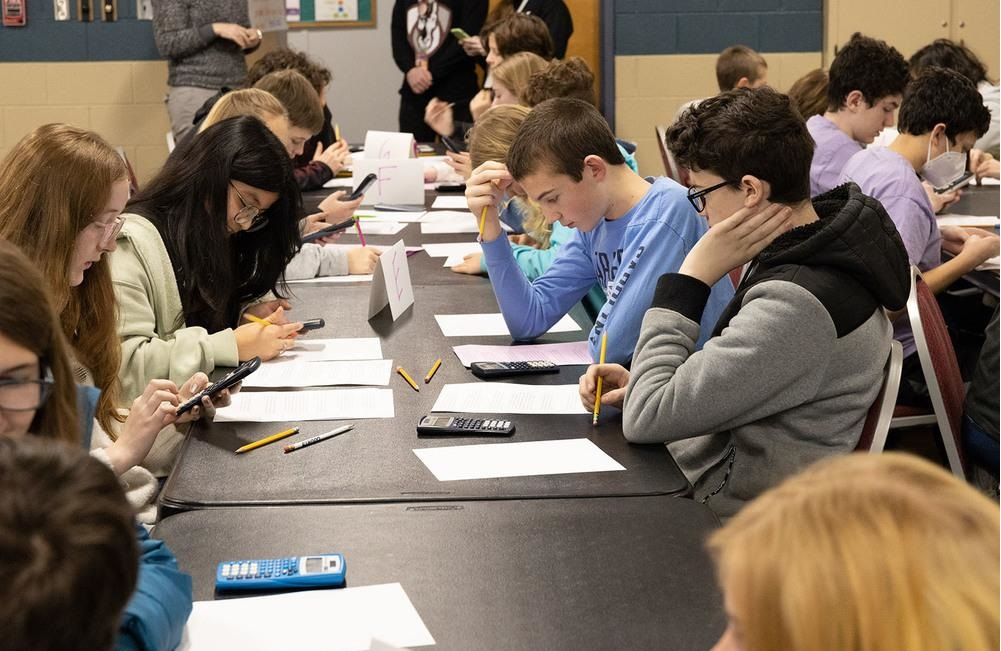
Don’t Just Practice More Problems. Learn to Recognize Them Before the Contest.
At Ivy League Education Center, our AMC 8 preparation program goes beyond conventional problem-solving instruction. We emphasize recognizing recurring mathematical structures, understanding the underlying ideas behind competition problems, and developing efficient strategies that students can apply to unfamiliar questions.
A Research-Based Approach to AMC 8 Preparation
We go further than simply reviewing past AMC exams. We systematically study the work of 16 official AMC 8 problem writers, examining their previous contest questions, published mathematical problems, and even their research papers to uncover recurring problem structures, mathematical techniques, and patterns in their problem design.
This research-based approach helps us develop more targeted instructional materials and problem-solving strategies, enabling students to recognize familiar mathematical structures and apply effective techniques to new contest problems.
Our analysis of the 2026 AMC 8 geometry problems provides a concrete example of this approach. Several contest questions were closely related to previously published problems and familiar problem-solving templates. Our previous training had covered several of these classic geometry structures, demonstrating the practical value of studying recurring patterns rather than simply practicing individual questions.
For a detailed explanation of our research methodology, the 2026 AMC 8 geometry analysis, and how our research informs our teaching, please visit our Winter Intensive Course page:
Course Schedule
Our Winter Intensive Preparation Program is designed for students in Grades 4–8 and consists of two sessions, with five classes in each session.
Classes meet on Saturdays from 6:00–9:00 PM Eastern Time.
Winter Session I — Comprehensive Problem-Solving
5 classes · 15 hours · November 14 – December 12, 2026
| Class | Date | Topic |
|---|---|---|
| 1 | Nov. 14 | Triangle and Polygon Geometry |
| 2 | Nov. 21 | Circle Geometry and Applications |
| 3 | Nov. 28 | Sequences, Series, and Patterns |
| 4 | Dec. 5 | Statistics, Data Analysis, and Interpretation |
| 5 | Dec. 12 | Algebraic Techniques and Equation Solving |
Winter Session II — Continuation of Session I
5 classes · 15 hours · December 19, 2026 – January 16, 2027
| Class | Date | Topic |
|---|---|---|
| 6 | Dec. 19 | Fundamental Number Theory |
| 7 | Dec. 26 | Advanced Number Theory and Applications |
| 8 | Jan. 2 | The Art of Solving Counting Problems |
| 9 | Jan. 9 | Advanced Combinatorial Problem Solving |
| 10 | Jan. 16 | Comprehensive Problem-Solving in Probability |
What Students Will Receive
-
10 Comprehensive Tutorial Handouts: Approximately 600 pages of original instructional materials developed by Dr. Henry Wan.
-
500 Additional Practice Problems: Carefully selected contest-level problems to reinforce concepts and develop advanced problem-solving skills.
-
Two Full-Length AMC 8 Mock Tests: Each test contains 25 questions selected from a licensed AMC database.
-
Live Interactive Online Classes: Direct instruction through Google Meet, with opportunities to ask questions and discuss alternative solutions.
-
Homework and Individualized Feedback: Regular assignments and rotating individualized review to help students identify weaknesses and improve.
Who Should Enroll?
This program is particularly suitable for students in Grades 4–8 who:
-
Are preparing for the 2027 AMC 8 or MathCounts competitions.
-
Have a solid foundation in elementary and middle-school mathematics.
-
Want to strengthen their mathematical reasoning and problem-solving abilities.
-
Need to improve their speed and accuracy when solving challenging problems.
-
Are ready to go beyond routine school mathematics and explore more advanced contest problems.
Course Information and Enrollment
For the complete course description, teaching philosophy, tuition information, and enrollment instructions, please visit our course announcement
Instructor: Henry Wan, Ph.D.
School: Ivy League Education Center
Phone: 240-300-4380
Email: mathteam@ivyleaguecenter.org
Train smarter. Recognize faster. Compete stronger.
6. Follow a Practical Preparation Schedule
A structured preparation schedule helps students make steady progress without becoming overwhelmed.
For the 2027 AMC 8, we recommend dividing preparation into three stages.
Stage 1: Strengthen Mathematical Foundations
Early November
-
Review essential arithmetic, algebra, geometry, number theory, counting, and probability.
-
Identify weaknesses through diagnostic problems.
-
Strengthen mental math and basic computational skills.
-
Practice problems from previous AMC 8 and MathCounts contests.
Stage 2: Intensive Problem-Solving Training
November–December
-
Work systematically through previous AMC 8 and MathCounts contests.
-
Focus on problems 11–25, especially those involving multiple concepts.
-
Study efficient solution methods and common problem structures.
-
Participate in structured instruction and complete regular homework.
-
Take mock tests to evaluate progress.
Stage 3: Final Review and Contest Preparation
January 2027
-
Complete additional timed mock tests.
-
Review frequently missed problem types.
-
Practice solving problems under the 40-minute time limit.
-
Refine time-management and answer-selection strategies.
-
Avoid spending excessive time on a single difficult question.
By the final week, students should focus on reviewing familiar concepts, maintaining confidence, and getting adequate rest.
7. Develop the Right Contest-Day Strategy
Even well-prepared students can lose points because of poor time management or careless mistakes. A good contest strategy is therefore just as important as mathematical knowledge.
We recommend the following approach:
1. Begin with the Problems You Can Solve Confidently
Do not spend too much time on a difficult problem at the beginning. Complete the more accessible questions first and build momentum.
2. Manage Your Time Carefully
Keep track of the remaining time. If a problem requires too much effort, mark it and move on. Return to it after completing the questions you can solve more efficiently.
3. Check Your Calculations
Careless arithmetic errors can cost valuable points. Pay particular attention to signs, fractions, units, and the interpretation of the question.
4. Use Answer Choices Strategically
Multiple-choice answers provide useful information. Estimation, substitution, and elimination can sometimes lead to a much faster solution than direct computation.
5. Make a Thoughtful Decision When Unsure
Students should understand the AMC 8 scoring system: each correct answer earns 1 point, each incorrect answer earns 0 points, and unanswered questions receive 0 points. There is no penalty for guessing.
When time permits, students should make a reasonable attempt at every question.
8. Final Recommendations
Success on the AMC 8 does not come from memorizing formulas or solving hundreds of problems without reflection. It comes from developing a deeper understanding of mathematics, recognizing problem structures, and learning to apply effective strategies.
We encourage students to follow these principles:
-
Build a strong foundation: Master essential mathematical concepts before moving on to more challenging problems.
-
Practice consistently: Work with authentic AMC 8 problems and review solutions carefully.
-
Think efficiently: Learn to recognize patterns, simplify calculations, and choose appropriate methods.
-
Develop mental math skills: Improve computational speed and accuracy.
-
Analyze mistakes: Understand why an approach failed and how to improve it.
-
Prepare systematically: Use timed mock tests to measure progress and refine contest strategies.
The most important lesson is that mathematical problem-solving is a skill that can be developed through consistent practice, thoughtful analysis, and effective instruction.
Start early, practice consistently, and make every problem-solving experience count.
We wish all students the very best in the 2027 AMC 8!
Henry Wan, Ph.D.
Ivy League Education Center
https://ivyleaguecenter.org/




Pingback: Online Intensive AMC 8/Mathcounts Prep (for 4th to 8th Graders) Winter Weekend Course Starting Nov. 14 | Ivy League Education Center