Category Archives: Math Competitions

Senior SAT Math Instructor: Frank Dai

Frank Dai graduated from UC Berkeley with degrees in Mathematics and Information Science. Passionate about math, he was introduced to the nuances of teaching it while working for Classroom Matters in Berkeley. After 15 years of working with students of all ages, is now extremely comfortable teaching math of all levels (elementary to high school), and the SAT/ACT tests. He enjoys teaching both foundation and esoteric math through simplification and analogies to the real-world.

Frank has worked extensively with young people as a teacher, mentor, and tutor. He believes in helping students build strong fundamental skills, developing students’ confidence in their abilities to learn, and incorporating games into tutoring sessions when and wherever possible. Frank really enjoys getting to know students individually and strives to tailor learning to each student’s unique strengths and needs.

Frank always improves and sharps students’ critical thinking and problem solving skills in mathematics from grades 3 to 12, including IB Math. He devises content plans that integrate the math program and strategies, and provides exercises accordingly to major topics of study and teach in an easily understandable manner how to approach and solve.

Senior Math Instructor: Dr. Natasha Kufareva

Dr. Natasha Kufareva received a Master of Science in Mathematics and a Ph.D. in Computer Science in 1994 and 1999, respectively, both from Moscow State University, Russia. She currently works as a computational biologist for the National Institutes of Health. Working with youth and creative math problem solving are two of her greatest hobbies, so she spend her free time organizing and volunteering for middle and high school math clubs in the MCPS.

Head Math Instructor: Dr. Irina Khovanova

Dr. Irina Khovanova is a freelance mathematician and a Research Affiliate at the Mathematics Department at the University of Maryland—​College Park. She has had a varied and interesting career.  She grew up in Russia where she participated in many math competitions, winning 3 gold medals at the national level and one gold and a silver at the IMO.

Dr. Khovanova received her Ph.D. in mathematics from Moscow University in 1987. Her research was in group theory, discrete mathematics, quantum computing, and superstring theory. Currently, she is interested in combinatorics and recreational mathematics. Dr. Khovanova presently coaches mathletes at the Ivy League Education Center. She also coordinates math research at the MIT’s Research Science Institute (RSI).

Math Competition Prep Class (for 7th to 11th graders) Spring Session II Starting on May 3

BANNER_Top_Mathletics

New-1

imagesFX9CEY3LPurpose: To prepare for the 2016 AMC 10/12, and the 2015 University of Maryland High School Math Competition

Specific Goal: To earn a score of 120 or more out of 150 on the American Mathematics Contest 10 (AMC 10), or a score of 100 or more out of 150 on the American Mathematics Contest 12 (AMC 12), and then qualify for the American Invitational Mathematics Examination (AIME), which is used to determine qualification for the United States of America Mathematical Olympiad (USAMO). There are many math competitions in the United States. Of those, only AMC → AIME → USAMO sequence would take you to the IMO (International Math Olympiad), the highest level math competition for high school students in the world.math-olympiad-web

Who should take this class: This class is very appropriate for 7th-11th grade students who are hoping to qualify for the AIME.

Monthly Mock Test: A simulated test every month helps students assess their level of preparation for the Math Competitions. The test consists of 25 questions similar to AMC 10/12 level from the licensed AMC Database, and is intended to mimic an actual math competition exam. After attempting the test, students get answers, explanations, and a detailed score report and wise performance summary.

Weekly Homework: At least 3 hours per week. We will carefully review and check each student’s homework, and correct any mistakes. Based on his/her work, we will provide the student with individualized proposal and support.

The only way to learn mathematics is by doing mathematics. Homework assignments are a fundamental part of a mathematics course. Homework is also seen as a welcome challenge and an opportunity for further learning. Homework given prior to a lesson can aid in understanding later during class. Homework also provides opportunities for reinforcement of the material learned in class.

We have to face the simple truth that to do well on this grueling contest, we will need to practice. Just like it is for sports and music, the key to success is repetition and practice. We strongly believe in effort and the malleability of intelligence. Intelligence can be enhanced through effort. People can develop impressive levels of expertise through hard work and practice. Effort and persistence are the keys to success. Hard work always pays off. Practice makes perfect!

All problems from past AMC 10/12 exams (2000-2014) and AHSME (1983–1999) form our “big data” system. The AHSME (American High School Mathematics Examination) was the former name of the AMC, before 2000. We have used data mining and predictive analytics to examine the types and the frequencies of questions in all these materials, and then completely “decoded” the AMC 10/12. We will show all the “secret code” cracked from the above big data to students, and teach them to totally grasp and “control” the AMC. For all questions on the recent AMC contests, we can find their “ancestors” and “roots” from the old AMC problems. Therefore, the best way to prepare for the contest is to practice by solving old AMC problems.

Benefits:

  • 7 tutorial handouts (140 pages) developed by Dr. Henry Wan and 210 new problems similar to AMC 10/12 level from the licensed AMC Database
  • 2 FREE mock tests, each of which has 25 questions taken from the licensed AMC Database

Class Outline:

In AMC 10/12 Prep Class, we will focus on efficient tricks, shortcuts, and strategies to solve AMC problems as well as test-taking tactics. The emphasis of this class will be on fundamental discrete math which is very common in competition math.

AMC 10 Prep Class Spring II

Class Date Topic Homework Tutorial Handouts
1 5/3 Special right triangles I(30o-60o-90o triangles, 45o-45o-90o triangles) AMC 10/12 Problem Set on Special Right Triangles (30o-60o-90o triangles, 45o-45o-90o triangles), Plus some new problems with a similar difficulty level from the licensed AMC Database Yes
2 5/10 Special right triangles II(15o-75o-90o triangles, 18o-72o-90o triangles) AMC 10/12 Problem Set on Special Right Triangles (15o-75o-90o triangles, 18o-72o-90o triangles), Plus some new problems with a similar difficulty level from the licensed AMC Database Yes
3 5/17 Logical reasoning techniques to solve AMC 10 problems AMC 10/12 Problem Set on Logical Reasoning, Plus some new problems with a similar difficulty level from the licensed AMC Database Yes
4 5/24 Most commonly used methods to draw auxiliary lines and applications of the ruler, protractor, and compass to solve AMC geometry problems AMC 10/12 Problem Set on Drawing Auxiliary Lines, Plus some new problems with a similar difficulty level from the licensed AMC Database Yes
5 5/31 Triangle geometry: common base theorem of triangles, triangle inequality, angle bisector theorem, Heron’s formula AMC 10/12 Problem Set on Triangle Geometry, Plus some new problems with a similar difficulty level from the licensed AMC Database Yes
6 6/7 Circle geometry: intersecting chords theorem, Ceva’s theorem, Menelaus’ theorem, AMC 10/12 Problem Set on Circle Geometry, Plus some new problems with a similar difficulty level from the licensed AMC Database Yes
7 6/14 Polygons, cyclic polygons, Ptolemy’s theorem, Hippocrates’ theorem AMC 10/12 Problem Set on Polygons, Plus some new problems with a similar difficulty level from the licensed AMC Database Yes

Our main purpose is to help our students gain deeper understanding of the fundamental math concepts, build a solid foundation in math, and develop the critical thinking and problem-solving skills that are so valuable to success in any career. We are big believers in the FUNDAMENTALS! Our students will receive the LIFELONG BENEFITS from learning math.

IMG_2563_0Regardless of his/her math level, each student will have the opportunity to learn math in a fun, friendly, cooperative, supportive learning environment. The most important thing is to have fun.

New-2

Although the 2015 AMC 10/12 contests has just finished, we must prepare in advance for the 2016 AMC 10/12 contests. As the great scientist Louis Pasteur said, “Chance favors only the prepared mind.” Those who strive to prepare early, and work hard are the ones who achieve the best results. The AMC is a complex math competition that requires dedication and focus. Therefore, the earlier our students start preparing, the better their scores will be.

We are only one in the Washington DC metropolitan area to offer elementary, middle, and high-school level competition math courses. Our tutoring model is very unique. We ask that all students complete all the required problems at home, and then email their work to us before come to the class. We will carefully review and check the students’ work. Based on their work, we can detect what are the student’s specific weaknesses and use those problems in class to teach the students all the tricks, shortcuts, strategies, and tactics for taking the contest. The entire two hours are used for instructional teaching only. We firmly believe that learning is extremely important, and that a student should not waste time doing problems with our supervision if they can do those problems at home. So our 2-hour session is equivalent to a regular 4-hour session, and thus our hourly rate is equivalent to $20 per hour.

Click the following articles to read more about our class:

3

4

Math Competition Prep Class (for 7th to 11th graders) Spring Sessions

BANNER_Top_Mathletics1Purpose: To prepare for the 2016 AMC 10/12, and the 2015 University of Maryland High School Math Competition

Specific Goal: To earn a score of 120 or more out of 150 on the American Mathematics Contest 10 (AMC 10), or a score of 100 or more out of 150 on the American Mathematics Contest 12 (AMC 12), and then qualify for the American Invitational Mathematics Examination (AIME), which is used to determine qualification for the United States of America Mathematical Olympiad (USAMO). There are many math competitions in the United States. Of those, only AMC → AIME → USAMO sequence would take you to the IMO (International Math Olympiad), the highest level math competition for high school students in the world.

Who should take this class: This class is very appropriate for 7th-11th grade students who are hoping to qualify for the AIME.

Monthly Mock Test: A simulated test every month helps students assess their level of preparation for the Math Competitions. The test consists of 25 questions similar to AMC 8 level from the licensed AMC Database, and is intended to mimic an actual math competition exam. After attempting the test, students get answers, explanations, and a detailed score report and wise performance summary.

Weekly Homework: At least 3 hours per week. We will carefully review and check each student’s homework, and correct any mistakes. Based on his/her work, we will provide the student with individualized proposal and support.

The only way to learn mathematics is by doing mathematics. Homework assignments are a fundamental part of a mathematics course. Homework is also seen as a welcome challenge and an opportunity for further learning. Homework given prior to a lesson can aid in understanding later during class. Homework also provides opportunities for reinforcement of the material learned in class.

We have to face the simple truth that to do well on this grueling contest, we will need to practice. Just like it is for sports and music, the key to success is repetition and practice. We strongly believe in effort and the malleability of intelligence. Intelligence can be enhanced through effort. People can develop impressive levels of expertise through hard work and practice. Effort and persistence are the keys to success. Hard work always pays off. Practice makes perfect!

All problems from past AMC 10 exams (2000-2014) and AHSME (1983–1999) form our “big data” system. The AHSME (American High School Mathematics Examination) was the former name of the AMC, before 2000. We have used data mining and predictive analytics to examine the types and the frequencies of questions in all these materials, and then completely “decoded” the AMC 10. We will show all the “secret code” cracked from the above big data to students, and teach them to totally grasp and “control” the AMC. For all questions on the recent AMC contests, we can find their “ancestors” and “roots” from the old AMC problems. Therefore, the best way to prepare for the contest is to practice by solving old AMC problems.

Benefits:

  • 16 tutorial handouts (320 pages) developed by Dr. Henry Wan and 500 new problems similar to AMC 10 level from the licensed AMC Database
  • 4 FREE mock tests, each of which has 25 questions taken from the licensed AMC Database

Class Outline:

In AMC 10 Prep Class, we will focus on efficient tricks, shortcuts, and strategies to solve AMC problems as well as test-taking tactics. The emphasis of this class will be on fundamental discrete math which is very common in competition math.

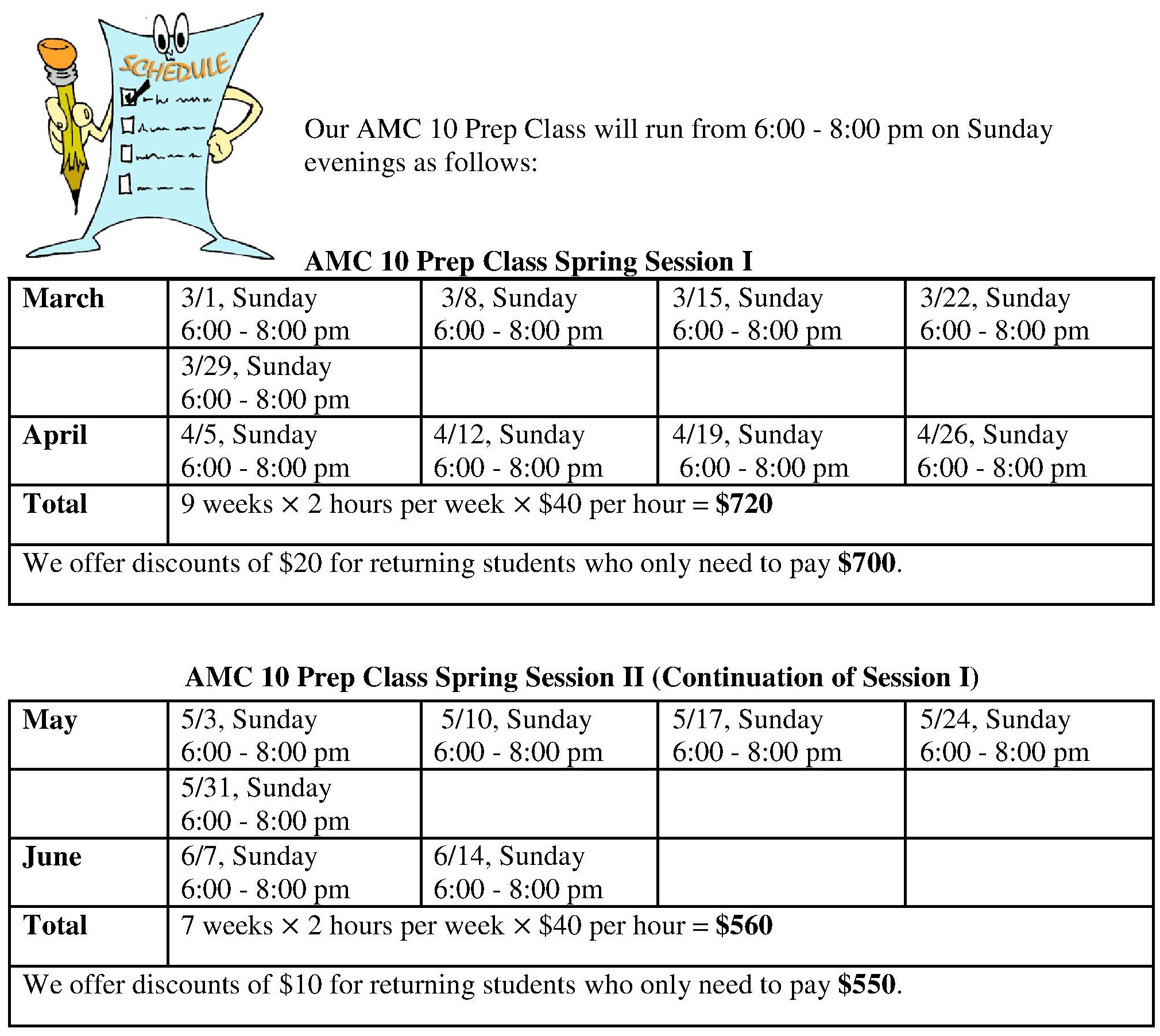
AMC 10 Prep Class Spring I

Class Date Topic Homework Tutorial Handouts
1 3/1, Sun Sequences and series, including arithmetic, geometric sequence with other common sequence AMC 10 Problem Set on Sequences and Series, Plus some new problems with a similar difficulty level from the licensed AMC Database Yes
2 3/8, Sun Patterns (logic patterns, number patterns, word patterns, recursive patterns,  geometric patterns, repeating patterns,   growing patterns, shirking patterns) AMC 10 Problem Set on Patterns, Plus some new problems with a similar difficulty level from the licensed AMC Database Yes
3 3/15, Sun Finding the hundreds, tens, and units digits of a number AMC 10 Problem Set on Hundreds/tens/units Digits, Plus some new problems with a similar difficulty level from the licensed AMC Database Yes
4 3/22, Sun Using the inclusion-exclusion principle and pigeonhole principle to solve AMC problems AMC 10 Problem Set on Counting, Plus some new problems with a similar difficulty level from the licensed AMC Database Yes
5 3/29, Sun Prime factorization, integer equations, Diophantine equations and systems of integer equations AMC 10 Problem Set on Integer Equations, Plus some new problems with a similar difficulty level from the licensed AMC Database Yes
6 4/5, Sun Solving Quadratic Diophantine and Pell Equations, Special Factoring Trick –– Completing the Rectangle AMC 10 Problem Set on Quadratic Diophantine and Pell Equations, Plus some new problems with a similar difficulty level from the licensed AMC Database Yes
7 4/12, Sun Arithmetic, ratios, rates, properties of proportionality, and proportional reasoning AMC 10 Problem Set on Arithmetic, Plus some new problems with a similar difficulty level from the licensed AMC Database Yes
8 4/19, Sun Newly defined functions and operations, and algebraic methods and strategies for solving AMC problems AMC 10 Problem Set on Newly Defined Functions, Plus some new problems with a similar difficulty level from the licensed AMC Database Yes
9 4/26 Algebraic Inequality: Linear and quadratic inequalities, AM-GM Inequality, Bernoulli Inequality, Cauchy-Schwarz Inequality, Hӧlder Inequality, Rearrangement Inequality AMC 10 Problem Set on Algebraic Inequality, Plus some new problems with a similar difficulty level from the licensed AMC Database Yes


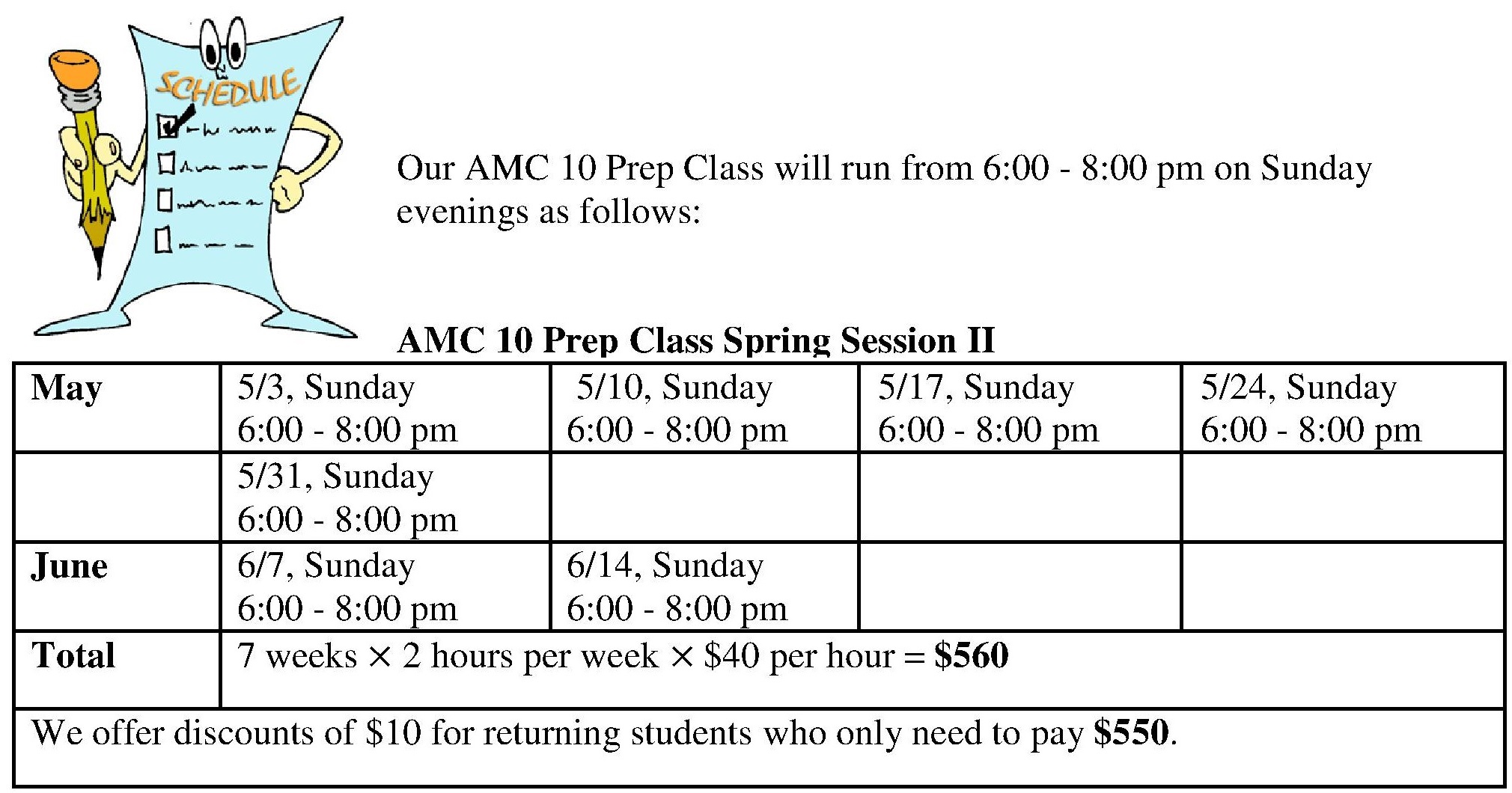
AMC 10 Prep Class Spring II (Continuation of Session I)

Class Date Topic Homework Tutorial Handouts
1 5/3 Special right triangles I(30o-60o-90o triangles, 45o-45o-90o triangles) AMC 10 Problem Set on Logical Reasoning, Plus some new problems with a similar difficulty level from the licensed AMC Database Yes
2 5/10 Special right triangles II(15o-75o-90o triangles, 18o-72o-90o triangles) AMC 10 Problem Set on Completing the Rectangle, Plus some new problems with a similar difficulty level from the licensed AMC Database Yes
3 5/17 Logical reasoning techniques to solve AMC 10 problems AMC 10 Problem Set on Special Right Triangles, Plus some new problems with a similar difficulty level from the licensed AMC Database Yes
4 5/24 Most commonly used methods to draw auxiliary lines and applications of the ruler, protractor, and compass to solve AMC geometry problems AMC 10 Problem Set on Drawing Auxiliary Lines, Plus some new problems with a similar difficulty level from the licensed AMC Database Yes
5 5/31 Triangle geometry: common base theorem of triangles, triangle inequality, angle bisector theorem, Heron’s formula AMC 10 Problem Set on Triangle Geometry, Plus some new problems with a similar difficulty level from the licensed AMC Database Yes
6 6/7 Circle geometry: intersecting chords theorem, Ceva’s theorem, Menelaus’ theorem, AMC 10 Problem Set on Circle Geometry, Plus some new problems with a similar difficulty level from the licensed AMC Database Yes
7 6/14 Polygons, cyclic polygons, Ptolemy’s theorem, Hippocrates’ theorem AMC 10 Problem Set on Polygons, Plus some new problems with a similar difficulty level from the licensed AMC Database Yes

Our main purpose is to help our students gain deeper understanding of the fundamental math concepts, build a solid foundation in math, and develop the critical thinking and problem-solving skills that are so valuable to success in any career. We are big believers in the FUNDAMENTALS! Our students will receive the LIFELONG BENEFITS from learning math.

Regardless of his/her math level, each student will have the opportunity to learn math in a fun, friendly, cooperative, supportive learning environment. The most important thing is to have fun.

2

Tuition Payment Policy

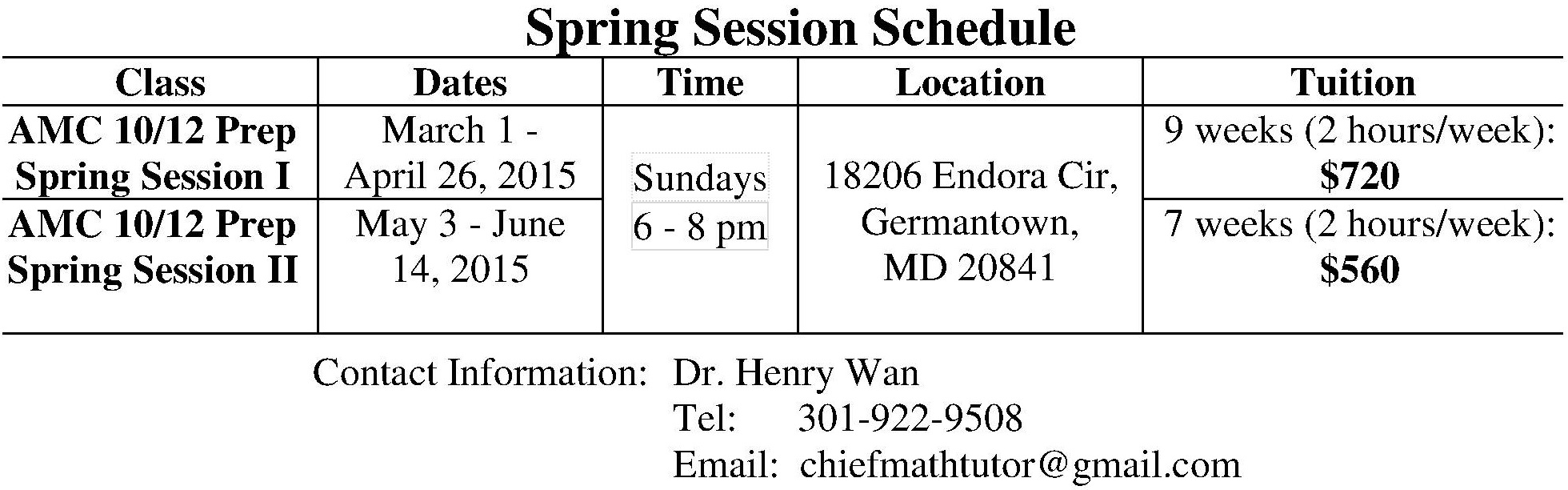
There are 2 tuition 2 payment options. In the first option, students may choose to pay on session-by-session basis. That is, choosing to pay for Session I, only, and then, if they decide to continue, pay for Session II. Note that Session I and Session II have different tuition fees because Session I has 9 classes and Session II only has 7. In the second option, students may pay for the whole 2 sessions at a discounted price of $1,260. Returning students only need to pay $1,230.

Although the 2015 AMC 10 contests has just finished, we must prepare in advance for the 2016 AMC 10 contests. As the great scientist Louis Pasteur said, “Chance favors only the prepared mind.” Those who strive to prepare early, and work hard are the ones who achieve the best results. The AMC is a complex math competition that requires dedication and focus. Therefore, the earlier our students start preparing, the better their scores will be.

We are only one in the Washington DC metropolitan area to offer elementary, middle, and high-school level competition math courses. Our tutoring model is very unique. We ask that all students complete all the required problems at home, and then email their work to us before come to the class. We will carefully review and check the students’ work. Based on their work, we can detect what are the student’s specific weaknesses and use those problems in class to teach the students all the tricks, shortcuts, strategies, and tactics for taking the contest. The entire two hours are used for instructional teaching only. We firmly believe that learning is extremely important, and that a student should not waste time doing problems with our supervision if they can do those problems at home. So our 2-hour session is equivalent to a regular 4-hour session, and thus our hourly rate is equivalent to $20 per hour.

Click the following articles to read more about our class:

3

4

Math Competition Prep Class (for 3rd to 7th graders) Spring Session

1Purpose: To help 3rd-7th graders prepare for math competitions, such as Mathcounts, AMC 8, Math Olympiads for Elementary and Middle Schools (MOEMS), Math Kangaroo, and Math League

Description:

In Math Competition Prep Class, we will focus on fundamental discrete math which comes up a lot on competition math. A variety of math contest questions are used to teach students strategies to solve problems and help students prepare for the competitions. These problems stimulate their interest and enthusiasm for problem solving, broaden their mathematical intuition, and develop their brainpower. The topics taught in this class are not covered in regular school math classes, allowing our students to stay one step ahead.

The main feature of this course is the use of the concrete => pictorial => abstract approach. The emphasis is placed on development and complete understanding of mathematical concepts and their interesting applications, as well as on proficiency in multi-step problem solving, non-routine approach, mathematical reasoning, higher order thinking, and creative thinking.

Benefits:

  • 11 tutorial handouts (220 pages) developed by Dr. Henry Wan and 275 new problems similar to AMC 8 level from the licensed AMC Database
  • 3 FREE mock tests, each of which has 25 questions taken from the licensed AMC Database

Grade Levels: Current Grades 3-7

Class Outline:

In Competition Math Prep Class, we will focus on efficient tricks, shortcuts, and strategies to solve competitive math problems as well as test-taking tactics. The emphasis of this class will be on fundamental discrete math which is very common in competition math.

Class Date Topic Homework Tutorial Handouts
1 4/4, Sat The Fundamental Principle of Counting: Product Rule, Sum Rule, Introduction to Probability AMC 8 Problem Set on Counting Principle, Plus some new problems from the licensed AMC Database Yes
2 4/11, Sat Factorials: Multiplying & Dividing Factorials, Trailing Zeroes AMC 8 Problem Set on Factorials, Plus some new problems from the licensed AMC Database Yes
3 4/18, Sat Pascal’s Triangle: Building the Pascal’s Triangle, Pascal Patterns, Hockey Sticks AMC 8 Problem Set on Pascal’s Triangle, Plus some new problems from the licensed AMC Database Yes
4 4/25, Sat Factorial Representation and Applications of Permutations, Combinations of Letters and Numbers AMC 8 Problem Set on Permutations, Plus some new problems from the licensed AMC Database Yes
5 5/2, Sat Factorial Representation of Combinations, Distinguishability, Counting Paths on a Grid AMC 8 Problem Set on Combinations, Plus some new problems from the licensed AMC Database Yes
6 5/9, Sat Permutations with Repetitions, Putting the Labeling Principle to Practice AMC 8 Problem Set on Permutations with Repetitions, Plus some new problems from the licensed AMC Database Yes
7 5/16, Sat Combinations with Repetitions, Multinomial Coefficient AMC 8 Problem Set on Combinations with Repetitions, Plus some new problems from the licensed AMC Database Yes
8 5/23, Sat Binomial Coefficients, The Sum of All Combinations, The Binomial Theorem and Formulas AMC 8 Problem Set on Binomial Theorem and Formulas, Plus some new problems from the licensed AMC Database Yes
9 5/30, Sat Counting the Complement and Inclusion – Exclusion. AMC 8 Problem Set on Counting the Complement, Plus some new problems from the licensed AMC Database Yes
8 6/6, Sat Arranging Objects in a Circle, Circular Permutations/ Combinations AMC 8 Problem Set on Circular Permutations/ Combinations, Plus some new problems from the licensed AMC Database Yes
11 6/13, Sat Discrete Probability: Equally Likely Outcomes, Basic Probability Techniques, Complementary Probabilities AMC 8 Problem Set on Discrete Probability, Plus some new problems from the licensed AMC Database Yes

Why Discrete Math Is Very Important

Our main goal is to help our students gain deeper understanding of the fundamental math concepts, build a solid foundation in math, and develop the critical thinking and problem-solving skills that are so valuable to succeed in any career. We are big believers in the fundamentals of mathematics. Our students will receive the lifelong benefits from learning math.

Regardless of his/her math level, each student will have the opportunity to learn math in a fun, friendly, cooperative and supportive learning environment. The most important thing is to have fun!

+++++++++++++++++++++++++++++++++++++++++++++++++++++++++++++++++++++

Monthly Mock Test: A simulated test every month helps students assess their level of preparation for the Math Competitions. The test consists of 25 questions similar to AMC 8 level from the licensed AMC Database, and is intended to mimic an actual math competition exam. After attempting the test, students get answers, explanations, and a detailed score report and wise performance summary.

Weekly Homework: On average, at least a half hour per day. We will carefully review and check each student’s homework, and correct any mistakes. Based on his/her work, we will provide the student with individualized proposal and support.

The only way to learn mathematics is by doing mathematics. Homework assignments are a fundamental part of a mathematics course. Homework is also seen as a welcome challenge and an opportunity for further learning. Homework given prior to a lesson can aid in understanding later during class. Homework also provides opportunities for reinforcement of the material learned in class.

We have to face the simple truth that to do well on these grueling contests, we will need to practice. Just like it is for sports and music, the key to success is repetition and practice. We strongly believe in effort and the malleability of intelligence. Intelligence can be enhanced through effort. People can develop impressive levels of expertise through hard work and practice. Effort and persistence are the keys to success. Hard work always pays off: practice makes perfect!

Small-sized Class Teaching Model:

We utilize the highly effective small-sized class teaching model. For the class size, we will maintain a size of less than 6 students. Smaller classes lead to pupils receiving more individual attention from teachers, and having more active interactions with them. We focus on every individual, not the whole class. Students will thrive from the smaller class sizes that allow them to reach their full potential. Particularly, students can benefit tremendously from high-frequent individualized student-teacher interactions leading to establishment of a stronger foundation for lifelong learning.

2

We are only one in the Washington DC metropolitan area to offer elementary, middle, and high-school level competition math courses. Our tutoring model is very unique. We ask that all students complete all the required problems at home, and then email their work to us before come to the class. We will carefully review and check the students’ work. Based on their work, we can detect what are the student’s specific weaknesses and use those problems in class to teach the students all the tricks, shortcuts, strategies, and tactics for taking the contest. The entire two hours are used for instructional teaching only. We firmly believe that learning is extremely important, and that a student should not waste time doing problems with our supervision if they can do those problems at home. So our 2-hour session is equivalent to a regular 4-hour session, and thus our hourly rate is equivalent to $15 per hour.

Click the following articles to read more about our class:

Our class will mainly focus on preparing for the following math competitions:

1. Prestigious National Elementary/Middle School Math Competitions:

  • Math Olympiads for Elementary and Middle Schools (MOEMS): This is a large and popular mathematics competition for students in grades 4 through 8. The goal of MOEMS is to expose students to elementary methods of mathematical problem solving.
  • Mathematical Kangaroo: This is the world’s largest mathematics competition with students in grades 2-12 competing from many nations around the world.
  • Math League: This is a well-known mathematics competition for elementary, middle, and high school students in the United States.
  • Continental Mathematics League (CML): This is an important mathematics contest for students in grades 2 through 12.

2. Premier National Middle School Math Competitions:

  • American Mathematics Contest 8 (AMC 8): The AMC 8 is the most rigorous nationwide mathematics competition at the middle school level, dedicated to the goal of strengthening the mathematical capabilities of our nation’s youth.
  • MATHCOUNTS: This is the preeminent middle school mathematics completion in the United States, sponsored by the National Society of Professional Engineers.

3

Investing in your children’s education is an investment in their future, which pays the best interest!

Education: A debt due from present to future generations.

                                                                        — George Peabody

FROM — The Secret: What Your High Schools Don’t Tell you? by Elizabeth Wissner-Gross

Forget what other parents may tell you about the value of just “letting kids be kids”. Fun, play, relaxation are important for kids and adults alike, but most would agree that being engaged in an educational activity that they are passionate about is fun and also has long-term benefits to get into college and ultimately enhancing one’s career.

Competition for admission to America’s top colleges is more cutthroat than ever. Gone are the days when parents could afford to let high school guidance counselors handle the admissions process alone-gone, also, are the days when a student could wait until senior year to prepare for it. If you want to raise a kid colleges will compete for, you must act, EARLY and AGGRESSIVELY, as opportunity scout, coach, tutor, manager, and publicist -or be willing to watch that acceptance letter go to someone whose parents did.

4

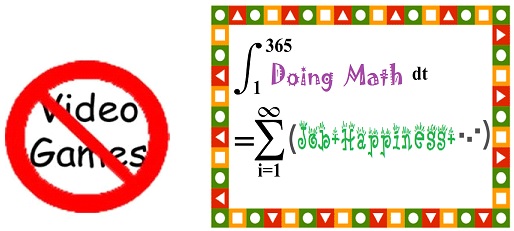
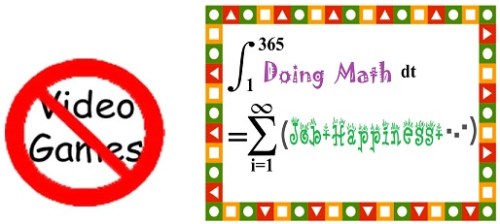
Just let your child play 30 minutes LESS video games per day and do 30 minutes EXTRA on math problems instead. Those little EXTRAs add up to EXTRA-ORDINARY results! Thus, your child will receive the LIFELONG BENEFITS from learning math.

5

The Big Value of Middle School Math Competitions

1de17dd68550035298362544d7128796The importance of mathematics competitions has been widely recognized for three reasons: they help develop imaginative capacity and thinking skills whose value far transcends mathematics; they constitute the most effective way of discovering and nurturing mathematical talent; and they provide a means to combat the prevalent false image of mathematics held by students, as either a fearsomely difficult or a dull and uncreative subject.

Our Middle School Competitive Math course is designed purposefully to help students master Math Competitions, and enrich them academically. In the classes, we will cover all concepts/topics that frequently occur on the math contests and teach efficient strategies required for contest-based problem solving. We will review questions drawn from previous years’ contests as well as a variety of carefully selected resources. Students will think and learn math skills outside the realm of their school classrooms. All math skills developed through these courses will be helpful not only for math competitions, but also for comprehensive exams such as Johns Hopkins University CTY’s Scholastic and College Ability Test (SCAT), Montgomery County Public Schools’ magnet program admissions test, and even PSAT, SAT, and ACT.

In an increasingly competitive magnet program applications pool, the process of mastering math skills through our courses and participating in Math Competitions will help students strengthen and diversify their extracurricular activities. These contests can spur students’ interest in math and discover their talent through solving challenging problems different than those in the school classes. Good performance in Math Competitions will definitely enhance admission opportunities for students to magnet programs in Montgomery County Public Schools.

More articles about math competitions:

making%20awesome%20things%20happen

798191188girih2spiral

Premier National Mathematics Competition — AMC 8

https___cdn_evbuc_com_images_23502174_94898100017_1_original.gifThe American Mathematics Contest 8 (AMC 8), called the AJHSME until 1999, began in 1985. The AMC 8 is the most rigorous nationwide mathematics competition at the middle school level, dedicated to the goal of strengthening the mathematical capabilities of our nation’s youth. The AMC 8 is designed to promote the development of problem-solving skills. The AMC 8 provides an opportunity for middle school students to develop positive attitudes towards analytical thinking and mathematics that can assist in future careers. Students apply classroom skills to unique problem-solving challenges in a low-stress and friendly environment.

The AMC 8 is a 25-question, 40-minute, multiple-choice contest for any student grades 8 and below. It is run by the Mathematical Association of America. A correct answer scores 1 point and an incorrect or blank answer receives neither gain nor penalty. Hence a score of 25 is considered perfect.

logo_americanmath2

Grade Level: The AMC 8 is designed for middle school students in grades 6, 7, and 8. Highly motivated 4th and 5th grade students are encouraged to participate as well.

AMC 8-NewNational Awards:

  • Certificate of Distinction — is given to all students who receive a perfect score.
  • Distinguished Honor Roll (top 1%). In 2014, this was 22-25 correct out of 25 problems.
  • Honor Roll (top 2-5%). In 2014, this was 17-21 correct out of 25 problems.
  • Student Achievement Roll (6th grade and below placing in the top 10%). In 2014, this was 15-25 correct out of 25 problems.

Challenge Level: Problems progress from relatively easy to very challenging. Middle school students of all abilities who enjoy math problem solving are encouraged to participate.

image001amc

You can visit the official MAA AMC 8 page by clicking here.

There are many math competitions in the United States. Of those, only AMC AIME USAMO sequence would take you to the IMO (International Math Olympiad), the highest level math competition for high school students in the world.

More articles about math competitions:
 maausasf

Discrete Mathematics: Building Problem Solvers, Innovators, and Future Leaders

discrete-math

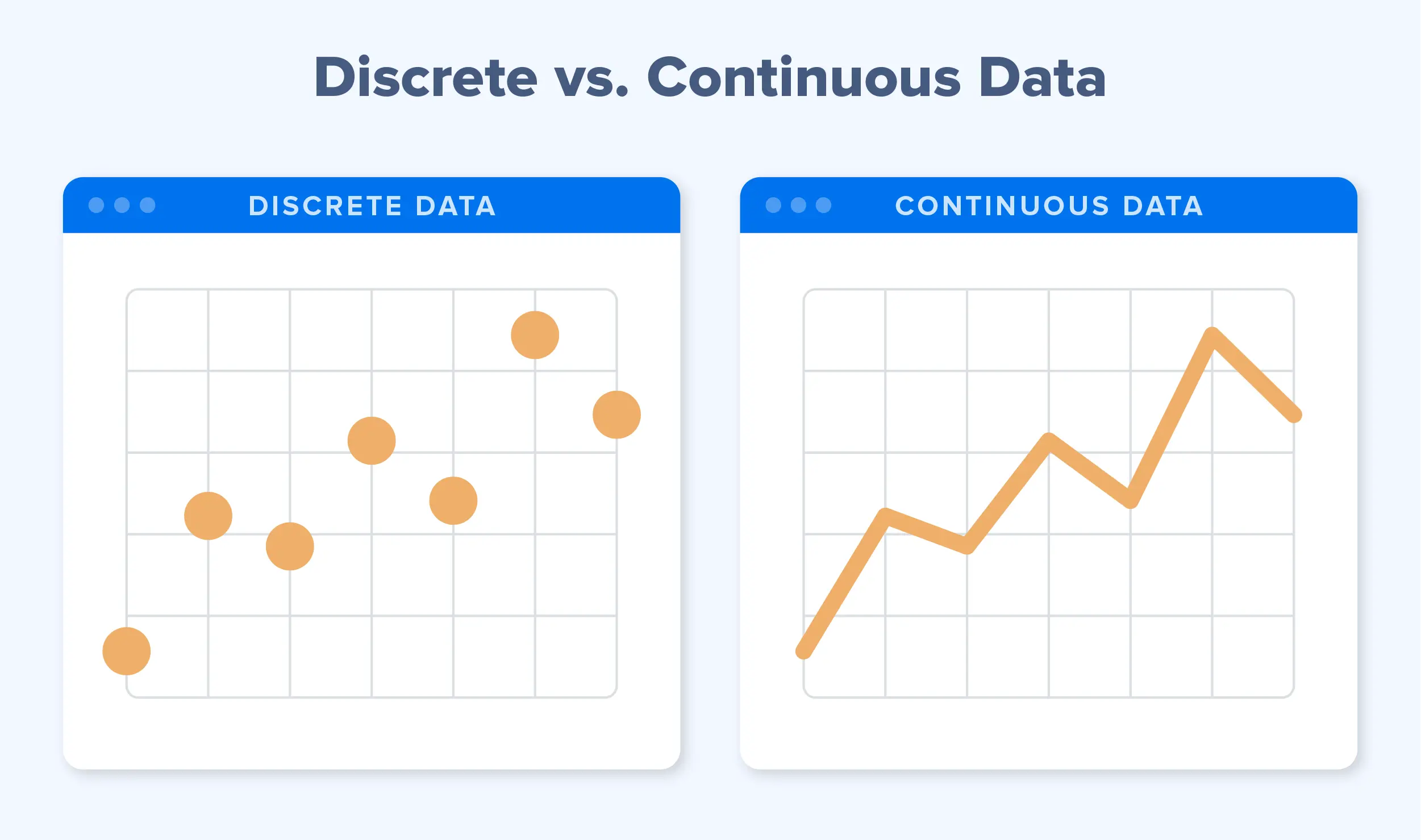
Discrete mathematics teaches students how to think logically, solve puzzles, and understand patterns behind computers, games, and real-world problems. Unlike traditional math that deals with continuous quantities like distances or measurements, discrete mathematics focuses on distinct, countable objects—like integers, graphs, and logic.

It’s not just about numbers; it’s about developing critical thinking, reasoning, and problem-solving skills that benefit students in competitions, technology, and future careers.

Image3


Why Schools Often Overlook Discrete Mathematics

Most middle and high schools in the U.S. follow a standard curriculum centered on continuous mathematics:

Pre-Algebra → Algebra 1 → Geometry → Algebra 2/Trigonometry → Precalculus → Calculus → Multivariable Calculus / Differential Equations

  • Discrete mathematics is rarely taught as a separate subject.
  • Standardized tests like the SAT and ACT do not assess discrete math.

Why it matters: Early exposure to discrete math builds skills in logic, pattern recognition, and problem-solving—giving students an edge in competitions, technology, and STEM careers.


Discrete Mathematics in Math Competitions

Discrete mathematics is the backbone of many math contests:

  • AMC (American Mathematics Competitions): 30–40% of problems involve combinatorics, number theory, or graph theory.
  • AIME (American Invitational Mathematics Examination): Over half the problems are based on discrete math.

Our Approach at Ivy League Education Center: At least one-third of our AMC prep curriculum focuses on discrete math, helping students master counting, logic, and networks.

Jesuit to Host Major Math Competition | News - Jesuit High School


Discrete Mathematics and Computer Science

Discrete math is essential for understanding:

  • Algorithms and programming logic
  • Data structures and graph theory
  • Cryptography and software engineering

Why it matters: Students at Ivy League Education Center gain skills that apply directly to coding, technology, and engineering careers.

Image4


Discrete Mathematics in Big Data

Discrete math provides tools for:

  • Analyzing high-dimensional data
  • Reasoning under uncertainty
  • Scaling algorithms for large datasets

Why it matters: Students develop skills for future careers in data science, analytics, and scientific research.


Discrete Mathematics and Artificial Intelligence (AI)

AI relies heavily on discrete math:

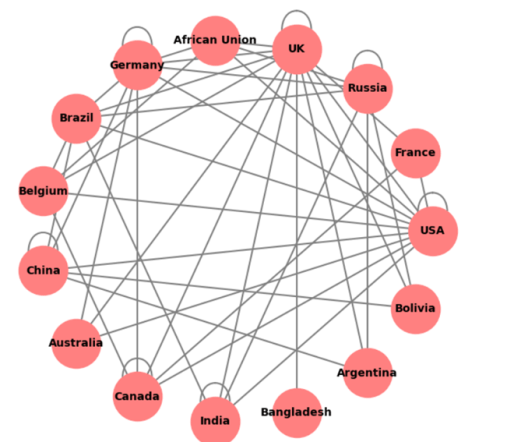
  • Graph theory: Search engines, recommendation systems, social networks
  • Logic & Boolean algebra: Rule-based reasoning, automated verification
  • Combinatorics & probability: Machine learning, model evaluation, uncertainty analysis

Why it matters: Discrete math skills help students understand and innovate in AI and technology.

Combining Neural Networks and Decision Trees


Why Students Should Start Early

Recommended focus areas:

  • Combinatorics
  • Graph theory
  • Discrete geometry
  • Number theory
  • Discrete probability

Even students with limited algebra skills can succeed in discrete math. The hands-on nature makes it intuitive, fun, and engaging while preparing them for competitions and STEM careers.

Pattern Blocks Puzzles Work Mats ~ ZOO ANIMALS ~ Activity Pictures-Task Cards


Get Started Today!

Whether your child wants to:

  • Compete in math contests
  • Explore coding and AI
  • Become a stronger problem solver

…discrete mathematics at Ivy League Education Center provides the tools to succeed.

Call to Action Buttons:

A cartoon teacher and a group of diverse children gathered around a computer, learning coding and programming concepts. Teacher kids computers illustrations


Author / Branding Footer

Written by Chief Instructor Dr. Henry Wan of Ivy League Education Center

Dedicated to cultivating problem solvers and future innovators through competitive mathematics and advanced mathematical thinking.

© 2026 Ivy League Education Center. All rights reserved.

2-castles-5

250px-Pen0305c


slide_9More articles about math competitions:

slide_3

kgldtgmc3qrgkb3qgqze

American Mathematics Contest 10 (AMC 10)

amc10The AMC 10 is lauded as the oldest, largest and most prestigious math competition in the United States. The AMC 10 is part of the series of contests administered by the MAA American Mathematics Competitions that determines the United States team in the International Math Olympiad. The AMC 10 is for students in grades 10 and below. Two different versions of the contests are given on two different dates, the A and the B. Both the AMC 10A and the AMC 10B have the same number of questions, the same scoring and the same rules for administration. The only difference is that each has a distinct set of questions, although the two contests are designed to be equal in difficulty and distribution of topics.

The main purpose of the AMC 10 is to spur interest in mathematics and to develop talent through the excitement of solving challenging problems in a timed multiple-choice format. The problems range from the very easy to the extremely difficult. Students who participate in the AMC 10 should find that most of the problems are challenging but within their grasp. The contest is intended for everyone from the average student at a typical school who enjoys mathematics to the very best student at the most special school.

A special purpose of the AMC 10 is to help identify those few students with truly exceptional mathematics talent. Students who are among the very best deserve some indication of how they stand relative to other students in the country and around the world. The AMC 10 provides one such indication, and it is the first in a series of examinations (followed in the United States by the American Invitational Examination and the USA Mathematical Olympiad) that culminate in participation in the International Mathematical Olympiad, the most prestigious and difficult secondary mathematics examination in the world. In this way the very best young mathematicians are recognized, encouraged and developed. Another valuable comparison students can make is between their own level of achievement and their levels in previous years. In particular, they are encouraged to begin taking the contests early in their mathematics studies and to look back with pride each year on how they have learned to answer questions that they could not have answered previously.

Format

The AMC 10 is a 25 question, 75 minute multiple choice test. Problems generally increase in difficulty as the exam progresses. Calculators were permitted; however, as of 2008, calculators are not allowed any more.

The AMC 10 is scored in a way that penalizes guesses. Correct answers are worth 6 points, incorrect questions are worth 0 points, and unanswered answers are worth 1.5 points, to give a total score out of 150 points. From 2002 to 2006, unanswered questions were awarded 2.5 points. In 2006 and 2007, unanswered questions were awarded 2 points. Students that score over 120 points or are in the top 2.5% of the AMC 10 contest are invited to take the AIME.

Curriculum

The AMC 10 tests mathematical problem solving with arithmetic, algebra, counting/combinatorics, geometry, number theory, and probability and other secondary school math topics. Problems are designed to be solved by students without any background in calculus or trigonometry.

 AMC10-MedalNational Awards

  • A Certificate of Distinction is given to all students who qualify to take the American Invitational Mathematics Examination.
  • An AMC 10 Honor Roll of Distinction Pin is given to the top 1% of all participating students.
  • An AMC 10 Certificate of Achievement is given to high scoring students who are in 8th grade or below.

More details can be found at: http://www.maa.org/math-competitions/amc-10

More articles about math competitions: