The 2020 AMC 10/12 Contests Recycle Four Previous AIME Problems

The AMC 10/12 contests are getting harder. This year, the 2020 AMC 10/12 contests recycled four problems from previous AIME contests, which proves that higher level problems are showing up on lower level exams

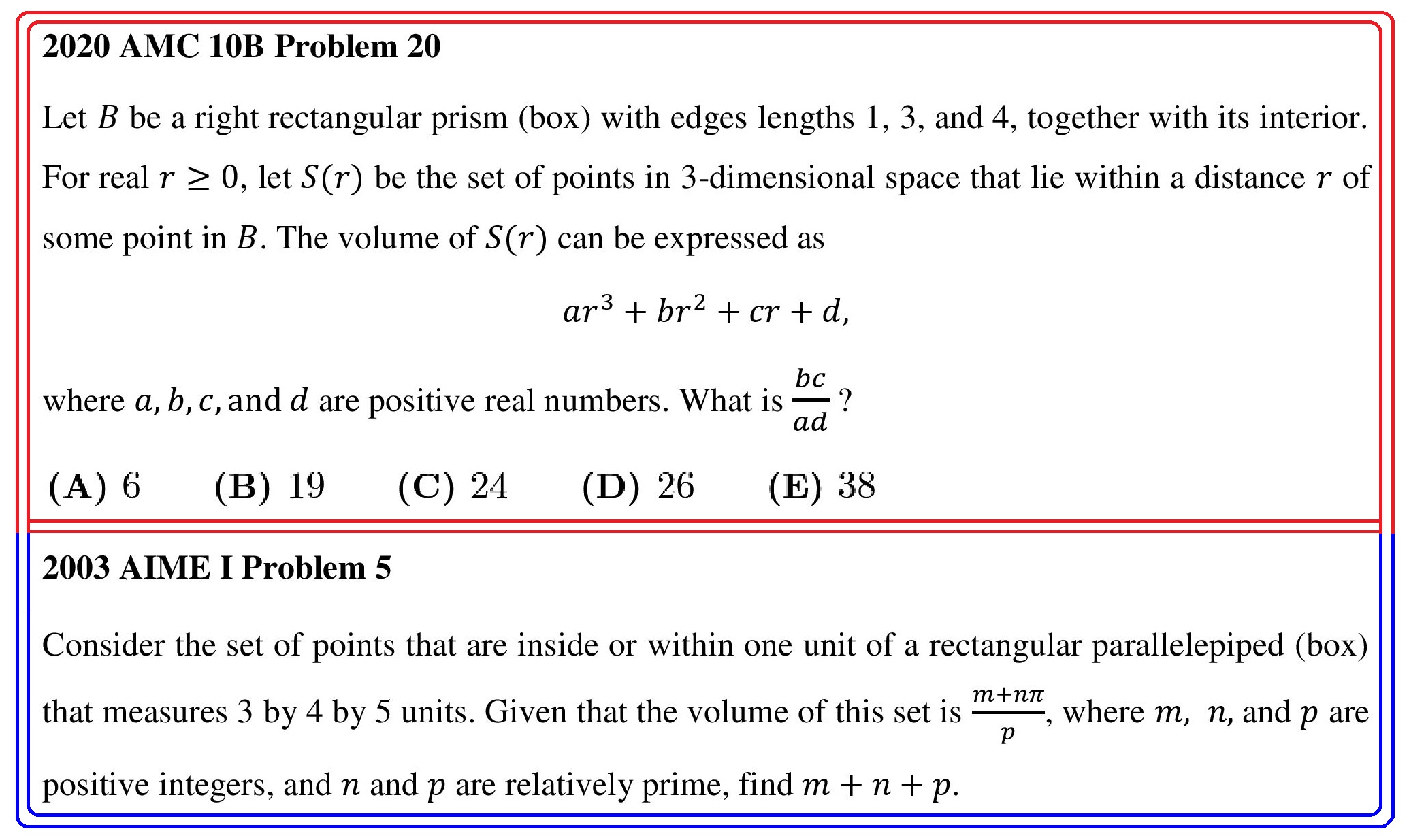
These three problems from previous AIME contests are shown below:

  • The 2020 AMC 10A Problem 19 is the exact same as the 2016 AIME I Problem 3.
  • The 2020 AMC 12A Problem 24 is the exact same as the 2012 AIME I Problem 13.
  • The 2020 AMC 10B Problem 20 is the exact same as the 2003 AIME I Problem 5.
  • The 2020 AMC 10B Problem 21 (also known as Problem 18 on the 2020 AMC 12B) is the exact same as the 2015 AIME I Problem 7.

2003 AIME I Problem 5

Because we discussed the detailed solutions for these three problems from past AIME contests in our AMC 10/12 prep class, our students were able to successfully answer these exact same problems on the 2020 AMC 10/12 contests. This greatly improved their overall score to qualify for the AIME.

Because the AMC 10/12 problems are getting harder, we must practice not only previous AMC 10/12 problems but also easy or medium difficulty level problems from previous AIME to do well on the AIME.1136217959-c032701ebba946fc4a01ff9a1aa9f3cd

amclogocolors

More details can be found at:

AMC-General

There are many math competitions in the United States. Of those, only

AMC → AIME → USAMO sequence

would take you to the IMO (International Math Olympiad), the highest level math competition for high school students in the world!

Featured Math Instructors

All of our sessions are taught by highly qualified instructors who are excellent experts on preparing students for the exam. We distinguish ourselves by the high quality of our instructors. Finding top-quality instructors is no easy task. We’ve hand-picked some of the best, including graduates of Ivy League institutions.

Our instructors are dedicated to teaching and student success. They are very knowledgeable, patient, available, and willing to help our students. Our students receive a quality education that goes beyond the classroom.

Meet some of them here:

IMG_2563_0

Bronze_medal

Our Students

In 2020, we had 82 students who are qualified to take the AIME either through the AMC 10A/12A or AMC 10B/12B. One of our students was among the 11 Perfect Scorers worldwide on the AMC 12A: Yiyang X, and one of our students was among the 13 Perfect Scorers worldwide on the AMC 10A: Jason W.. 43 middle schoolers and 9 elementary schoolers qualified for the AIME!

In 2019, we had 71 students who obtained top scores on the AMC 8 contest!

  • 8 of our students were among the top 151 National Winners (Perfect Scorers), including 2 sixth graders.
  • 36 students received National Distinguished Honor Roll Certificates awarded to top 1% test takers, as shown in Table 2.
  • 27 students received National Honor Roll Certificates awarded to top 5% test takers, as shown in Table 3.
  • 71 out of our 73 students (97.3%) received National Awards for the AMC 8 from the Mathematical Association of America

Read more at: 2019 AMC 8 Results Just Announced — Eight Students Received Perfect Scores

In 2019, we had 4 students qualified for the USAMO and 4 Students for the USAJMO.

  • Of the 280 USA Math Olympiad national qualifiers, 4 are our students: Luke C., Zipeng L., Sameer P., and Peter P.
  • Of the 235 USA Junior Math Olympiad national qualifiers, 4 are our students: Michael H., Noah W., Holden W., and Isabella Z.

Read more at: 2019 USAMO and USAJMO Qualifiers Announced — Four Students Qualified for the USAMO and Four Students for the USAJMO

In 2019, we had 76 students who are qualified to take the AIME either through the AMC 10A/12A or AMC 10B/12B. One of our students was among the 22 Perfect Scorers worldwide on the AMC 10A: Noah W.and one of our students were among the 10 Perfect Scorers worldwide on the AMC 12B: Kenneth WVery impressively, 32 middle schoolers and 7 elementary schoolers qualified for the AIME!

In 2018, we had 64 students who obtained top scores on the AMC 8 contest!

  • of our students were among the top 44 National Winners (Perfect Scorers): Eric B., Kevin Y., and Isabella Z.
  • 40 students received National Distinguished Honor Roll Certificates awarded to top 1% test takers.
  • 21 students received National Honor Roll Certificates awarded to top 5% test takers.
  • 64 out of our 66 students (96.5%) received National Awards for the AMC 8 from the Mathematical Association of America

Read more at: 2018 AMC 8 Results Just Announced — Three Students Received Perfect Scores

In 2018, we had 73 students who are qualified to take the AIME either through the AMC 10A/12A or AMC 10B/12B. Two of our students were among the 35 Perfect Scorers worldwide on the AMC 10A: Austen M. and Jason W.  and two of our students were among the 21 Perfect Scorers worldwide on the AMC 12B: Kaan D. and Edward W. Remarkably, 11 middle schoolers and 2 elementary schoolers qualified for the AIME!

In 2017, we had 63 students who earned top scores on the AMC 8 contest!

  • of our students were among the top 75 National Winners (Perfect Scorers).
  • 34 students received National Distinguished Honor Roll Certificates awarded to top 1% test takers.
  • 22 students received National Honor Roll Certificates awarded to top 5% test takers.
  • 63 out of our 65 students (97%) received National Awards for the AMC 8 from the Mathematical Association of America

Read more at: 2017 AMC 8 Results Just Announced — Seven Students Received Perfect Scores

In 2017, we had 61 students who are qualified to take the AIME either through the AMC 10A/12A or AMC 10B/12B. One of our students was among the 28 Perfect Scorers worldwide on the AMC 10A: Austen M., and two of our students were among the 65 Perfect Scorers worldwide on the AMC 10B: Ashwin A. and Brad Z. Remarkably, eight middle schoolers and one elementary schooler qualified for the AIME, which is geared toward high school students. Very impressively, Bryan Z., a 6th grader, gained a score of 132 out of 150 on the AMC 10B.Read more at: 2017 AIME Qualifiers Announced — 61 Students Qualified for the AIME

In 2016, we had 36 students who are qualified to take AIME either through AMC 10A/12A or AMC 10B/12B. One of our students was among the 23 Perfect Scorers worldwide on the AMC 10A: Joel (Junyao) T. Particularly, seven middle schoolers and one elementary schooler qualified for the AIME, which is geared toward high school students. Pravalika P., a 6th grader, got a 115.5 out of 150 on the AMC10B, which is very impressive. Read more at: 2016 AIME Qualifiers Announced — 36 Students Qualified for AIME

2011 – 2015: In total, 37 students scored above 120 on the American Mathematics Contest 10 (AMC 10) and qualified for the American Invitational Mathematics Examination (AIME); 26 students scored above 100 on the American Mathematics Contest 12 (AMC 12) and qualified for the American Invitational Mathematics Examination (AIME); 3 students qualified for the USA Mathematical Olympiad (USAMO), the highest level of math competition for high school students in the USA

2011 – 2015: In total, 23 students achieved perfect scores of 28 on the AMC 8

Read more at: Notable Achievements of Our Students

AAEAAQAAAAAAAAKeAAAAJDkzYTk2ZjE5LTk1YWQtNDBkNy1hZDhjLTVjOTA2YWQ2NmQ2Mw

Our Uniqueness

We have a long history of close collaboration with the MAA‘s American Mathematics Competitions (AMC), which are dedicated to strengthening the mathematical capabilities of our nation’s youth, and are the first of a series of competitions in high school mathematics that determine the United States team for the International Mathematical Olympiad (IMO).

We are only one in the Washington DC metropolitan area to offer elementary, middle, and high-school level competition math courses. Our students have received top scores and awards at prestigious national math competitions.

Great Benefits of Math Competitions

In an increasingly competitive college application pool, the process of mastering math skills through our courses and participating in the American Math Competitions will help students strengthen and diversify their extracurricular activities. These contests can motivate students’ interest and passion in math, and they can discover their talent through solving challenging problems different from those in the school classes. Many top colleges also request AMC scores as part of the college application process. Both MIT and Caltech have entry blanks on their official admission application forms for the applicant to enter their best AMC and AIME scores. Ivy League Colleges and Stanford ask for to the AMC and AIME scores in their Supplement to the Common Application Forms. Your children deserve the chance to list these scores on their applications! Good AMC scores will greatly enhance admission opportunities for students to elite colleges.

Read more:

Contact Information:

Ivy League Education Center
Tel:  301-922-9508     or        240-780-8828
Email:  chiefmathtutor@gmail.com

education priceless treasure

2014124135627709

Click HERE find out more about Math Competitionssat-logo-3

Click HERE to find out more about SAT Prep!

1090007ad4f9061d818

AMC

Making%20Awesome%20Things%20Happen

Online High School Competitive Math (for 6th to 11th graders) Special Spring Session Starting April 12

It’s time to prepare for the 2021 AMC contests!  Chance favors only the prepared mind.Success is doing ordinary things EXTRA ordinarily well!

See: 2019 USAMO and USAJMO Qualifiers Announced — Four Students Qualified for the USAMO and Four Students for the USAJMO

BANNER_Top_Mathletics

Purpose: To prepare for the ARML and the AMC 10/12A — Thursday, February 4, 2021 and AMC 10/12B — Wednesday, February 10, 2021.

Special Spring Session
9 Weekends (EASTERN Time: 6:00 – 8:00 pm), Total: 18 Hours
4/12,  4/19,  4/26,  5/3 (Monthly Mock Test/Review)
5/10,  5/17,  5/24,  5/31,  6/7 (Final Mock Exam/Review)

New Students: $720

Buy Now Button

Returning Students: $700

Buy Now Button

Online Registration is now open! Click HERE to register and pay.

You are very welcome to sign up for our online course which offers a quick, efficient way for students to interact with teachers over long distance. We use Google Meet to video chat and easily connect with students to teach them our tricks and shortcuts to getting an amazing score on their contests, as well as offer them our guidance and support. Students can ask questions face-to-face, and can complete problems with the supervision of our teachers/coaches. Click HERE to see detailed instruction.

A commitment to the whole course can maximize the benefit of learning all the math ideas, methods, strategies, tactics, skills, and techniques.

Click HERE to see payment and refund policy.

  • This is a live class, not a pre-recorded one. Instructors will ask students questions, and students can also ask questions during the class or email their questions to instructors after class.
  • We record all of our lessons as a big bonus so that our students can watch class videos after class for review and self-study.
  • We will help students gain a deeper understanding of the fundamental math concepts, build a solid foundation in math, and develop the critical thinking and problem-solving skills different from those in the school classes, motivation, and perseverance for reaching their full potential.
  • We will focus on efficient tricks, shortcuts, and strategies to solve competitive math problems, especially those hard problems on the AMC 10/12 and easy problems on the AIME, as well as test-taking tactics.
  • The emphasis of this class will be on comprehensive problem-solving, which is very common in competitive math, but is not included in school curriculum.
  • We will utilize a highly effective teaching model as described in the article: Small-sized Class Instruction-focused Model.

Instructors:

Contact Information:
Ivy League Education Center
Tel:  301-922-9508     or        240-406-3402
Email:  chiefmathtutor@gmail.com

Each Session: 

Tuition : $520
Material:$200 (including 720 pages handouts, and problem sets with detailed solutions)
Total Fee:$720 (We offer discounts of $20 for returning students.)

commitment to the whole course can maximize the benefit of learning all the math ideas, methods, strategies, tactics, skills, and techniques.

math-olympiad-web

Specific Goal: To earn a score of 120 or more out of 150 on the American Mathematics Contest 10 (AMC 10), or a score of 100 or more out of 150 on the American Mathematics Contest 12 (AMC 12), and then qualify for the American Invitational Mathematics Examination (AIME), which is used to determine qualification for the United States of America Mathematical Olympiad (USAMO). See for more details: Optimal Strategies to Solve Hard AMC Problems

AMC-General

There are many math competitions in the United States. Of those, only

AMC → AIME → USAMO sequence

would take you to the IMO (International Math Olympiad), the highest level math competition for high school students in the world!

AMC 10-12-New

Although the last round of this year’s AMC 10/12 will be coming at a close on February 5, 2020, we must prepare in advance for the 2021 AMC 10/12 contests. As the great scientist Louis Pasteur said, “Chance favors only the prepared mind.” Those who strive to prepare early, and work hard are the ones who achieve the best results. The AMC is a complex math competition that requires dedication and focus. Therefore, the earlier our students start preparing, the better their scores will be.

Read more at:

imagesFX9CEY3L

Who should take this class: This class is very appropriate for 6th-11th grade students who are hoping to qualify for the AIME.

Benefits:

  • 9 tutorial handouts (>360 pages) developed by Dr. Henry Wan and 500 new problems similar to AMC 10/12 level from the licensed AMC Database
  • 2 FREE mock tests that are intended to mimic an actual math competition exam, each of which has 25 questions similar to AMC 10/12 level taken from the licensed AMC Database. These simulated tests help students assess their level of preparation for the Math Competitions. After attempting the test, students get answers, explanations, and a detailed score report and wise performance summary.
  • FREE registration for the AMC 10/12A — Thursday, February 4, 2021 and AMC 10/12B — Wednesday, February 10, 2021. Please see: The AMC 10/12 Contests at the Montgomery College on January 30, 2020, and February 5, 2020

Weekly Homework:

At least 3 hours per week. Problem sets include all problems from 82 past real AMC 10/12 test booklets, and 500 brand new problems having similar difficulty and style as the real AMC 10/12 problems, extracted from the licensed AMC Database.

The focus will on the final 10 problems on the AMC 10/12, and the first 5 problems on the AIME, as well as those hard problems on the ARML. Note that some hard problems on the recent AMC 10 and 12 are exactly the same as previous ARML Problems. Read More at: Some Problems on the 2016 AMC 10/12 are Exactly the Same as Previous AMC/ARML Problems 

Each week, we will carefully review and check 2 students’ homework, and correct any mistakes. The next week, we will check another 2 students’ homework, and this will continue on a rotational basis until all students have had their homework checked at least once and the cycle will start again. Based on the work of the 2 students that week, we will provide the those 2 students with individualized proposal and support.

Qualifying AIME

Class Outline:

In our high school competitive math class, we will focus on efficient tricks, shortcuts, and strategies to solve AMC problems as well as test-taking tactics. The emphasis of this class will be on advanced geometry and comprehensive problem-solving which are very common in competitive math. We will also help students develop quick problem solving strategies and effective time management skills. We reserve the right to adjust the teaching content and method according to students’ understanding and comprehension of new knowledge.

Special Spring Session 

ClassDateTopic
14/12, Sun

Circle geometry

24/19, Sun

Circles and triangles: circumcircles and incircles

34/26, Sun

Circles and regular polygons, efficient strategy to construct auxiliary lines in circles

45/3, SunQuadrilateral geometry: trapezoids, parallelograms, kites, and rhombuses
55/10, Sun

Trigonometry I

65/17, SunTrigonometry II
75/24, Sun3-D geometry
85/31, SunAnalytic geometry and complex number geometry
96/7, SunConstructing auxiliary lines and applying the ruler, protractor, and compass to solve hard AMC geometry problems (See more at: Optimal Strategies to Solve Hard AMC Geometry Problems

Small-sized Class Teaching Model:

We utilize the highly effective small-sized class teaching model. Smaller classes lead to pupils receiving more individual attention from teachers, and having more active interactions with them. We focus on every individual, not the whole class. Students will thrive from the smaller class sizes that allow them to reach their full potential. Particularly, students can benefit tremendously from high-frequent individualized student-teacher interactions leading to establishment of a stronger foundation for lifelong learning.

Our main purpose is to help our students gain deeper understanding of the fundamental math concepts, build a solid foundation in math, and develop the critical thinking and problem-solving skills that are so valuable to success in any career. We are big believers in the FUNDAMENTALS! Our students will receive the LIFELONG BENEFITS from learning math.

IMG_2563_0

Regardless of his/her math level, each student will have the opportunity to learn math in a fun, friendly, cooperative, supportive learning environment. The most important thing is to have fun.

Bronze_medal

Our Students

In 2020, we had 82 students who are qualified to take the AIME either through the AMC 10A/12A or AMC 10B/12B. One of our students was among the 11 Perfect Scorers worldwide on the AMC 12A: Yiyang X, and one of our students was among the 13 Perfect Scorers worldwide on the AMC 10A: Jason W.. 43 middle schoolers and 9 elementary schoolers qualified for the AIME!

In 2019, we had 71 students who obtained top scores on the AMC 8 contest!

  • 8 of our students were among the top 151 National Winners (Perfect Scorers), including 2 sixth graders.
  • 36 students received National Distinguished Honor Roll Certificates awarded to top 1% test takers, as shown in Table 2.
  • 27 students received National Honor Roll Certificates awarded to top 5% test takers, as shown in Table 3.
  • 71 out of our 73 students (97.3%) received National Awards for the AMC 8 from the Mathematical Association of America

Read more at: 2019 AMC 8 Results Just Announced — Eight Students Received Perfect Scores

In 2019, we had 4 students qualified for the USAMO and 4 Students for the USAJMO.

  • Of the 280 USA Math Olympiad national qualifiers, 4 are our students: Luke C., Zipeng L., Sameer P., and Peter P.
  • Of the 235 USA Junior Math Olympiad national qualifiers, 4 are our students: Michael H., Noah W., Holden W., and Isabella Z.

Read more at: 2019 USAMO and USAJMO Qualifiers Announced — Four Students Qualified for the USAMO and Four Students for the USAJMO

In 2019, we had 76 students who are qualified to take the AIME either through the AMC 10A/12A or AMC 10B/12B. One of our students was among the 22 Perfect Scorers worldwide on the AMC 10A: Noah W., and one of our students was among the 10 Perfect Scorers worldwide on the AMC 12B: Kenneth WVery impressively, 32 middle schoolers and 7 elementary schoolers qualified for the AIME!

In 2018, we had 64 students who obtained top scores on the AMC 8 contest!

  • of our students were among the top 44 National Winners (Perfect Scorers): Eric B., Kevin Y., and Isabella Z.
  • 40 students received National Distinguished Honor Roll Certificates awarded to top 1% test takers.
  • 21 students received National Honor Roll Certificates awarded to top 5% test takers.
  • 64 out of our 66 students (96.5%) received National Awards for the AMC 8 from the Mathematical Association of America

Read more at: 2018 AMC 8 Results Just Announced — Three Students Received Perfect Scores

In 2018, we had 73 students who are qualified to take the AIME either through the AMC 10A/12A or AMC 10B/12B. Two of our students were among the 35 Perfect Scorers worldwide on the AMC 10A: Austen M. and Jason W.  and two of our students were among the 21 Perfect Scorers worldwide on the AMC 12B: Kaan D. and Edward W. Remarkably, 11 middle schoolers and 2 elementary schoolers qualified for the AIME!

In 2017, we had 63 students who earned top scores on the AMC 8 contest!

  • of our students were among the top 75 National Winners (Perfect Scorers).
  • 34 students received National Distinguished Honor Roll Certificates awarded to top 1% test takers.
  • 22 students received National Honor Roll Certificates awarded to top 5% test takers.
  • 63 out of our 65 students (97%) received National Awards for the AMC 8 from the Mathematical Association of America

Read more at: 2017 AMC 8 Results Just Announced — Seven Students Received Perfect Scores

In 2017, we had 61 students who are qualified to take the AIME either through the AMC 10A/12A or AMC 10B/12B. One of our students was among the 28 Perfect Scorers worldwide on the AMC 10A: Austen M., and two of our students were among the 65 Perfect Scorers worldwide on the AMC 10B: Ashwin A. and Brad Z. Remarkably, eight middle schoolers and one elementary schooler qualified for the AIME, which is geared toward high school students. Very impressively, Bryan Z., a 6th grader, gained a score of 132 out of 150 on the AMC 10B.Read more at: 2017 AIME Qualifiers Announced — 61 Students Qualified for the AIME

In 2016, we had 36 students who are qualified to take AIME either through AMC 10A/12A or AMC 10B/12B. One of our students was among the 23 Perfect Scorers worldwide on the AMC 10A: Joel (Junyao) T. Particularly, seven middle schoolers and one elementary schooler qualified for the AIME, which is geared toward high school students. Pravalika P., a 6th grader, got a 115.5 out of 150 on the AMC10B, which is very impressive. Read more at: 2016 AIME Qualifiers Announced — 36 Students Qualified for AIME

2011 – 2015: In total, 37 students scored above 120 on the American Mathematics Contest 10 (AMC 10) and qualified for the American Invitational Mathematics Examination (AIME); 26 students scored above 100 on the American Mathematics Contest 12 (AMC 12) and qualified for the American Invitational Mathematics Examination (AIME); 3 students qualified for the USA Mathematical Olympiad (USAMO), the highest level of math competition for high school students in the USA

2011 – 2015: In total, 23 students achieved perfect scores of 28 on the AMC 8

Read more at: Notable Achievements of Our Students

AAEAAQAAAAAAAAKeAAAAJDkzYTk2ZjE5LTk1YWQtNDBkNy1hZDhjLTVjOTA2YWQ2NmQ2Mw

Our Uniqueness

We have a long history of close collaboration with the MAA‘s American Mathematics Competitions (AMC), which are dedicated to strengthening the mathematical capabilities of our nation’s youth, and are the first of a series of competitions in high school mathematics that determine the United States team for the International Mathematical Olympiad (IMO).

We are only one in the Washington DC metropolitan area to offer elementary, middle, and high-school level competition math courses. Our students have received top scores and awards at prestigious national math competitions.

1Great Benefits of Math Competitions

In an increasingly competitive college application pool, the process of mastering math skills through our courses and participating in the American Math Competitions will help students strengthen and diversify their extracurricular activities. These contests can motivate students’ interest and passion in math, and they can discover their talent through solving challenging problems different from those in the school classes. Many top colleges also request AMC scores as part of the college application process. Both MIT and Caltech have entry blanks on their official admission application forms for the applicant to enter their best AMC and AIME scores. Ivy League Colleges and Stanford ask for to the AMC and AIME scores in their Supplement to the Common Application Forms. Your children deserve the chance to list these scores on their applications! Good AMC scores will greatly enhance admission opportunities for students to elite colleges.

Read more:

education priceless treasure

2014124135627709

Click HERE find out more about Math Competitions!sat-logo-3

Click HERE to find out more about SAT Prep!

6e2ad27c20314a60cdd086927f15b524

Panada

1090007ad4f9061d818

AIME_RGBAMC

0AMC_Airlines_logo_svg

education priceless treasure

31eaba7d8a4376fedc290c94d5702d429

2020 AMC 10B Problems and Answers

The 2020 AMC 10B contest was held on February 5, 2020. We posted the 2020 AMC 10B Problems and Answers at 12 a.m. (EST) midnight on February 5, 2020You can click the following links to download them:

amclogocolors

More details can be found at:

2014124135627709

Click HERE find out more about Math Competitions!sat-logo-3

Click HERE to find out more about SAT Prep!

math is fundamental 928x223.png

AMC 10

AMC Logo

cof-10merit

2010 AMC 10A

problemamc10_t

AMC 10-2017.png

AMC

2020 AMC 12B Problems and Answers

AMC 12-2017

The 2020 AMC 12B contest was held on February 5, 2020. We posted the 2020 AMC 12B Problems and Answers at 12 a.m. (EST) midnight on February 5, 2020You can click the following links to download them:

amclogocolors

More details can be found at:

2014124135627709

Click HERE find out more about Math Competitionssat-logo-3

Click HERE to find out more about SAT Prep!

AAEAAQAAAAAAAAKeAAAAJDkzYTk2ZjE5LTk1YWQtNDBkNy1hZDhjLTVjOTA2YWQ2NmQ2Mw


Our Uniqueness

We have a long history of close collaboration with the MAA‘s American Mathematics Competitions (AMC), which are dedicated to strengthening the mathematical capabilities of our nation’s youth, and are the first of a series of competitions in high school mathematics that determine the United States team for the International Mathematical Olympiad (IMO). There are many math competitions in the United States. Of those, only AMC → AIME → USAMO sequence would take you to the IMO (International Math Olympiad), the highest level math competition for high school students in the world. We are only one in the Washington DC metropolitan area to offer elementary, middle, and high-school level competition math courses. Our students have received top scores and awards at prestigious national and math competitions. We have collected all AMC8/10/12 and AIME Official Problems and Official Solutions as shown in the article ” American Mathematics Competitions (AMC) Materials,” which have formed our “big data” system, a golden resource for our students, who are the ultimate beneficiaries.

AMC 12-2017

AMC 12 Logo

AMC 12-New

cof-12merit

MAA AMC 12

1090007ad4f9061d818AMCMaking%20Awesome%20Things%20Happen

2020 AMC 12A Problems and Answers

AMC 12-2017

The 2020 AMC 12A contest was held on Jan. 30, 2020. We posted the 2020 AMC 12A Problems and Answers at 12 a.m. (EST) midnight on January 30, 2020. You can click the following to download them:

amclogocolors

More details can be found at:

2014124135627709

Click HERE find out more about Math Competitionssat-logo-3

Click HERE to find out more about SAT Prep!

AAEAAQAAAAAAAAKeAAAAJDkzYTk2ZjE5LTk1YWQtNDBkNy1hZDhjLTVjOTA2YWQ2NmQ2Mw


Our Uniqueness

We have a long history of close collaboration with the MAA‘s American Mathematics Competitions (AMC), which are dedicated to strengthening the mathematical capabilities of our nation’s youth, and are the first of a series of competitions in high school mathematics that determine the United States team for the International Mathematical Olympiad (IMO). There are many math competitions in the United States. Of those, only AMC → AIME → USAMO sequence would take you to the IMO (International Math Olympiad), the highest level math competition for high school students in the world. We are only one in the Washington DC metropolitan area to offer elementary, middle, and high-school level competition math courses. Our students have received top scores and awards at prestigious national and math competitions. We have collected all AMC8/10/12 and AIME Official Problems and Official Solutions as shown in the article ” American Mathematics Competitions (AMC) Materials,” which have formed our “big data” system, a golden resource for our students, who are the ultimate beneficiaries.

AMC 12-2017

AMC 12 Logo

AMC 12-New

cof-12merit

MAA AMC 12

1090007ad4f9061d818AMCMaking%20Awesome%20Things%20Happen

2020 AMC 10A Problems and Answers

The 2020 AMC 10A contest was held on Jan. 30, 2020. We posted the 2020 AMC 10A Problems and Answers at 12 a.m. (EST) midnight on January 30, 2020. You can click the following to download them:

amclogocolors

More details can be found at:

2014124135627709

Click HERE find out more about Math Competitions!sat-logo-3

Click HERE to find out more about SAT Prep!

math is fundamental 928x223.png

AMC 10

AMC Logo

cof-10merit

2010 AMC 10A

problemamc10_t

AMC 10-2017.png

AMC

2020 Spring – Competitive Math Courses

Spring is the golden time to prepare for the American Mathematics Competitions!

Only undertake what you can do in an excellence fashion. There are no prizes for average performance.

See more at:

BANNER_Top_Mathletics
Competitive Math Program — Spring Schedule

Class Day/Time Grade
High School Competitive Math Spring Session I
9 Classes (Time: 6:00 – 8:00 pm)
Total: 18 Hours 
2/9, 2/16, 2/23, 3/1, 3/8, 3/15, 3/22, 3/29, 4/5
Spring Session II
9 Classes (Time: 6:00 – 8:00 pm)
Total: 18 Hours
4/12, 4/19, 4/26, 5/3, 5/10, 5/17, 5/24, 5/31, 6/7
View Course Outline
6-11
Online High School Competitive Math Spring Session I
9 Classes (Time: 6:00 – 8:00 pm)
Total: 18 Hours 
2/9, 2/16, 2/23, 3/1, 3/8, 3/15, 3/22, 3/29, 4/5
Spring Session II
9 Classes (Time: 6:00 – 8:00 pm)
Total: 18 Hours
4/12, 4/19, 4/26, 5/3, 5/10, 5/17, 5/24, 5/31, 6/7
View Course Outline
6-11
Middle School Competitive Math Spring Session I
9 Classes (Time: 6:00 – 8:00 pm)
Total: 18 Hours
2/8, 2/15, 2/22, 2/29, 3/7, 3/14, 3/21, 3/28, 4/4
Spring Session II
9 Classes (Time: 6:00 – 8:00 pm)
Total: 18 Hours
4/11, 4/18, 4/25, 5/2, 5/9, 5/16, 5/23, 5/30, 6/6
View Course Outline
4-8
Online Middle School Competitive Math Spring Session I
9 Classes (Eastern Time: 6:00 – 8:00 pm)
Total: 18 Hours
2/8, 2/15, 2/22, 2/29, 3/7, 3/14, 3/21, 3/28, 4/4
Spring Session II
9 Classes (Eastern Time: 6:00 – 8:00 pm)
Total: 18 Hours
4/11, 4/18, 4/25, 5/2, 5/9, 5/16, 5/23, 5/30, 6/6
View Course Outline
4-8
Intensive AIME Prep Spring Session
5 Classes (EASTERN Time: 3:00 – 5:30 pm)
Total: 12.5 Hours 
2/9,  2/16,  2/23,  3/1,  3/8
View Course Outline
6-11
Online Intensive AIME Prep Spring Session
5 Classes (EASTERN Time: 3:00 – 5:30 pm)
Total: 12.5 Hours 
2/9,  2/16,  2/23,  3/1,  3/8
View Course Outline
6-11

We record all of our lessons as a big bonus so that our students can watch class videos after class for review and self-study.

Team_Building-338.fc.image

There are many math competitions in the United States. Of those, only

AMC → AIME → USAMO sequence

would take you to the IMO (International Math Olympiad), the highest level math competition for high school students in the world!

AMC-General

Featured Math Instructors

All of our sessions are taught by highly qualified instructors who are excellent experts on preparing students for the exam. We distinguish ourselves by the high quality of our instructors. Finding top-quality instructors is no easy task. We’ve hand-picked some of the best, including graduates of Ivy League institutions.

Our instructors are dedicated to teaching and student success. They are very knowledgeable, patient, available, and willing to help our students. Our students receive a quality education that goes beyond the classroom.

Meet some of them here:

IMG_2563_0

Bronze_medal

Our Students

In 2020, we had 82 students who are qualified to take the AIME either through the AMC 10A/12A or AMC 10B/12B. One of our students was among the 11 Perfect Scorers worldwide on the AMC 12A: Yiyang X, and one of our students was among the 13 Perfect Scorers worldwide on the AMC 10A: Jason W.. 43 middle schoolers and 9 elementary schoolers qualified for the AIME!

In 2019, we had 71 students who obtained top scores on the AMC 8 contest!

  • 8 of our students were among the top 151 National Winners (Perfect Scorers), including 2 sixth graders.
  • 36 students received National Distinguished Honor Roll Certificates awarded to top 1% test takers, as shown in Table 2.
  • 27 students received National Honor Roll Certificates awarded to top 5% test takers, as shown in Table 3.
  • 71 out of our 73 students (97.3%) received National Awards for the AMC 8 from the Mathematical Association of America

Read more at: 2019 AMC 8 Results Just Announced — Eight Students Received Perfect Scores

In 2019, we had 4 students qualified for the USAMO and 4 Students for the USAJMO.

  • Of the 280 USA Math Olympiad national qualifiers, 4 are our students: Luke C., Zipeng L., Sameer P., and Peter P.
  • Of the 235 USA Junior Math Olympiad national qualifiers, 4 are our students: Michael H., Noah W., Holden W., and Isabella Z.

Read more at: 2019 USAMO and USAJMO Qualifiers Announced — Four Students Qualified for the USAMO and Four Students for the USAJMO

In 2019, we had 76 students who are qualified to take the AIME either through the AMC 10A/12A or AMC 10B/12B. One of our students was among the 22 Perfect Scorers worldwide on the AMC 10A: Noah W.and one of our students were among the 10 Perfect Scorers worldwide on the AMC 12B: Kenneth WVery impressively, 32 middle schoolers and 7 elementary schoolers qualified for the AIME!

In 2018, we had 64 students who obtained top scores on the AMC 8 contest!

  • of our students were among the top 44 National Winners (Perfect Scorers): Eric B., Kevin Y., and Isabella Z.
  • 40 students received National Distinguished Honor Roll Certificates awarded to top 1% test takers.
  • 21 students received National Honor Roll Certificates awarded to top 5% test takers.
  • 64 out of our 66 students (96.5%) received National Awards for the AMC 8 from the Mathematical Association of America

Read more at: 2018 AMC 8 Results Just Announced — Three Students Received Perfect Scores

In 2018, we had 73 students who are qualified to take the AIME either through the AMC 10A/12A or AMC 10B/12B. Two of our students were among the 35 Perfect Scorers worldwide on the AMC 10A: Austen M. and Jason W.  and two of our students were among the 21 Perfect Scorers worldwide on the AMC 12B: Kaan D. and Edward W. Remarkably, 11 middle schoolers and 2 elementary schoolers qualified for the AIME!

In 2017, we had 63 students who earned top scores on the AMC 8 contest!

  • of our students were among the top 75 National Winners (Perfect Scorers).
  • 34 students received National Distinguished Honor Roll Certificates awarded to top 1% test takers.
  • 22 students received National Honor Roll Certificates awarded to top 5% test takers.
  • 63 out of our 65 students (97%) received National Awards for the AMC 8 from the Mathematical Association of America

Read more at: 2017 AMC 8 Results Just Announced — Seven Students Received Perfect Scores

In 2017, we had 61 students who are qualified to take the AIME either through the AMC 10A/12A or AMC 10B/12B. One of our students was among the 28 Perfect Scorers worldwide on the AMC 10A: Austen M., and two of our students were among the 65 Perfect Scorers worldwide on the AMC 10B: Ashwin A. and Brad Z. Remarkably, eight middle schoolers and one elementary schooler qualified for the AIME, which is geared toward high school students. Very impressively, Bryan Z., a 6th grader, gained a score of 132 out of 150 on the AMC 10B.Read more at: 2017 AIME Qualifiers Announced — 61 Students Qualified for the AIME

In 2016, we had 36 students who are qualified to take AIME either through AMC 10A/12A or AMC 10B/12B. One of our students was among the 23 Perfect Scorers worldwide on the AMC 10A: Joel (Junyao) T. Particularly, seven middle schoolers and one elementary schooler qualified for the AIME, which is geared toward high school students. Pravalika P., a 6th grader, got a 115.5 out of 150 on the AMC10B, which is very impressive. Read more at: 2016 AIME Qualifiers Announced — 36 Students Qualified for AIME

2011 – 2015: In total, 37 students scored above 120 on the American Mathematics Contest 10 (AMC 10) and qualified for the American Invitational Mathematics Examination (AIME); 26 students scored above 100 on the American Mathematics Contest 12 (AMC 12) and qualified for the American Invitational Mathematics Examination (AIME); 3 students qualified for the USA Mathematical Olympiad (USAMO), the highest level of math competition for high school students in the USA

2011 – 2015: In total, 23 students achieved perfect scores of 28 on the AMC 8

Read more at: Notable Achievements of Our Students

AAEAAQAAAAAAAAKeAAAAJDkzYTk2ZjE5LTk1YWQtNDBkNy1hZDhjLTVjOTA2YWQ2NmQ2Mw

Our Uniqueness

We have a long history of close collaboration with the MAA‘s American Mathematics Competitions (AMC), which are dedicated to strengthening the mathematical capabilities of our nation’s youth, and are the first of a series of competitions in high school mathematics that determine the United States team for the International Mathematical Olympiad (IMO).

We are only one in the Washington DC metropolitan area to offer elementary, middle, and high-school level competition math courses. Our students have received top scores and awards at prestigious national math competitions.

Great Benefits of Math Competitions

In an increasingly competitive college application pool, the process of mastering math skills through our courses and participating in the American Math Competitions will help students strengthen and diversify their extracurricular activities. These contests can motivate students’ interest and passion in math, and they can discover their talent through solving challenging problems different from those in the school classes. Many top colleges also request AMC scores as part of the college application process. Both MIT and Caltech have entry blanks on their official admission application forms for the applicant to enter their best AMC and AIME scores. Ivy League Colleges and Stanford ask for to the AMC and AIME scores in their Supplement to the Common Application Forms. Your children deserve the chance to list these scores on their applications! Good AMC scores will greatly enhance admission opportunities for students to elite colleges.

Read more:

Contact Information:

Ivy League Education Center
Tel:  301-922-9508     or        240-780-8828
Email:  chiefmathtutor@gmail.com

education priceless treasure

2014124135627709

Click HERE find out more about Math Competitions!sat-logo-3

Click HERE to find out more about SAT Prep!

1090007ad4f9061d818

%e6%95%b0%e5%ad%a6%e5%a4%a7%e6%9c%89%e4%bd%9c%e4%b8%ba

AIME_RGB

%e6%95%b0%e4%b8%ad%e8%87%aa%e6%9c%89%e9%bb%84%e9%87%91%e5%b1%8bAMCAMC_Airlines_logo_svg

education priceless treasure

3

mathis_1IMOLogos-gudder-quote-the-essence-of-mathematics-is-not-to-make-simple-things

education priceless treasure

4

Studying Math: Want a Challenge?

Dave Peterson, Ph.D.

Many students who write to us are involved in math competitions. They don’t always say that explicitly, but we can tell when the problems they ask about may be far beyond ordinary homework, requiring deeper problem-solving skills. The three questions I’ll look at today are from students asking how to prepare for these competitions, or just to develop their own abilities beyond the normal.

The Math Olympiad

Here is a question from Ryan, in 2000:

Preparing for a Math Olympiad

This question may be a little weird. I’m fifteen years old and I’m in grade 10. I really like math and I do relatively well in school. But I want to be a candidate for the International Math Olympiad in grade 11 and/or grade 12. In order to do so, I have to push way past the subjects covered in class. I’m ready to work really hard and make sacrifices in order to reach my goal. My question for you is: what is the best way to learn senior level math and beyond, and know how to do well on math contests? I can’t just look over grade 12 math contests and learn the math. Do you have any ideas on how I could efficiently “reach the top”?

Doctor Ian first stated the obvious:

I once had a neighbor once who was always trying different diets. We were talking about it one day, when she blurted out that she’d do anything to lose weight… except eat less, and exercise more. Anyone who has become really good at math did it by reading books and practicing. I know that sounds too simple to be true, but there it is.

He then added general advice about finding useful books (back then, there probably weren’t many websites, if any, dedicated to this sort of preparation) and using them to self-teach:

Here’s how to choose a book:

Look for one where the stuff in the first chapter is too easy, and the stuff in the last chapter is too hard. That means you need to learn the stuff that’s in between. When you’ve found a few like that, open each one up to a section that tries to explain something you don’t understand, and see how well the author’s style of teaching meshes with your style of learning. Choose the one that seems best suited for you. As you go through the book you’ve selected, work the problems in each section until you can do them easily. If you get stuck, go back to the previous chapter, or the previous book, until you find what you failed to learn earlier. When you reach the end of one book, select another one, using the same process described above. Keep selecting and reading books until you know everything. :^D If you haven’t read anything by or about Richard Feynman, you should remedy that deficiency as soon as possible. (_Surely You’re Joking, Mr. Feynman_ would be the natural place to start.) He was one of the great problem-solvers of all time, and his insights in that direction will be of great value to you. You should also look at some of George Polya‘s classic works on problem-solving.

How about practicing? Math competitions commonly involve problems that go beyond the ordinary: that is, puzzles.

And work as many puzzles as you can. The value of puzzles is that they teach you alternative ways of thinking about problem solving by forcing you to learn to ‘think outside the box’, so to speak. As with textbooks, start with easy puzzles and work your way up to harder ones. When you’ve solved a puzzle, take some time to stop and think about what assumptions or habits of thought you had to work past in order to find the solution. (Why didn’t you see it immediately? Where else might you be blinded by the same prejudices?) Write them down, and look over your notes from time to time. One thing that you should keep in mind is that the people you’ll be competing against have not, by and large, learned a lot of math in order to compete. They compete because they have learned a lot of math, and they have learned a lot of math because they love learning it.

He closes with a story reminding us to be patient when learning, which I have to omit here.

Challenging yourself

Now let’s turn to a 2014 question from Stephanie, who had been asking a number of difficult questions:

Giving Myself a Challenge

In my younger years, I participated in a lot of maths competitions, which put me ahead of many of my classmates. Now I’m 14 and approaching IGCSEs. Can I do those contest puzzles alongside my textbooks? Which ones do you think will help me most?

Doctor Ian took this question, too:

I got a good chuckle from reading you say, “In my younger years …” :^D Yes: I think competition problems and textbooks are complementary. In a textbook, you have information being presented to you in an orderly way, and you have problems that are created to let you practice using that information. So most of the time, when you’re solving a problem from a textbook, there’s not much question about what you’re supposed to do. Sometimes you have to decide which variant of a technique should be applied, or there’s some small wrinkle that arises (for example, “What if the local maximum is less than the value at an endpoint?”), but it’s pretty straightforward. It’s *designed* to be straightforward. By contrast, a competition problem is often designed so that the “straightforward” approach is more difficult than some other, easier approach. But to find that easier approach, you have to come at it from a different angle; and it’s figuring out that angle — by altering the problem so that it more closely resembles something you’ve seen before — that provides the challenge, and the benefit.

They are two different kinds of training, and the good “mathlete” needs both.

For example, you might have a problem where the straightforward approach would require you to create and then factor some third-degree polynomial. But if you recast it as a particular kind of problem in geometry, then you can use symmetry to get the answer quickly. But there won’t be anything in the problem to tell you that! It’s something you have to arrive at yourself, by allowing your mind to wander through almost everything you’ve ever learned, looking for interesting connections that you haven’t noticed before. You’re not going to see problems like that in your textbooks (unless they’re really unusual!). Competition problems are the best source that I know of for this kind of experience. And in my opinion, at least, this skill — this kind of alchemical changing of the problem you have into one you’d rather have — is probably the most important “problem solving skill” that there is, inside and outside of mathematics. So I would encourage you to use textbooks to incrementally increase the range of your knowledge; and competition problems to challenge you to take the new things you’re learning and tie them to what you’ve already learned, in ways that can surprise and delight you.

Stephanie had several follow-up questions, to which I will show only Doctor Ian’s answers:

If you want to use the “mathematics as language” analogy, then math textbooks are like language textbooks, and competition programs are like actually going out and having conversations with people. The thing about conversations is that they are largely uncontrolled, which is to say, just about any topic can lead to any topic; and often the connections can be somewhat obscure … just like with competition problems!

The best advice I can give you … is to develop the habit of trying to solve any problem you come across in as many ways as possible. Got one answer? What’s a second way to attack the problem? What’s a third way? A fourth way? If you switch around the knowns and unknowns, which of those solution methods still work? What new ways of approaching it would be required? A second good habit to develop is generalizing the solutions you learn. If this technique will solve this problem, what other seemingly unrelated problems could it be used to solve? Is this technique a special case of some more general idea? Is it a generalization of some more specific ideas that I’ve learned in the past, and can now subsume under this one? Can I abstract this idea so that it applies to things in other fields of mathematics? To areas outside of mathematics? In this way, just about any problem serves the role of a “competition problem,” even if it’s not expressly constructed for that.

Turn your textbook into a competition lesson, by taking everything farther! Polya has some similar comments in How to Solve It.

Stephanie responded:

Thanks for your advice, Dr. Ian! I will remember your two ways of solving problems. Given the vast range of subjects in “conversations” (I do love that extended analogy — thank you!), do you think there are any groups of competition questions that will be at my current IGCSE level? or that will help with my IGCSEs in some way?

Doctor Ian concluded:

To be honest, I don’t have a lot of experience with various competitions, or with IGCSE for that matter. So I’m not able to tell you which ones would be most beneficial for you. But that’s why I discussed how to turn *any* problem into a “competition” problem. That is, if you get good at that, you won’t have to spend time looking around for problems that other people have made up. You can make up your own. It’s worth noting, by the way, that this is very close to the heart of how mathematics gets extended. Mathematicians solve one problem, then think about how they could change it (e.g., by adding or removing constraints), until they find that they have a problem that no one has solved before. Then they solve that new problem, re-visit it — and the process continues. Also, I realize that in my previous messages, I forgot to mention one other habit that you might want to develop. Feynman talks a lot about this one. That is the habit of trying to “see” ahead of time what a solution should be, before you sit down to try to calculate it. Sometimes this looks like finding estimates for upper or lower bounds, or noticing where symmetry can rule out certain kinds of solutions, and so on. There are at least two reasons for doing this. One is that if you know approximately what the solution has to be, then you can catch errors if you arrive at something far away from that. The second is that it can give you a better understanding of the problem, and in so doing, may help you make a connection to something you might not otherwise have thought about.

Of course, for any given competition, today there will be sample questions and tests from the source, and probably other sites dedicated to helping students prepare, so one can find out what sorts of problems to expect; but developing good habits while doing any kind of work is perhaps more valuable.

By the way, some of the Math Doctors have had considerable experience working with students on math competitions, and they have often answered questions about particular competition-style problems, giving additional general hints as well. These are much harder to search for!

The Putnam Exam

Let’s look at one more question, this one about an extremely challenging college-level competition.

Preparing for the Putnam Exam

I was wondering if you could give me some specific advice on how to study for the Putnam Exam because I will be taking it for my first time. I know the test is very hard, and I would like some helpful hints from people who are more experienced than me at mathematics. I am reading a book called Techniques of Problem Solving and I will probably finish it before the Putnam Exam is given.

Two of us answered this one. First, Doctor Pete described the exam, and gave general advice. Then  Doctor Vogler got more specific:

Thanks for writing to Dr. Math. I competed in the Putnam exam three times, and I thoroughly enjoy math puzzles, so I still like to work on the problems even though I am no longer an undergraduate and therefore no longer eligible to compete. If you look at some old exams, I think you’ll notice that in each of the two sections (A and B), the six questions are approximately in order of difficulty. So the first question is generally within reach of anyone who’s taken calculus and maybe linear algebra, although most such students will still find the question very challenging. (Remember that the median score on any question is zero.) The second question is harder, but still feasible. I found question three usually doable but very challenging. Then question four was only sometimes doable, and five and six rarely. The first four or five problems usually only require exposure to normal undergraduate mathematics (like Doctor Pete listed off for you) and a lot of creativity or cleverness. The sixth (and sometimes the fifth) question will usually require some advanced math that most undergraduates haven’t learned yet. That might seem unfair, but it’s supposed to be the most challenging problem on (arguably) the most challenging math test in the world. And, even if not all students learned that subject, they all had the chance. (You have a university library with a math section that you can use, right?) So it is probably better to spend more time on earlier problems until you get those than wasting time trying to work the sixth problem, which you’re not likely to get. (Unless you’re really *really* smart.) In other words, a half hour per problem is not very realistic. If you want to finish all six problems, then you had better get the first one or two done very quickly so that you have more time on the sixth. A more realistic approach might be: a half hour for the first problem, an hour for the second, an hour and a half for the third, and never mind the other three. Or perhaps even: three hours for the first problem, and never mind the rest.

Note that your goal has to be to do as well as you can do! This is not for those who can’t stand failure. (If you like challenges, then you have to accept failure as a step in learning.)

I would agree with Doctor Pete that you should practice by working problems on old exams, but I would not say that the ability to do well on this exam is not related to the ability to do math in general. In trying to work old problems, and in reading solutions to the ones you can’t get, you will learn mathematical techniques that are very useful in many fields of mathematics, and which will come up in your courses later. You can learn some really neat things. Better yet, you learn these techniques with a use in mind, so that makes them seem very worthwhile. If you learned the same thing in a class, you might think, “Why do we have to learn this? When will I ever use this?” By the way, you can find the questions for previous Putnam exams, along with complete solutions for each question, in a fall issue of the American Mathematical Monthly, around the October or November issue of the next year. (Does it take professional mathematicians that long to get good solutions to all of the problems?) You can probably find that math journal in the periodicals section of your university library. Ask the librarian if you need assistance.

Doing (trying!) old exam problems can be a great learning experience, even apart from taking the exam.

Be familiar with writing clear proofs, because this is the style of writing that they will be looking for, even when it isn’t a proof they ask for. Be familiar with mathematical rigor, such as using definitions as they are given to you, and not making incorrect assumptions. You can use other theorems that you’ve learned in your courses, but you usually won’t need obscure theorems, just the ones normally taught in undergraduate courses. And one other thing: They will often ask a question with a fairly large number, like “What is the 30th term in this sequence?” Almost always it will require *way* too much time to generate 30 terms in the sequence, and that’s not what they want you to do. You should generate a few terms, find a pattern, write out a formula for the n’th term, and then prove it by induction. They only say “30’th” to disguise the fact that it’s easier to get the general n’th term than it is to get 30 terms. Then you just substitute n=30 into the formula. (Notice that this type of question is an example of a question that doesn’t ask for a proof, but you should give one anyway: a proof by induction of your formula.)

We have previously discussed the process of finding patterns and formulas; this takes it to a whole new level. I will be getting back to that topic soon, looking at this more advanced type of problem.

nj0703200018

Intensive AIME Prep Course Starting Feb. 9

Spring is the golden time to develop students’ math skills and prepare for the American Invitational Mathematics Examination!

See: 2019 USAMO and USAJMO Qualifiers Announced — Four Students Qualified for the USAMO and Four Students for the USAJMO

Purpose: To prepare for the AIME I on Wednesday, March 11, 2020 or AIME II on Thursday, March 19, 2020

Five Weekends (EASTERN Time: 3:00 – 5:30 pm), Total: 12.5 Hours
2/9,  2/16,  2/23,  3/1,  3/8 (Final Review)

Online Registration is now open! Click HERE to to register and pay.
(Payment can be made by check or via PayPal)

Tuition (including all materials)
New Students: $625  Buy Now Button
Returning Students: $610  Buy Now Button

Location:
18206 Endora Cir, Germantown, MD 20841 (Two spots are available!)

commitment to the whole course can maximize the benefit of learning all the math ideas, methods, strategies, tactics, skills, and techniques.

Click HERE to see payment and refund policy.

aime2
This program has been carefully designed for the students have higher expectation for their American Invitational Mathematics Examination (AIME) scores. While enriching their resume through the school classes, honing the test skill for AIME becomes even more critical.

AMC-General

The AIME is used to determine qualification for the United States of America Mathematical Olympiad (USAMO). There are many math competitions in the United States. Of those, only

AMC → AIME → USAMO sequence

would take you to the IMO (International Math Olympiad), the highest level math competition for high school students in the world!

Instructors:

Contact Information:
Ivy League Education Center
Tel:  301-922-9508        Email:  chiefmathtutor@gmail.com

ObjectivesAIME-Logo

  • Improve student scores by working on both fundamental theorems and ideas
  • Develop and foster creative problem solving strategies
  • Make the USA(J)MO!!!

For Whom?
This AIME course is aimed at those students with AMC 10/12 scores of 100+ to students who have scored around 4 on the AIME.

AIME_RGB

What?
This class will focus mostly on building strong basics in the five main pillars of Combinatorics, Number Theory, Geometry, Algebra, and Probability. The goal is for students to obtain the mental agility required to tackle these complex problems and hopefully get them within and past range of qualification for the USAMO and USAJMO, or around 9 problems.

How?
Focus on basic concepts and essential knowledge before moving on developing the skills and intuition to find and pursue good lines of attack for complex problems.

Class Outline:
In AMIE Prep Class, we will focus on efficient tricks, shortcuts, and strategies to solve AIME problems as well as test-taking tactics.

  • This is a live class, not a pre-recorded one. Instructors will ask students questions, and students can also ask questions during the class or email their questions to instructors after class.
  • We record all of our lessons as a big bonus so that our students can watch class videos after class for review and self-study.

Class Outline:
In AMIE Prep Class, we will focus on efficient tricks, shortcuts, and strategies to solve AIME problems as well as test-taking tactics.

Class Date Topic
1 2/9, Sun Advanced Geometry: Plane Geometry, Spatial Geometry, and Analytic Geometry
2 2/16, Sun Using the Advanced Algebra Toolkit to Solve the AIME Problems
3 2/23, Sun The Comprehensive Art of Problem-solving in Number Theory
4 3/1, Sun The Art and Craft for Solving AIME Counting and Combinatorics Problems
5 3/8, Fri Tricks and Shortcuts for Solving AIME Probability Problems

Benefits:

  • 5 tutorial handouts (>250 pages) developed by Dr. Henry Wan and 100 new problems at the AIME level from the licensed AMC Database
  • 2 FREE mock tests that are intended to mimic an actual math competition exam, each of which has 15 questions similar to the AIME level taken from the licensed AMC Database. These simulated tests help students assess their level of preparation for the Math Competitions.

Homework: At least 3 hour of homework per class. Students are expected to complete the first eight problems of all previous AIME contests in the past 10 years. Our instructors are open to questions on any previous AIMEs.
AIME_large

All problems from all of the previous 54 AIME contests (1983-2019) form our “big data” system. We have used data mining and predictive analytics to examine the types and the frequencies of questions in all these materials, and then completely “decoded” the AIME. We will show all the “secret code” cracked from the above big data to students, and teach them to totally grasp and “control” the AIME. For all questions on the recent AIME contests, we can find their “ancestors” and “roots” from the old AIME problems. Therefore, the best way to prepare for the contest is to practice by solving old AIME problems.

Bronze_medal

Our Students

In 2019, we had 4 students qualified for the USAMO and 4 Students for the USAJMO.

  • Of the 280 USA Math Olympiad national qualifiers, 4 are our students: Luke C., Zipeng L., Sameer P., and Peter P.
  • Of the 235 USA Junior Math Olympiad national qualifiers, 4 are our students: Michael H., Noah W., Holden W., and Isabella Z.

Read more at: 2019 USAMO and USAJMO Qualifiers Announced — Four Students Qualified for the USAMO and Four Students for the USAJMO

In 2019, we had 76 students who are qualified to take the AIME either through the AMC 10A/12A or AMC 10B/12B. One of our students was among the 22 Perfect Scorers worldwide on the AMC 10A: Noah W., and one of our students was among the 10 Perfect Scorers worldwide on the AMC 12B: Kenneth WVery impressively, 32 middle schoolers and 7 elementary schoolers qualified for the AIME!

In 2018, we had 64 students who obtained top scores on the AMC 8 contest!

  • of our students were among the top 44 National Winners (Perfect Scorers): Eric B., Kevin Y., and Isabella Z.
  • 40 students received National Distinguished Honor Roll Certificates awarded to top 1% test takers.
  • 21 students received National Honor Roll Certificates awarded to top 5% test takers.
  • 64 out of our 66 students (96.5%) received National Awards for the AMC 8 from the Mathematical Association of America

Read more at: 2018 AMC 8 Results Just Announced — Three Students Received Perfect Scores

In 2018, we had 73 students who are qualified to take the AIME either through the AMC 10A/12A or AMC 10B/12B. Two of our students were among the 35 Perfect Scorers worldwide on the AMC 10A: Austen M. and Jason W.  and two of our students were among the 21 Perfect Scorers worldwide on the AMC 12B: Kaan D. and Edward W. Remarkably, 11 middle schoolers and 2 elementary schoolers qualified for the AIME!

In 2017, we had 63 students who earned top scores on the AMC 8 contest!

  • of our students were among the top 75 National Winners (Perfect Scorers).
  • 34 students received National Distinguished Honor Roll Certificates awarded to top 1% test takers.
  • 22 students received National Honor Roll Certificates awarded to top 5% test takers.
  • 63 out of our 65 students (97%) received National Awards for the AMC 8 from the Mathematical Association of America

Read more at: 2017 AMC 8 Results Just Announced — Seven Students Received Perfect Scores

In 2017, we had 61 students who are qualified to take the AIME either through the AMC 10A/12A or AMC 10B/12B. One of our students was among the 28 Perfect Scorers worldwide on the AMC 10A: Austen M., and two of our students were among the 65 Perfect Scorers worldwide on the AMC 10B: Ashwin A. and Brad Z. Remarkably, eight middle schoolers and one elementary schooler qualified for the AIME, which is geared toward high school students. Very impressively, Bryan Z., a 6th grader, gained a score of 132 out of 150 on the AMC 10B.Read more at: 2017 AIME Qualifiers Announced — 61 Students Qualified for the AIME

In 2016, we had 36 students who are qualified to take AIME either through AMC 10A/12A or AMC 10B/12B. One of our students was among the 23 Perfect Scorers worldwide on the AMC 10A: Joel (Junyao) T. Particularly, seven middle schoolers and one elementary schooler qualified for the AIME, which is geared toward high school students. Pravalika P., a 6th grader, got a 115.5 out of 150 on the AMC10B, which is very impressive. Read more at: 2016 AIME Qualifiers Announced — 36 Students Qualified for AIME

2011 – 2015: In total, 37 students scored above 120 on the American Mathematics Contest 10 (AMC 10) and qualified for the American Invitational Mathematics Examination (AIME); 26 students scored above 100 on the American Mathematics Contest 12 (AMC 12) and qualified for the American Invitational Mathematics Examination (AIME); 3 students qualified for the USA Mathematical Olympiad (USAMO), the highest level of math competition for high school students in the USA

2011 – 2015: In total, 23 students achieved perfect scores of 28 on the AMC 8

Read more at: Notable Achievements of Our Students

AAEAAQAAAAAAAAKeAAAAJDkzYTk2ZjE5LTk1YWQtNDBkNy1hZDhjLTVjOTA2YWQ2NmQ2Mw

Our Uniqueness

We have a long history of close collaboration with the MAA‘s American Mathematics Competitions (AMC), which are dedicated to strengthening the mathematical capabilities of our nation’s youth, and are the first of a series of competitions in high school mathematics that determine the United States team for the International Mathematical Olympiad (IMO).

7

We are only one in the Washington DC metropolitan area to offer elementary, middle, and high-school level competition math courses. Our students have received top scores and awards at prestigious national math competitions.

mathiswhatyoumakeofitnm

Great Benefits of Math Competitions

In an increasingly competitive college application pool, the process of mastering math skills through our courses and participating in the American Math Competitions will help students strengthen and diversify their extracurricular activities. These contests can motivate students’ interest and passion in math, and they can discover their talent through solving challenging problems different from those in the school classes. Many top colleges also request AMC scores as part of the college application process. Both MIT and Caltech have entry blanks on their official admission application forms for the applicant to enter their best AMC and AIME scores. Ivy League Colleges and Stanford ask for to the AMC and AIME scores in their Supplement to the Common Application Forms. Your children deserve the chance to list these scores on their applications! Good AMC scores will greatly enhance admission opportunities for students to elite colleges.

Read more:

education priceless treasure

2014124135627709

Click HERE find out more about Math Competitions!sat-logo-3

Click HERE to find out more about SAT Prep!

6e2ad27c20314a60cdd086927f15b524

2014124135627709

beckmathclub-19-728

aime

Aime_hi_res_logo_colour

logo-aime logoaime2

1

education priceless treasure

How Can I Stop Making Careless Mistakes?

Dave Peterson, Ph.D.
This image has an empty alt attribute; its file name is 7.gif

From time to time, a student will write to us asking for advice on studying, rather than on math itself. As either successful students, or teachers, or (quite often) as adults who recall overcoming difficulties in the past, we have some good advice to offer. Today, I want to look at three answers, by three Math Doctors, over a span of more than a decade, all answering the basic question, How can I stop making these careless mistakes? In each case, the answer is long and I will only summarize the main points; to get the full benefit, you will have to read the whole answers.

Slow down!

The first is by Doctor Ian in 2002:

Avoiding Careless Mistakes

How to avoid careless mistakes? I have tried do as many problems as possible, but mistakes are constantly made just because of carelessness!

Doctor Ian makes three main points, each illustrated by detailed examples that I will omit:

1. Realize how important it is

Once I became convinced of the importance of what he calls ‘the habit of correctness and precision’, I found that I started adopting it quite naturally, without much effort at all.

2. Don’t do too much in your head

Write more steps than you think you need to, so that you can see what you’ve done. (My personal version of this is: Until you write something, you can’t tell whether it’s wrong; writing clarifies what you are thinking.)

Having said that, it seems to me that many, if not most, of the careless mistakes that we see here at Ask Dr. Math are caused by trying to do too many steps at once. …

A good rule to keep in mind that you can’t make mistakes fast enough to get a correct answer. :^D

3. Always check your answer

(That is, make sure it really does what you were asked to do.)

I also make it a point _always_ to check my answer, after I think I’ve found it. At first this is something you have to remember to do, but after a while it becomes natural.

In addition, doing a check with actual numbers sometimes clarifies what you should have done with variables.

4. Translate “word problems” into equations in small steps

A second kind of careless error, which sort of falls into the same category, is caused by translating story problems too quickly into equations. …

5. But there’s a trade-off:

The less you write, the more easily you can make a mistake, but the more you write, the more places there are to make a mistake! (I just said this to a student yesterday!)

On the one hand, working ‘in place’ is an easy way to get sucked into making careless mistakes; but on the other hand, the more times you copy something, the greater the error that you’re going to copy it incorrectly. With a computer, you can simply copy the old line and change it, which is what I’ve done here. Without a computer, you have to use your judgment about whether working in place or copying is more likely to cause a problem. To make that judgment, you have to have some idea about the kinds of mistakes that you tend to make, and how often you make them.

6. Keep a record of the kinds of mistakes you make

Which leads to my final recommendation, which is that you might want to keep a notebook of the careless mistakes you make. Keeping track of them would allow you to observe patterns, and figuring out what you’re doing is the first step towards changing _any_ kind of behavior.

Develop routines

The second answer was written by Doctor Rick to a different student just a few days later:

Careless Mistakes

No matter how hard I try it’s not good enough. I understand the material – it’s the other stuff, like when it asked me for the range, domain, and inverse of ordered pairs, I just put the inverse because I misread the question. Or like when I had the right answer on scrap paper but I left off part of the answer when I wrote it on the answer sheet. It makes me feel really stupid.

I’ve had this problem with careless mistakes since 6th grade, but it’s getting worse. Proofreading my work helps very little and sometimes I don’t have time when I’m done with the test. What do I do?

Doctor Rick has two main suggestions for this student, who clearly is a diligent student with good observations of his own.

1. Learn from your mistakes

(I ask my own students to rework any problems they get wrong on a test and turn it in for partial extra credit; you should do this yourself even if there is no external reward.)

You have observed some specific kinds of mistakes you make, and that’s a great way to start. One step in problem solving that many people forget about – even after checking your work, which is easy enough to forget – is to look back on what you’ve done and see what you can learn from it. Sometimes you see something positive that you’ll be able to use again – a trick that worked, or a pattern you saw (“when I see this, I can try that”). Other times, as in your case, you see something to avoid next time. The question is, how can you avoid these sorts of mistakes?

2. Make a habit of writing what you are asked to find

(I commonly list the “givens” and the “goals”, with blanks next to the latter; I may also underline these things in the original problem.)

You say that you misread a question, so you didn’t give all the answers that you should have. This is a reminder that another important step in problem solving – the first, and sometimes the most important – is to ask, “What am I supposed to find?” Try making a ritual of starting a problem by listing exactly what you are supposed to find. Then when you finish your work, write each answer next to the list, or at least check off your list as you copy the answers. This will also solve your other observation: that you forgot to copy all the answer from your scratch paper.

Develop a growth mindset

Finally, in 2016, Doctor Floor gave a very helpful answer to a long and thoughtful question:

Coping with Carelessness: Strategies, Stresses, and Mindsets

Our son, a high school junior, is currently taking Advanced Placement BC Calculus. He has always excelled in math (and all other subjects), and never had to study much, because he easily understands concepts. He has, however, always had a tendency of making careless mistakes.

This year this tendency has become a particular problem, with his grades suffering for the first time. Part of his tests are multiple choice — no calculator allowed. Here, he does not have to show any work. But this part needs to be turned in prior to starting on the next section, one where calculators are allowed. On the calculator section, he does need to show his work; and the brevity of the short answers often belies the many intermediary steps they required. …

My son’s teacher says all his mistakes have been careless ones, not conceptual ones: he makes simple calculation errors, or misreads questions, or omits units, or runs out of time, depriving him the opportunity to check his work.

Doctor Floor lists three observations:

1. Smart kids often have surprisingly poor strategies

Smart kids often have learning strategies that seem lazy or careless, due to the fact that they haven’t been really challenged in younger years. Because of this lack of challenge, there has never been any motivation to develop learning strategies or solving strategies. Easy tasks pave the way for good grades, and the cycle reinforces itself.

But at some point in a school career, relying on talent alone turns out to be not enough. Even worse, teachers often think that by high school, high-performing kids must have good strategies. …

So the key is in his homework. Do not only complete homework, but *review it.* Learn from your mistakes. Even when you do it correctly, wonder if you could have done it smarter, or quicker. If you encounter a trick or novel thought, make a note. Be concentrated and targeted in your review.

2. Too much stress holds you back

People cope with this very differently, so consider these as only the most general of observations:

  • Be confident. If you know you are well-prepared, there is no need to be stressed. …
  • At the same time, be realistic about what to expect. This is particularly important if the test turns out to be more difficult than you thought, or time pressure is higher than you thought.
  • Force yourself not to think of any consequences while taking the test. Just take your test, and stick with taking the test. Other thoughts will only break your concentration. Prepare ahead of time so that if you do lose concentration, you already have a way to re-focus and get back on track. …
  • If you can show your abilities in a test, that is the best you can do.

3. Mindset matters

Quite a few kids have a mindset that holds them back. It is called fixed mindset, and comes with the thought, “It doesn’t really matter if I do the homework or not; either I will understand it or I won’t.” Often kids who are labeled as “smart” or “intelligent” develop such a mindset. These kids think their intelligence is fixed, learning is understanding, and that developing intelligence does not exist (e.g., by homework).

By contrast, a “growth mindset” posits that developing intelligence is possible. Research shows that there is indeed a correlation between mindset and intellectual development.

The parent responded:

We can’t thank you enough for your response! It was spot-on!

I feel all your points are excellent and will be very useful. I can’t wait to share your response with our son (he came home with the flu yesterday), because I think he will now understand the underlying issues, make the adjustments needed, and as a result cope better. The difficulty will be for him to accept that he needs more practice even if he already “understands” concepts, and to figure out how to change his habits.

While we were familiar with “smart kid” issues and the danger of not being challenged, we had not anticipated that this would become THE instant when everything would back-fire.

As you can see, there are a wide variety of ways in which careless errors can arise; each of us has to be aware of our own personal issues, and make a strategy. I hope these three discussions will help others.

I’ll add something I’ve been telling students recently, which summarizes many of the points made above: In order to solve a problem well, you have to

  • Think.
  • Write what you thought.
  • Think about what you wrote.
  • Then fix it!
This image has an empty alt attribute; its file name is 1.gif