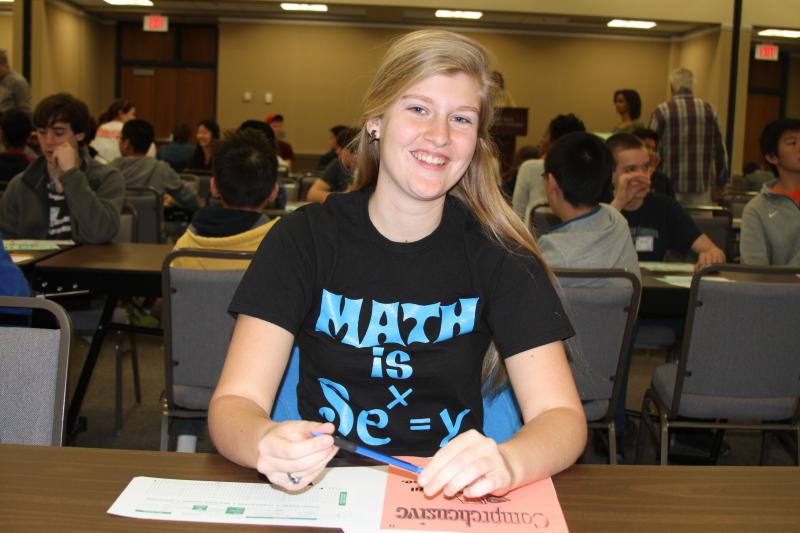
Mathcounts — Challenging Students to Achieve in Math!

Mathcounts
MATHCOUNTS is a national math coaching and competition program that promotes middle school mathematics achievement through grassroots involvement in every U.S. state and territory. The competition is designed for sixth, seventh, and eighth graders only. The subject matter includes geometry, combinatorics, counting, number theory, and algebra.

ED00027_[1]ED00277_[1]

MATHCOUNTS is one of the country’s largest and most successful education partnerships involving volunteers, educators, industry sponsors and students. President Barack Obama and former Presidents George W. Bush, Bill Clinton, George H. W. Bush, and Ronald Reagan have all recognized MATHCOUNTS in White House ceremonies. The MATHCOUNTS program has also received two White House citations as an outstanding private sector initiative.

presphoto1
President Barack Obama meets award recipients of the 2010 Mathcounts National Competition in the Oval Office Monday, June 28, 2010.

presphoto1
President George W. Bush meets award recipients of the 2005 Mathcounts National Competition in the Oval Office Thursday, May 12, 2005.

MATHCOUNTS promotes student interest in mathematics by making math achievement as challenging, exciting and prestigious as a school sport. At the beginning of each school year, the MATHCOUNTS Foundation provides a complimentary copy of its School Handbook and other materials to middle schools across the country. Teachers and volunteers use these materials to coach student “Mathletes,” as part of in-class instruction or as an extracurricular activity. After several months of coaching, participating schools select students to compete individually or as part of a team in one of the more than 500 written and oral competitions held nationwide and in U.S. schools overseas.

A school can register a maximum of one team of four students and six individuals; these 1-10 students will represent the school at the Chapter Competition. The first competitions are held at the local (chapter) level in February with winners progressing to state competitions in March. Results at the state level determine the top four individuals and top coach who earn the opportunity to represent their state or overseas team at the national finals. trip to represent their state at the national finals in May. At all levels, MATHCOUNTs challenges students’ math skills and rewards them for their achievements.

Click HERE to find out more about MathCounts!

MC1433Medal

Click the following articles to read more about math competitions:

3

The Redesigned SAT’s Math Test

The new SAT Math Test will test certain topics in math as well as your ability to use reasoning and critical thinking to solve real-world problems. These concepts and skills provide the foundations for the math you will learn in college and use in everyday life. The SAT groups these concepts into four major areas that you will see on the Math Test: Heart of Algebra, Problem Solving and Data Analysis, Passport to Advanced Math, and Additional Topics in Math.

sat_math_logo

Format of Math Test

The SAT Math Test includes two sections and a total of 58 questions. In the first math section calculators are not permitted, there are a total of 20 questions and you have 25 minutes to complete the no-calculator section. Here is a summary of the two sections:

Section Number of Questions Amount of Time Amount of Time Per Question
No-Calculator Section 20 questions 25 minutes 1.25 minutes
Calculator Section 38 questions 55 minutes 1.45 minutes

Topics

There are four main content areas covered by the Math Test. Here is a breakdown of the topics and number of questions in each content area:

Content Area Topics Covered Calculator Questions No-Calculator Questions
Heart of Algebra Fundamental concepts in algebra involving linear equations and inequalities 11 8
Problem Solving and Data Analysis Interpreting qualitative and quantitative data, analyzing relationships 17 0
Passport to Advanced Math More advanced concepts in algebra, including quadratic and higher-order equations 7 9
Additional Topics in Math Geometry, trigonometry, complex numbers 3 3

SAT-Math.png

Questions

Both sections on the Math Test will have two types of questions: multiple choice questions and student-produced responses. In total, you will see 45 multiple choice questions and 13 student-produced responses on the Math Test.

Each section will start with the multiple choice questions, then progress to the student-produced responses.

Within each section, the multiple choice questions will be ordered by difficulty, and so will the student-produced responses. For example, in the Calculator Section, you will see 30 multiple choice questions ordered from easy to difficult, then 8 student-produced responses ordered from easy to difficult. The No-Calculator Section has 15 multiple choice questions and 5 student-produced responses.

Some of the questions will include real-world contexts in areas such as science and social studies. These questions will require you to apply reasoning and critical thinking skills to analyze situations, create mathematical models, and find relevant solutions. You will also see graphs, charts, and diagrams in some of the problems and answer choices.

New SAT

TheNewSAT

redesigned_SAT

Online SAT Math 800 Tutoring and Coaching

Are you scoring in the 550-750 range on the SAT math section? Do you want to raise that score as high as possible — to a perfect 800?

Getting to an 800 SAT math score is not easy. It requires perfection, especially meticulous and careful calculating. But with hard work and our help, you will be able to do it. Most of our students scored 800 on the math section, and we know what it takes to get there.

SAT800

There is no room for error. Even one wrong answer or omitted question can drop you down to a 770 or worse. If you’re going for that 800, you must try every question and you must be reasonably certain that you got every question right.
Most people err in two ways:

  •  making mistakes (or getting tricked) on easy questions, and
  • not knowing how to approach the harder problems.

On the SAT, the difficulty level of each math problem is ranked 1 through 5, with 5 being the hardest. There are usually around 15 to 18 problems with difficulty level 4-5 on the entire test, and getting these questions right closes the gap between a 700 and a perfect score.

The best way to optimize your chances of a perfect score is to is to practice more and more difficult problems collected from the past real SAT exams. We have extracted a total of 1152 SAT math problems of difficulty level 4-5 from 72 full-length real SATs as described in our article: 72 Full-length Real SATs are a Golden Resource to Our SAT Prep Program, and have included these problems with their answers in a bundle entitled “Hard Real SAT Math Problems.” Click here to purchase it in our Bookstore. Working on these problems is perfect for advanced students to maximize their scores by zeroing in on the difficult problems on the SAT math section, and raise their scores to a 800.

Our philosophy is extremely different from most experts in that we concentrate on test specific strategy designed to save time, avoid carelessness, solve problems with difficulty level 4-5, and exploit the weaknesses of standardized tests, as opposed to spending valuable time on the conventional teaching of mathematics.

We will help you work on all real SAT math problems of difficulty level 4-5. This is the key to help you get a perfect score of 800 on the SAT math section. We will also help you develop quick problem solving strategies and effective time management skills. The timing of the SAT test is limited. In total, you will have 70 minutes to knock down 54 math problems – that leaves you with 1 minute and 17.7 seconds per math question on average (keep in mind that some questions will take less time and others will take more time). We will train you to be able to solve each math problem within one minute, even each hard problem.

SAT Prep Customization is the Key! We solve this problem with automatically customized online prep. Here’s how it works:

First, we assign you a diagnostic to figure out your exact level in over forty different SAT skills. Next, we create a week-by-week study plan customized specifically for you. By adapting content to your skill level, you always get questions and lessons that are the right level of challenging. Every part is designed to get you the biggest score improvement possible.

Our SAT prep classes/tutoring/coaching have been extremely effective in raising students’ math scores on the SAT, usually well over 150 points, and many of our students have received perfect scores. Read more: Notable Achievements of Our Students

Featured SAT Instructors

All of our sessions are taught by highly qualified instructors who are excellent experts on preparing students for the exam. We distinguish ourselves by the high quality of our instructors. Finding top-quality instructors is no easy task. We’ve hand-picked some of the best, including graduates of Ivy League institutions. Meet some of them here:

Registration and PAYMENT

Online Registration is now open! Click HERE to register and make payment.

1 Hour (including 2 real SAT packets extracted from the College Board; only math sections)

$120

Buy Now Button

5-Hour Package (including 12 real SAT packets extracted from the College Board; only math sections)

$550

Buy Now Button

10-Hour Package (including 30 real SAT packets extracted from the College Board; only math sections)

$1000

Buy Now Button

Click HERE to find out more about SAT Prep!

Hard Real SAT Math Problems

We have extracted a total of 1152 SAT math problems of difficulty level 4-5 from 72 full-length real SATs as described in our article: 72 Full-length Real SATs are a Golden Resource to Our SAT Prep Program, and have included these problems with their answer keys in a bundle entitled “Hard Real SAT Math Problems.” Click here to purchase it in our Bookstore. Working on these problems is perfect for ambitious students to maximize their scores by zeroing in on the difficult problems on the SAT Math Section, and aim for an 800.

body_youcandoit

We have a long history of close collaboration with the College Board and the Educational Testing Service. The 72 full-length real SATs have formed our “big data” system, a golden resource for our students, who are the ultimate beneficiaries. For all questions on the recent SAT tests, we can find their “ancestors” and “roots” from the old SAT problems. We have used data mining and predictive analytics to examine the types and the frequencies of questions in all these materials, and then completely “decoded” the SAT.

We are only one in the Washington DC metropolitan area who have a contract with the College Board to use all real questions from the past SAT tests in our SAT Prep program. Our students have gained great benefits from the program and received top scores on the SAT.

Our SAT prep classes/tutoring/coaching have been extremely effective in raising students’ math scores on the SAT, usually well over 150 points, and many of our students have received perfect scores. Please view here: Notable Achievements of Our Students

Bundle — Hard Real SAT Math Problems: $400.00
Buy Now Button

2015 Fall – Competitive Math Prep

BANNER_Top_Mathletics

  1. AMC 10/12 Prep (for 8th to 12th Graders) Fall Weekend Course

Purpose: To prepare for the AMC 10/12 A — Tuesday, February 2, 2016 and/or AMC 10/12 B — Wednesday, February 17, 2016

14 Weekends (Time: 6:00 – 8:00 pm):

Sept. 9/13, Sun 9/20, Sun 9/27, Sun
Oct. 10/4, Sun 10/11, Sun 10/18, Sun 10/25, Sun
Nov. 11/1, Sun 11/8, Sun 11/15, Sun 11/22, Sun 11/29, Sun, Thanksgiving— No Class
Dec. 12/6, Sun 12/13, Sun 12/20, Sun 12/27, Sun, Winter Break—No Class

View Course Outline

Tuition: $1120 (including all materials)

Online Registration is now open! Click HERE to register.

  1. AMC 8/Mathcounts Prep (for 5th to 8th Graders) Fall Weekend Course

Purpose: To prepare for the AMC 8 — Tuesday, November 17, 2015 and the 2016 Mathcounts

14 Weekends (Time: 6:00 – 8:00 pm):

Sept. 9/12, Sat 9/19, Sat 9/28, Sat
Oct. 10/3, Sat 10/10, Sat 10/17, Sat 10/24, Sat 10/31, Sat
Nov. 11/7, Sat 11/14, Sat 11/21, Sat 11/28, Sat, Thanksgiving— No Class
Dec. 12/5, Sat 12/12, Sat 12/19, Sat 12/26, Sat, Winter Break—No Class

View Course Outline

Tuition:
Option 1: $700 (including all materials)
Option 2: $840 (including all materials and an extensive correction of the incorrect answers of all homework) 

Online Registration is now open! Click HERE to register.

  1. Math Olympiad Prep (for 3rd to 5th Graders) Fall Weekend Course

Purpose: To prepare for the Math Olympiads for Elementary and Middle Schools (MOEMS) and Math Kangaroo

14 Weekends (Time: 3:30 – 5:30 pm):

Sept. 9/12, Sat 9/19, Sat 9/28, Sat
Oct. 10/3, Sat 10/10, Sat 10/17, Sat 10/24, Sat 10/31, Sat
Nov. 11/7, Sat 11/14, Sat 11/21, Sat 11/28, Sat, Thanksgiving— No Class
Dec. 12/5, Sat 12/12, Sat 12/19, Sat 12/26, Sat, Winter Break—No Class

View Course Outline

Tuition: $700 (including all materials)

Online Registration is now open! Click HERE to register.

  1. Self-studying for AMC 8/10/12 Contests

Even if you cannot attend our classes, you can purchase the official AMC materials from our bookstore and, using our solutions, self-learn/study the tricks, shortcuts, tips, and strategies to solve AMC problems as well as test-taking tactics. VIEW ALL OFFICIAL AMC MATERIALS

  1. Private and Semi-private Tutoring

(1)     One-on-One Private Individualized Coaching/Tutoring:                 $110/hour

  • 1-on-1 instruction
  • Completely personalized prep
  • Books and materials included
  • Only our best and most sought after tutors
  • Tutors with the skills and style to totally meet your needs
  • The freedom to meet when you want
  • A plan to help you get into your top-choice schools

(2)     One-on-Two Semi-Private Instruction:    $65/hour

  • Specialized 1-on-2 instruction
  • Books and materials included
  • Only our best and most sought after tutors
  • Individualized attention
  • Customizable schedules

Our Uniqueness

We have a long history of close collaboration with the MAA‘s American Mathematics Competitions (AMC), which are dedicated to strengthening the mathematical capabilities of our nation’s youth, and are the first of a series of competitions in high school mathematics that determine the United States team for the International Mathematical Olympiad (IMO). There are many math competitions in the United States. Of those, only AMC → AIME → USAMO sequence would take you to the IMO (International Math Olympiad), the highest level math competition for high school students in the world. We are only one in the Washington DC metropolitan area to offer elementary, middle, and high-school level competition math courses. Our students have received top scores and awards at prestigious national and math competitions. We have collected all AMC8/10/12 and AIME Official Problems and Official Solutions as shown in the article ” American Mathematics Competitions (AMC) Materials,” which have formed our “big data” system, a golden resource for our students, who are the ultimate beneficiaries.

 Featured Instructors

All of our sessions are taught by highly qualified instructors who are excellent experts on preparing students for the contests. We distinguish ourselves by the high quality of our instructors. Finding top-quality instructors is no easy task. We’ve hand-picked some of the best, including distinguished mathematicians. Meet some of them here:

Our Students

From 2011 to 2015, in total, 37 students scored above 120 on the American Mathematics Contest 10 (AMC 10) and qualified for the American Invitational Mathematics Examination (AIME); 26 students scored above 100 on the American Mathematics Contest 12 (AMC 12) and qualified for the American Invitational Mathematics Examination (AIME); 3 students qualified for the USA Mathematical Olympiad (USAMO), the highest level of math competition for high school students in the USA

Read more: Notable Achievements of Our Students

Great Benefits of Math Competitions

In an increasingly competitive college application pool, the process of mastering math skills through our courses and participating in the American Math Competitions will help students strengthen and diversify their extracurricular activities. These contests can motivate students’ interest and passion in math, and they can discover their talent through solving challenging problems different from those in the school classes. Many top colleges also request AMC scores as part of the college application process. Both MIT and Caltech have entry blanks on their official admission application forms for the applicant to enter their best AMC and AIME scores. Ivy League Colleges and Stanford ask for to the AMC and AIME scores in their Supplement to the Common Application Forms. Your children deserve the chance to list these scores on their applications! Good AMC scores will greatly enhance admission opportunities for students to elite colleges.

Read more:

Locations: 13902 Bromfield Road, Germantown, MD 20874 18206 Endora Cir, Germantown, MD 20841

Contact Information: Ivy League Education Center Tel:  301-922-9508     or        240-780-8828 Email:  chiefmathtutor@gmail.com

Click the following articles to read more about our competitive math prep courses:

education priceless treasure

3

4

AMC 10/12 Prep (for 8th to 12th Graders) Fall Weekend Course Starting Sept 13

logo_americanmath
Instructors:

14 Weekends (Time: 6:00 – 8:00 pm):

  1.       9/13
  2.       9/20
  3.       9/27
  4.       10/4  (Monthly Mock Test/Review)
  5.       10/11
  6.       10/18
  7.       10/25
  8.       11/1   (Monthly Mock Test/Review)
  9.       11/8
  10.       11/15
  11.       11/22  (Monthly Mock Test/Review)
  12.       11/29   Thanksgiving No Class
  13.       12/6
  14.       12/13
  15.       12/20 (Final Mock Exam/Review)
  16.       12/27 Winter Break—No Class

Tuition: $1120 (including all materials). We offer discounts of $40 for returning students.

Online Registration is now open! Click HERE to register.

Click HERE to view our Tuition Payment/Refund Policy.

A late fee of $50 will be added to the tuition for payment after the first class.

Locations:
13902 Bromfield Road, Germantown, MD 20874 (The class is FULL!)
18206 Endora Cir, Germantown, MD 20841 (A few spots are available!)

Contact Information: Ivy League Education Center
Tel:  301-922-9508     or        240-780-8828
Email:  chiefmathtutor@gmail.com

imagesFX9CEY3LPurpose: To prepare for the AMC 10/12 A — Tuesday, February 2, 2016 and/or AMC 10/12 B — Wednesday, February 17, 2016.

Specific Goal: To earn a score of 120 or more out of 150 on the American Mathematics Contest 10 (AMC 10), or a score of 100 or more out of 150 on the American Mathematics Contest 12 (AMC 12), and then qualify for the American Invitational Mathematics Examination (AIME), which is used to determine qualification for the United States of America Mathematical Olympiad (USAMO). There are many math competitions in the United States. Of those, only AMC → AIME → USAMO sequence would take you to the IMO (International Math Olympiad), the highest level math competition for high school students in the world.

math-olympiad-web

Who should take this class: This class is very appropriate for 8th-12th grade students who are hoping to qualify for the AIME.

Mock Tests: Four simulated tests help students assess their level of preparation for the Math Competitions. The test consists of 25 questions similar to AMC 10/12 level from the licensed AMC Database, and is intended to mimic an actual math competition exam. After attempting the test, students get answers, explanations, and a detailed score report and wise performance summary.

Weekly Homework: At least 3 hours per week. We will carefully review and check each student’s homework, and correct any mistakes. Based on his/her work, we will provide the student with individualized proposal and support.

The only way to learn mathematics is by doing mathematics. Homework assignments are a fundamental part of a mathematics course. Homework is also seen as a welcome challenge and an opportunity for further learning. Homework given prior to a lesson can aid in understanding later during class. Homework also provides opportunities for reinforcement of the material learned in class.

We have to face the simple truth that to do well on this grueling contest, we will need to practice. Just like it is for sports and music, the key to success is repetition and practice. We strongly believe in effort and the malleability of intelligence. Intelligence can be enhanced through effort. People can develop impressive levels of expertise through hard work and practice. Effort and persistence are the keys to success. Hard work always pays off. Practice makes perfect!

All problems from past AMC 10/12 exams (2000-2015) and AHSME (1973–1999) form our “big data” system. The AHSME (American High School Mathematics Examination) was the former name of the AMC, before 2000. We have used data mining and predictive analytics to examine the types and the frequencies of questions in all these materials, and then completely “decoded” the AMC 10/12. We will show all the “secret code” cracked from the above big data to students, and teach them to totally grasp and “control” the AMC. For all questions on the recent AMC contests, we can find their “ancestors” and “roots” from the old AMC problems. Therefore, the best way to prepare for the contest is to practice by solving old AMC problems.

Small-sized Class Teaching Model: We utilize the highly effective small-sized class teaching model. Smaller classes lead to pupils receiving more individual attention from teachers, and having more active interactions with them. We focus on every individual, not the whole class. Students will thrive from the smaller class sizes that allow them to reach their full potential. Particularly, students can benefit tremendously from high-frequent individualized student-teacher interactions leading to establishment of a stronger foundation for lifelong learning.

Benefits:

  • 14 tutorial handouts (>300 pages) developed by Dr. Henry Wan and 800 new problems similar to AMC 10/12 level from the licensed AMC Database
  • 4 FREE mock tests, each of which has 25 questions taken from the licensed AMC Database
  • Registration for free for the AMC 10/12 A — Tuesday, February 2, 2016 and/or AMC 10/12 B — Wednesday, February 17, 2016.

Course Description:

This course is designed to extend skills in problem solving and critical thinking, to foster mathematical creativity, and to introduce the fundamentals of proof. Students learn to think at an advanced level as they tackle challenging problems.

Topics addressed in this course will draw from: number theory, set theory, algebra, geometry, combinatorics, graph theory, and probability. The class will also discuss problems from all past AMC 10/12 exams (2000-2015), as well as efficient strategies for taking the test.

Each week, students explore a different math topic or problem-solving strategy in depth, and practice both non-routine and contest problems. In tackling non-routine problems whose solutions are not immediate, students are encouraged to approach problems from different angles. Additionally, they will learn to create inductive and deductive proofs, with a focus on the proper use of notation and terminology and precision in their writing. Our classroom provides interactive and team-building experiences for students.

Each topic covered in the course is independent of the other topics.  One topic is taught a week on a continuous repeating basis. Students will not necessarily start with “Topic 1” in their first week of enrollment.

Class Outline:

In AMC 10/12 Prep Class, we will focus on efficient tricks, shortcuts, and strategies to solve AMC problems as well as test-taking tactics.

AMC 10/12 Prep Class

Class Date Topic Homework Tutorial Handouts
1 9/13, Sun Polynomials and their zeros AMC 10/12 Problem Set on Polynomials and their zeros, Plus some new problems with a similar difficulty level from the licensed AMC Database Yes
2 9/20, Sun Exponentials and radicals AMC 10/12 Problem Set on Exponentials and radicals, Plus some new problems with a similar difficulty level from the licensed AMC Database Yes
3 9/27, Sun Defined functions and operations AMC 10/12 Problem Set on Defined functions and operations, Plus some new problems with a similar difficulty level from the licensed AMC Database Yes
4 10/4, Sun Inequalities: The AM-GM Inequality, Cauchy-Schwarz, and Chebyshev AMC 10/12 Problem Set on Inequalities, Plus some new problems with a similar difficulty level from the licensed AMC Database Yes
5 10/11, Sun Pigeonhole and Inclusion-Exclusion Principles AMC 10/12 Problem Set on Pigeonhole and Inclusion-Exclusion Principles, Plus some new problems with a similar difficulty level from the licensed AMC Database Yes
6 10/18, Sun Discrete counting and combinatorics AMC 10/12 Problem Set on Discrete counting and combinatorics, Plus some new problems with a similar difficulty level from the licensed AMC Database Yes
7 10/25, Sun Number theory: Fermat’s Little Theorem and Wilson Theorem AMC 10/12 Problem Set on Number theory, Plus some new problems with a similar difficulty level from the licensed AMC Database Yes
8 11/1, Sun Circle geometry AMC 10/12 Problem Set on Circle geometry, Plus some new problems with a similar difficulty level from the licensed AMC Database Yes
9 11/8, Sun Polygons AMC 10/12 Problem Set on Polygons, Plus some new problems with a similar difficulty level from the licensed AMC Database Yes
10 11/15, Sun Polyhedra, non-polyhedra, and solid geometry AMC 10/12 Problem Set on solid geometry, Plus some new problems with a similar difficulty level from the licensed AMC Database Yes
11 11/22 Sun Trigonometry AMC 10/12 Problem Set on Trigonometry, Plus some new problems with a similar difficulty level from the licensed AMC Database Yes
12 12/6 Sun Non-linear functions AMC 10/12 Problem Set on Non-linear functions, Plus some new problems with a similar difficulty level from the licensed AMC Database Yes
13 12/13, Sun Logarithms AMC 10/12 Problem Set on Logarithms, Plus some new problems with a similar difficulty level from the licensed AMC Database Yes
14 12/20, Sun Complex numbers AMC 10/12 Problem Set on Complex numbers, Plus some new problems with a similar difficulty level from the licensed AMC Database Yes

Our main purpose is to help our students gain deeper understanding of the fundamental math concepts, build a solid foundation in math, and develop the critical thinking and problem-solving skills that are so valuable to success in any career. We are big believers in the FUNDAMENTALS! Our students will receive the LIFELONG BENEFITS from learning math.

IMG_2563_0Regardless of his/her math level, each student will have the opportunity to learn math in a fun, friendly, cooperative, supportive learning environment. The most important thing is to have fun.

We are only one in the Washington DC metropolitan area to offer elementary, middle, and high-school level competition math courses. Our tutoring model is very unique. We ask that all students complete all the required problems at home, and then email their work to us before come to the class. We will carefully review and check the students’ work. Based on their work, we can detect what are the student’s specific weaknesses and use those problems in class to teach the students all the tricks, shortcuts, strategies, and tactics for taking the contest. The entire two hours are used for instructional teaching only. We firmly believe that learning is extremely important, and that a student should not waste time doing problems with our supervision if they can do those problems at home. So our 2-hour session is equivalent to a regular 4-hour session, and thus our hourly rate is equivalent to $20 per hour.

Click the following articles to read more about our competitive math prep courses:

AMC 8/Mathcounts Prep (for 5th to 8th Graders) Fall Weekend Course Starting Sept 12

BANNER_Top_MathleticsInstructors:

14 Weekends (Time: 6:00 – 8:00 pm):

  1.             9/12
  2.             9/19
  3.             9/26
  4.             10/3 (Monthly Mock Test/Review)
  5.             10/10
  6.             10/17
  7.             10/24
  8.             10/31 (Monthly Mock Test/Review)
  9.             11/7
  10.             11/14
  11.             11/21 (Monthly Mock Test/Review)
  12.             11/28   Thanksgiving No Class
  13.             12/5
  14.             12/12
  15.             12/19 (Final Mock Exam/Review)
  16.             12/26 Winter Break—No Class

Tuition:
Option 1: $700 (including all materials)
Option 2: $840 (including all materials and an extensive correction of the incorrect answers of all homework) 
America’s public school system has a major flaw: teachers grade homework for completion, rather than accuracy. They neglect to check their students’ daily progress through their homework, and lose the opportunity to correct their students’ mistakes. Our teaching style is unique in that we adamantly believe in the importance of checking and reviewing our students’ homework. By examining our students’ homework, we can assess their current levels of academic engagement and performance, and to identify their strengths and weaknesses. Additionally, our students can learn from their mistakes and ensure that these mistakes will not be repeated. No other tutoring center will provide such an emphasis on checking homework; this is merely one of the unique aspects of our education service.

We offer discounts of $30 for returning students.

Online Registration is now open! Click HERE to register.

Click HERE to view our Tuition Payment/Refund Policy.

Locations:
13902 Bromfield Road, Germantown, MD 20874 (The class is FULL!)
18206 Endora Cir, Germantown, MD 20841 (A few spots are available!)

Contact Information: Ivy League Education Center
Tel:  301-922-9508     or        240-780-8828
Email:  chiefmathtutor@gmail.com

Purpose: To prepare for the AMC 8 — Tuesday, November 17, 2015 and the 2016 Mathcounts

Description: Our curriculum focuses on advancing the mathematical skills of 5th-8th graders to prepare them for the AMC 8/MathCounts Contest. A variety of AMC 8/MathCounts Contest questions are used to teach students strategies to solve problems and help students prepare for the competitions. These problems stimulate their interest and enthusiasm for critical thinking and problem solving, broaden their mathematical intuition, and develop their brainpower. The topics taught in this class are not covered in regular school math classes, allowing our students to stay one step ahead.

Benefits:

  • 14 tutorial handouts (300 pages) developed by Dr. Henry Wan and 800 new problems similar to AMC 8 level from the licensed AMC Database
  • 4 FREE mock tests, each of which has 25 questions taken from the licensed AMC Database
  • Registration for free for the AMC 8 Contest on Tuesday, November 17, 2015. 

Grade Levels: Grades 5-8

Class Outline: In AMC 8/Mathcounts Prep Class, we will focus on efficient tricks, shortcuts, and strategies to solve competitive math problems as well as test-taking tactics. The emphasis of this class will be on problem-solving in fundamental discrete math which is the most important to competitive math.

Class Date Topic Homework Tutorial Handouts
1 9/12, Sat Arithmetic Sequences AMC 8/Mathcounts Problem Set on Arithmetic Sequences, Plus some new problems from the licensed AMC Database Yes
2 9/19, Sat Geometric Sequences AMC 8 Problem Set on Geometric Sequences, Plus some new problems from the licensed AMC Database Yes
3 9/26, Sat Consecutive Integers AMC 8/Mathcounts Problem Set on Consecutive Integers, Plus some new problems from the licensed AMC Database Yes
4 10/3, Sat Fibonacci and the Golden Ratio AMC 8/Mathcounts Problem Set on Fibonacci and the Golden Ratio, Plus some new problems from the licensed AMC Database Yes
5 10/10, Sat Factors and Primes AMC 8/Mathcounts Problem Set on Factors and Primes, Plus some new problems from the licensed AMC Database Yes
6 10/17, Sat Algebraic Approaches AMC 8/Mathcounts Problem Set on Algebraic Approaches, Plus some new problems from the licensed AMC Database Yes
7 10/24, Sat Statistics and Probability AMC 8/Mathcounts Problem Set on Statistics and Probability, Plus some new problems from the licensed AMC Database Yes
8 10/31, Sat Graph Theory AMC 8/Mathcounts Problem Set on Graph Theory, Plus some new problems from the licensed AMC Database Yes
9 11/7, Sat Combinatorics AMC 8/Mathcounts Problem Set on Combinatorics, Plus some new problems from the licensed AMC Database Yes
10 11/14, Sat Relations and Functions AMC 8/Mathcounts Problem Set on Relations and Functions, Plus some new problems from the licensed AMC Database Yes
11 11/21, Sat Coordinate Geometry AMC 8/Mathcounts Problem Set on Coordinate Geometry, Plus some new problems from the licensed AMC Database Yes
12 12/5, Sat Circle Geometry AMC 8/Mathcounts Problem Set on Circle Geometry, Plus some new problems from the licensed AMC Database Yes
13 12/12, Sat Triangle Geometry AMC 8/Mathcounts Problem Set on Triangle Geometry, Plus some new problems from the licensed AMC Database Yes
14 12/19, Sat Spatial Visualization, Origami, and 3-D Geometry AMC 8/Mathcounts Problem Set on Spatial Visualization, Origami, and 3-D Geometry, Plus some new problems from the licensed AMC Database Yes

 Mock Test: Four simulated tests will help students assess their level of preparation for the Math Competitions. The test consists of 25 questions similar to AMC 8/MathCounts level from the licensed AMC Database, and is intended to mimic an actual math competition exam. After attempting the test, students get answers, explanations, and a detailed score report and wise performance summary.

Homework: On average, at least 2 hours per week. For those students choosing Option 2, we will carefully review and check their homework, and correct any mistakes. Based on his/her work, we will provide the student with individualized proposal and support.

The only way to learn mathematics is by doing mathematics. Homework assignments are a fundamental part of a mathematics course. Homework is also seen as a welcome challenge and an opportunity for further learning. Homework given prior to a lesson can aid in understanding later during class. Homework also provides opportunities for reinforcement of the material learned in class.

We have to face the simple truth that to do well on these grueling contests, we will need to practice. Just like it is for sports and music, the key to success is repetition and practice. We strongly believe in effort and the malleability of intelligence. Intelligence can be enhanced through effort. People can develop impressive levels of expertise through hard work and practice. Effort and persistence are the keys to success. Hard work always pays off: practice makes perfect!

All problems from past AMC 8 exams (1985-2014) and MathCounts (1990–2015) form our “big data” system. We have used data mining and predictive analytics to examine the types and the frequencies of questions in all these materials, and then completely “decoded” the AMC 8 and MathCounts. We will show all the “secret code” cracked from the above big data to students, and teach them to totally grasp and “control” the AMC and MathCounts. For all questions on the recent AMC/MathCounts contests, we can find their “ancestors” and “roots” from the old AMC/MathCounts problems. Therefore, the best way to prepare for the contest is to practice by solving old AMC/MathCounts problems.

Small-sized Class Teaching Model: We utilize the highly effective small-sized class teaching model. Smaller classes lead to pupils receiving more individual attention from teachers, and having more active interactions with them. We focus on every individual, not the whole class. Students will thrive from the smaller class sizes that allow them to reach their full potential. Particularly, students can benefit tremendously from high-frequent individualized student-teacher interactions leading to establishment of a stronger foundation for lifelong learning.

Main Purpose: Our main purpose is to help our students gain deeper understanding of the fundamental math concepts, build a solid foundation in math, and develop the critical thinking and problem-solving skills that are so valuable to success in any career. We are big believers in the FUNDAMENTALS! Our students will receive the LIFELONG BENEFITS from learning math.

Regardless of his/her math level, each student will have the opportunity to learn math in a fun, friendly, cooperative, supportive learning environment. The most important thing is to have fun.

We are only one in the Washington DC metropolitan area to offer elementary, middle, and high-school level competition math courses. Our tutoring model is very unique. We ask that all students complete all the required problems at home, and then email their work to us before come to the class. We will carefully review and check the students’ work. Based on their work, we can detect what are the student’s specific weaknesses and use those problems in class to teach the students all the tricks, shortcuts, strategies, and tactics for taking the contest. The entire two hours are used for instructional teaching only. We firmly believe that learning is extremely important, and that a student should not waste time doing problems with our supervision if they can do those problems at home. So our 2-hour session is equivalent to a regular 4-hour session, and thus our hourly rate is equivalent to $12.5 per hour.

Click the following articles to read more about our competitive math prep courses:


education priceless treasure34

Math Olympiad Prep (for 3rd to 5th Graders) Fall Weekend Course Starting Sept 12

BANNER_Top_MathleticsInstructors:

14 Weekends (Time: 3:30 – 5:30 pm):

  1. 9/12
  2. 9/19
  3. 9/26
  4. 10/3 (Monthly Mock Test/Review)
  5. 10/10
  6. 10/17
  7. 10/24
  8. 10/31 (Monthly Mock Test/Review)
  9. 11/7
  10. 11/14
  11. 11/21 (Monthly Mock Test/Review)
  12. 11/28   Thanksgiving No Class
  13. 12/5
  14. 12/12
  15. 12/19 (Final Mock Exam/Review)
  16. 12/26 Winter Break—No Class

Tuition: $700 (including all materials)

Online Registration is now open! Click HERE to register.

Locations:
13902 Bromfield Road, Germantown, MD 20874
18206 Endora Cir, Germantown, MD 20841

Contact Information:
Ivy League Education Center
Tel:  301-922-9508     or        240-780-8828
Email:  chiefmathtutor@gmail.com

Purpose: To prepare for the Math Olympiads for Elementary and Middle Schools (MOEMS) and Math Kangaroo

Description:
This Math Olympiad Prep course is designed to teach the major strategies of problem solving, to foster mathematical creativity, and to stimulate enthusiasm and love for the types of problems that students encounter in competitive mathematics. Each class students explore a different math topic or problem-solving strategy in depth and practice non-routine contest problems. This course provides interactive experiences for students. Students and instructors work on problem solving, clarification of concepts, and group sessions.

The main feature of this course is the use of the concrete → pictorial → abstract approach. This method enables us to introduce simple algebra and geometry as early as in third grade and encourages active thinking processes, communication of mathematical ideas, and problem solving. The emphasis is placed on development and complete understanding of mathematical concepts and their interesting applications, as well as on proficiency in multi-step problem solving, non-routine approach, mathematical reasoning, higher order thinking, and creative thinking.

Grade Levels: Grades 3-5

Class Outline:

In Math Olympiad Prep Class, we will focus on efficient tricks, shortcuts, and strategies to solve competitive math problems as well as test-taking tactics.

Class Date Topic
1 9/12, Sat Mental Math — Best techniques to count faster in your head. Students will learn arithmetical calculations using only the human brain, with no help from calculators, computers, or pen and paper.
2 9/19, Sat Drawing a Picture or Diagram: Both theoretical and applied problems will be used to show how a sketch helps to make sense of and model a problem.
3 9/26, Sat Using Deduction: Students will apply principles of logic to solve classic riddles, such as those involving colored hats and identity of the truth-teller, in addition to non-routine math problems.
4 10/3, Sat Simplification: Students will learn techniques for decreasing the number and complexity of calculations for simplifying problems involving whole number operations, complex fractions, factorials, and exponents.
5 10/10, Sat Finding a Pattern: Students will investigate patterns involving time, additive number sequences, and repeated multiplication.
6 10/17, Sat Making a List: This topic expands on strategies for making lists for counting and arrangements, along with divisibility and remainders, laying a solid foundation for later work with more formal concepts in modular arithmetic, number theory and combinatorics.
7 10/24, Sat Making an Organized Table: Students use tables to compare unknown quantities in an organized way to test possible solutions, which serves as a basis for more algebraic methods in subsequent coursework.
8 10/31, Sat Using Number Operations: Students will broaden their understanding of number operations and factors as they apply methods to solve for unknown digits and complete magic squares.
9 11/7, Sat Working Backwards: This topic exposes students to various situations for which beginning at a given result and working backwards is the best strategy.
10 11/14, Sat Estimation and Elimination: Strong estimation skills are often required in making sense of problems and checking reasonableness of solutions. In this topic, students apply their number sense to make estimates as they narrow the number of possible solutions to problems involving exponents, divisibility, and remainders.
11 11/21, Sat Number Sense: Students will learn number meaning, number relationships, number magnitude, operations involving numbers and referents for numbers and quantities. These skills are considered important because they contribute to general intuitions about numbers and lay the foundation for more advanced skills.
12 12/5, Sat Elementary Number Theory: Prime numbers, factorization, greatest common factor, and least common multiple will be introduced and explored in ways that build stronger number theoretic foundation.
13 12/12, Sat Basic Algebraic Processes: Students will learn writing and using simple formulas, rules for writing algebra, and solving simple equations.
14 12/19, Sat Basic Processes of Geometry: Students will learn constructions. A construction is a method of creating a geometric object (such as a triangle) using a set of tools. In the case of this book, the tools we will be using are a compass and a ruler. The constructions are useful for letting the child experience geometric ideas and get visual results.

Our class will mainly focus on preparing for the following prestigious national elementary school mathematics competitions

  • Math Olympiads for Elementary and Middle Schools (MOEMS): This is a large and popular mathematics competition for students in grades 4 through 8. The goal of MOEMS is to expose students to elementary methods of mathematical problem solving.
  • Math Kangaroo in USA: This is the world’s largest mathematics competition with students in grades 2-12 competing from many nations around the world.
  • Math League: This is a well-known mathematics competition for elementary, middle, and high school students in the United States.
  • Continental Mathematics League (CML): This is an important mathematics contest for students in grades 2 through 12.

Click the following articles to read more about our competitive math prep courses:

PSAT Changes: Structure and Timing, Schedule, Scoring, National Merit Scholarship

slide_5Not only is the content of the PSAT changing in 2015 to align with the new SAT, there will be important structural changes, too, as compared in the following table. The most significant change, from the student’s perspective, is that the length of the test is increasing by more than 25% to 2 hours and 45 minutes. The time allotted per question is increasing, but it remains to be seen whether that will actually translate into a test that feels less fast-paced. This is because, by all accounts, the amount of text students must digest before answering the questions is expected to increase.
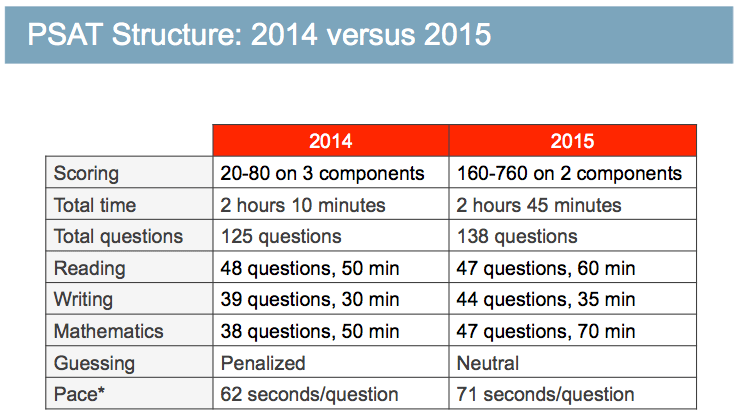
PSAT 2014 Versus Redesigned PSAT v2

Historically, the PSAT was offered on both a Wednesday and a Saturday in October, with each high school deciding between one of two national test dates. In this transition year, the College Board has decided not to offer a Saturday PSAT date. The recommended 2015 PSAT will be Wednesday, October 14, with schools having the option to offer the test on an alternate date of October 28. A Saturday alternative is expected to return in 2016. PSAT score release may slide to Jan 2016, but they are still hoping Dec 2015 might be possible.

11th graders will have only the October option for the PSAT, but starting in 2016 schools will have the option to administer a spring PSAT to their 10th graders. Dubbed the “PSAT 10,” this test will be identical in structure and scoring to the October PSAT/NMSQT (National Merit Scholarship Qualifying Test). Schools will have a multi-week window in the spring when they may choose to offer this test, and it is believed that schools who favor a spring-to-spring slate of assessments will opt for this timing.

With so much else changing, why not change the PSAT scale as well? As of October 2015, PSAT/NMSQT and PSAT 10 scores will be reported on a 160-760 scale for each of two components: Math and Evidence Based Reading & Writing. This normed-for-10th-grade scale is expected to play nicely with the 200-800 scale for the SAT. Younger students whose schools decide to offer the new “PSAT 8/9” to 8th and 9th graders will receive scores on a scale from 120-720. This “vertical scaling” allows educators to track student progress over time using a consistent scale. And, in case you missed it, the maximum total SAT score will once again be 1600. 2400 is dead, because Critical Reading and Writing are no longer scored separately.

We have established that the current SAT will suffice as a “confirming” score for National Merit Scholarship standing for those students who score in the 99th percentile on the new PSAT. Top scorers will not be forced to take the new SAT if they have already done well on the current SAT.

We welcome questions and feedback about any of the information discussed above. Meanwhile, we will keep our ear to the ground and will continue evaluating and reporting what we hear. The current 11th graders in the class of 2016 are forgiven for feeling relieved and fortunate that they will emerge from the college admission testing gauntlet without having had to cope with this rather chaotic period of change. 10th graders: hang on for the ride!

psat-scholarship

psat

PSAT-NMSQT

SAT Essay Scoring and Feedback

Click HERE to find out a complete list of real SAT essay prompts (March 2005 – June 2015), provided by the College Board. You can use these prompts for practice.

The essay on the writing section of the SAT is the most difficult part to prepare for because neither books nor most SAT prep courses provide students with what they most need to improve: individualized feedback on their own SAT practice essays from highly professional and well experienced writing instructors who are also official College Board SAT Essay Readers. Our SAT Essay Scoring and Feedback service is completely different from computer-based artificial intelligence scoring systems, which provide overly general feedback to pre-programmed essay prompts. We help students understand their own unique strengths and weaknesses and the different steps they need to take to boost their essay scores using specific examples from, and suggested corrections to, students’ own essays.

Each essay is independently and carefully scored by two SAT Essay Readers on a scale from 1 to 6, according to the College Board’s SAT Essay Scoring Guide. These readers’ scores are combined to produce the 2-12 scale. Note that the two readers are randomly selected from a pool of 39 Official College Board SAT Essay Readers, who have extensive experience scoring SAT essays.

We provide the following two types of score reports within 3 business days of essay submission.

1. Basic Score Report:

The report contains an overall score as well as separate sub-scores for the different skill areas assessed, including thesis and support, reasoning and analysis, structure and organization, and use of language.

Click HERE to view a sample of the report.
$20.
Buy Now Button

2. Comprehensive Individualized Score Report:

The report includes everything in the basic report above, plus individualized, comprehensive comments made by one of the two SAT Essay Readers, regarding the different skill areas assessed, such as: thesis and support, reasoning and analysis, structure and organization, and use of language.

SAT Essay Score Report-Sample1
Sample SAT Essay Score Report
Page 1
Click on image to view larger

SAT Essay Score Report-Sample2
Sample SAT Essay Score Report
Page 2
Click on image to view larger

SAT Essay Score Report-Sample3
Sample SAT Essay Score Report
Page 3
Click on image to view larger
$40.
Buy Now Button

Submission Guidelines:

  • Email your SAT essay question and completed response as an attachment to ivymocktest@gmail.com with the Order ID # in the subject line of the email. You can find the Order ID # in the receipt that will be emailed to you after your order is submitted.
  • Essay Prompt must be an official College Board SAT Essay Prompt. Essay questions and responses should be typed and submitted utilizing Microsoft Word in either a .doc or .docx format.
  • SAT essay responses are expected to be completed in 25 minutes and generally do not exceed 500 words. We will not comment on/respond to content that exceeds 500 words.

Please view: Notable Achievements of Our Students

Click HERE to find out more about SAT Prep!