有趣的数学,趣味究竟藏在哪里?

前文我们曾分享过应如何欣赏数学之美,又应如何感受数学之真。这些或许都需要你走进数学的世界,真正了解它,方可达成。但数学的趣味,却更直白!简单的一组数字、隐藏背后的性质,甚至是看起来毫无关联、实则关系颇深的“隐秘关系”,都会让你觉得数学是如此有趣!
撰文 | 袁亚湘
让我们回到数学的又一个关键词——有趣。
著名数学家陈省身曾说过:“数学好玩,玩好数学”。微分几何中有“高斯-博内-陈公式”、“陈示性类”、“陈-西蒙理论”等,由此可见他在微分几何学中的大师级地位。那么,数学究竟有哪些好玩之处呢?

陈省身(1911-2004)

首先,数本身就很好玩。在小学,小朋友们在认识数之后很快就会了解到很多有趣的数列,如等差数列、等比数列、斐波那契数列等等。等差数列和等比数列的每项计算和若干项求和都有简单的公式。斐波那契数列 {1,1,2,3,5,8,13,21,……} 是意大利数学家斐波那契在研究兔子繁殖的数目增长规律时发现的。
他在1202年出版的《算书》中提出了如下问题:假定每对兔子在出生两个月以后的每个月都会生出一对新的兔子,请问从一对兔子开始,一年后共有多少对兔子?研究每个月的兔子数目就可导出斐波那契数列,该数列的第1、第2项都是1,数列中的其它项都是该项之前的两项数字之和。斐波那契数列有很多有趣的性质,其中之一是它前后相邻两项的比值逐渐近似于黄金分割比例。《算书》把印度-阿拉伯计数法引进了欧洲,书中还包括了不少贸易和货币兑换的相关内容。

斐波那契(1170-1250)

若干个数以特定的方式排列可以组成一个方阵。我国在远古时代就有了著名的河图洛书。洛书是把1到9排成一个3乘3的方阵,横的每行、竖的每列三个数加起来都是15,而且每条对角线的三个数加起来也是15。类似地,我们可以用1到16排成一个四阶的方阵,使每条线上加起来都是34。

在乘法法则中,关于倍数和约数也有许多有趣的现象。例如:如果一个数是3的倍数,那么它的各位数之和也会是3的倍数;一个数是9的倍数,它的各位数之和也是9的倍数。
有些乘法还有速算方式,比如:一个数加1乘以这个数减1等于该数的平方减去1;个位是5的两位数的平方就是把其十位上的数字乘以它自己加1,再在后面补上25即可得到答案,譬如45的平方是2025、75的平方是5625。
只用到简单的加减乘除四则运算,我们就可以得到一些有趣的数字谜题。举个例子:任给一个正整数,如果是奇数就乘3加1,如果是偶数就除以2,一直做下去,这个数最终一定会变成1。如果从7开始,我们就会得到22,11,34,17,52,26,13,40,20,10,5,16,8,4,2,1。这个有趣的问题通常被称为“3X+1猜想”,该猜想在西方有很多不同的名字,其中之一是科拉兹猜想,而在东方它常常被称为角谷猜想。这是因为有人认为德国数学家科拉兹是最早研究这个问题的科学家,而日本数学家角谷是把该问题带到东方的学者。这个猜想虽然至今还没有被证明,但大家普遍认为其结论是正确的。事实上,有人用计算机验算过,“3X+1猜想”从1开始一直到20×258都是对的。

科拉兹(1910-1990)与角谷静夫(1911-2004)

还有一些数自身具有特殊的性质。一个数,如果它是三个边长都为有理数的直角三角形的面积,我们就称其为“同余数”。从下图可以看出5,6,7是同余数,而费马最早证明1,2,3不是同余数。

如果一个数等于除了它自身之外所有的约数之和,我们就它称为“完全数”。6就是个完全数,除了它自身,6的约数有1、2和3,且 6=1+2+3。同样地,28=1+2+4+7+14也是一个完全数。不难验证,496,8126,33550336也都是完全数。
与完全数相关的概念是“亲和数”。给定两个数A和B,如果A除了本身之外的所有约数之和等于B,并且反过来B除了本身之外的所有约数之和等于A,我们就称A和B是一对亲和数。例如:220除了本身之外的约数是1、2、4、5、11、20、22、44、55、110,它们之和是284,而284除了自身之外的约数是1、2、4、71、142,它们加和恰好是220。因此220和284是一对亲和数,它们最早由毕达哥拉斯发现。之后,费马发现了亲和数17298和18416,笛卡尔发现了亲和数9363584和9437056。其它已知的亲和数还有:1184和1210,2620和2924,5020和5564,6232和6368……借助计算机,目前科学家已经找到了数千对亲和数。
上述完全数和亲和数都是针对于合数,而素数本身就有许多奇妙的规律。如果一个大于1的自然数,除了1和它本身外没有其他约数,我们就称这个数是素数,也称为质数。最小的十个素数依次是2,3,5,7,11,13,17,19,23,29。欧几里得在《几何原本》中就素数做了一些讨论,并给出了“有无限多个素数”的论断。这个结论很容易证明。假定素数只有有限多个:2,3,5,…,p,其中p是最大的素数。我们把所有的素数乘起来再加1,即定义N=2×3×5×…×p+1。显然N的约数只有1和N本身,故知N(>p)也是一个素数,这与p是最大的素数相矛盾,假设不成立!因此素数一定有无限多个。
关于素数有许多神奇而有趣的现象,前面提到的哥德巴赫猜想就和素数相关。关于素数的另一个著名的猜想是孪生素数猜想,该猜想认为:存在无穷多对孪生素数对。这一猜想是1949年由法国数学家波利尼亚克提出的。孪生素数对指的是挨在一起(相差为2)的两个素数,例如3和5、5和7、11和13、17和19都是孪生素数对。数学家发现,当数字越大时,素数就越稀少,想要找到孪生素数对就越困难。但孪生素数猜想却认为存在无穷多组孪生素数对,也就是说,给定一个任意大的有限数,总能找到比它更大的孪生素数对。仔细想想,这个猜想颇有点玄幻的味道。遗憾的是,这个猜想至今还未被完全证明。
 

波利尼亚克(1826-1863)和一些孪生素数对,你能证明/证伪这个猜想么?

2013年,华人数学家张益唐在孪生素数猜想问题上取得了历史性的突破。他证明了存在无穷多个素数对,其中每对素数之差小于7000万。继而经过诸多数学家的努力,7000万这个差值界已经降到了200多。而孪生素数猜想中素数对的差值是2。

张益唐(1955-)

“数学是科学的皇后”,大多数人都知道这句德国数学家高斯的名言。其实这句话的后面还有一句:“数论是皇后的皇冠”。高斯被称为数学王子,他本人在数学,包括数论的许多方面做出了卓然的贡献,他还证明了代数基本定理,是非欧几何的发明人之一。数学中许多定理和方法以他命名,如高斯最小二乘法、高斯-博内定理、高斯正态分布、高斯积分公式、高斯二项式定理等等。
多元一次方程的消元解法在我国古书《九章算术》中就早有记载,在西方也被称为高斯消去法。高斯出生于贫苦人家,小时候家境不好。他父亲是个烧砖工人,不让高斯上学,希望高斯长大后继续烧砖的工作。在舅舅的劝说和母亲的坚持下,高斯直到7岁才开始上学。一上学高斯就展露了他的数学天赋。一个广为人知的故事是高斯9岁就自己推导出了特殊等差数列的求和公式1+2+…+N=(N+1)N/2。大学时,高斯给出了正十七边形的尺规作图法,24岁即出版了学术专著《算术研究》。该书至今仍是数论方面最重要的著作之一。高斯从30岁开始担任哥廷根大学的教授和天文台台长,直到他去世。

前西德货币上的高斯(1777-1855)

数学中有一些出名的常数,它们的性质和特点也十分神奇。前面我们已经详细地介绍了圆周率和黄金分割比例。这里还想介绍自然对数的底数,也即著名的欧拉常数

另一个与欧拉相关的常数是欧拉-马歇罗尼常数γ :

还有一个特别的常数是拉马努金常数,该常数利用三个无理数e、π和163开平方所生成,但它竟然与一个整数之间的误差小于10-12

印度传奇数学家拉马努金具有极高数学天赋和直觉,他发现了许多神奇的、出人意料的数学公式和定理。关于他本人也有许多有意思的小故事。其中一个故事讲到拉马努金病重,哈代前往探望。哈代对他说:“我坐出租车来,车牌号码是1729,这个数真无趣,希望不是不祥之兆。”拉马努金回答道:“不,恰恰相反,这是个非常有趣的数。它能表示为两种两个正整数的立方和(1729 = 1³+12³= 9³+10³)。在所有满足这种条件的数中,1729是最小的。”

拉马努金(1887-1920)与哈代(1877-1947)

数学中还有很多有趣的定理和公式。比如数学分析中有不同形式的中值定理以及格林公式、斯托克斯公式等等。以斯托克斯公式为例,它描述的是一个集合内的积分可以转换为该集合边界上的积分。斯托克斯是英国数学家、物理学家,他在流体力学的数学理论方面做出了奠基性的工作。数学千禧年七大难题之一是关于NS方程的解的问题。其中的NS方程就是以他和法国数学家纳维命名的。

斯托克斯(1819-1903)

在复变函数中,一个有趣的结论是解析函数两点之间沿着不同路径的曲线积分都相等,这是著名的柯西定理。柯西是法国数学家和物理学家,他提出了极限的定义方法、为微积分的严格化做出了至关重要的贡献,数学中许多结果以他的名字命名,如柯西不等式、柯西公式、柯西留数定理等。当前人工智能、机器学习中广泛使用的梯度方法也是由柯西提出的最速下降方法发展而来的。

柯西(1789-1857)

数学中很多变换也相当有意思,通过这些变换我们可以把一个函数变成看似与它自身迥异的函数。比较出名的变换有傅里叶变换、拉普拉斯变换、小波变换等。不过可不要小瞧这些变换,它们在其他科学与工程领域往往起着关键性的作用。例如:傅里叶变换在信号处理、图像处理等方面有广泛应用。在数学上,傅里叶变换是将一个函数转换为一系列周期函数来处理。从物理的角度理解,傅里叶变换的本质是将信号或图像从时间/空间域转换到频率域,其逆变换是从频域转换到时间/空间域。傅里叶是法国数学家、物理学家,他在热传导方面给出了最基本的数学理论,推动了微分方程边值问题的研究。他的名字在数学界也值得人们铭记,因为傅里叶级数、傅里叶积分、傅里叶变换、傅里叶分析等等数学概念都是冠他之名。

当然,提到有趣的数学怎么会少了几何学呢?在中学,即便不喜欢数学的学生也会觉得不少几何题目趣味性非常强。关于几何学的一个真实的故事发生在2002年北京的国际数学家大会上,会上有个有趣的问题:任给一个五角星,对每个角上的三角形作外接圆,证明这个五个外接圆的交点共圆。据说,在场的世界最著名的数学家们无一能立即给出证明过程(看来,做中学数学题目还数中学的数学老师厉害)。传说,当时的大会主席吴文俊先生会后通过数学机械化方法利用计算机证明了该命题。

吴文俊是我国著名数学家,他在拓扑学方面做出了奠基性的工作,其研究成果被称为“吴公式”“吴示性类”“吴示嵌类”等。他通过汲取中国古代数学的精髓,尝试用计算机证明几何定理,开创了数学机械化的道路。他发明的数学机械化方法在国际上被誉为“吴方法”。该方法推动了自动推理的发展。吴先生还曾获得过国家最高科学技术奖。

吴文俊(1919-2017)与《几何定理机器证明的基本原理》

上面的小故事是关于平面几何的。在立体几何中,则充满了更多的奥秘。例如:正多面体是指一种特殊的凸多面体,它的每个面都是有相同边数的正多边形、每个顶点都是有相同棱数的端点。正多面体只有正四面、正六面、正八面、正十二面、正二十面体。可以证明,其它面数的正多面体是不存在的。 

在三维空间的二维曲面,比如一张纸,具有正面与反面两个面。如果在正面有一只蚂蚁,只要它不从边界上翻到另外一面,它就永远在正面而爬不到反面。德国数学家、拓扑学的先驱莫比乌斯构造出了一个神奇的拓扑形状,他把一根纸条扭转了180°后再将两头拼接起来,就得到了著名的莫比乌斯带(环)。莫比乌斯带的神奇之处在于,它只有一个面。当一只蚂蚁从这个纸带的任意地方出发,沿着纸带的方向爬行,即可遍历这条纸带原先的两面。

莫比乌斯(1790-1868)与莫比乌斯带

神奇有趣的莫比乌斯带没有正反面之分,与之类似的是没有内外部之分的克莱因瓶。克莱因瓶可以看作是莫比乌斯带从二维到三维的延拓。

克莱因瓶

概率论是数学的一个分支,其中有趣的故事也数不胜数。最常见的与概率有关的事件是投硬币,硬币正面朝上和正面朝下的概率都是50%。投硬币的一个有趣题目是:连续投硬币直到连续出现N次正面朝上就停止,问投硬币次数的期望值是多少?答案是2N+1-2 , 这个神奇的答案其实有非常巧妙的简单推导方法。
美国电影《玩转21点》中有个经典场景:三扇门后面分别是一辆价格不菲的汽车和两头羊。男主角的任务是挑中汽车所在的门。他任意指认了一扇后,教授(知道哪扇门后有车)打开了另一扇门,后面是羊。请问男主角是否应该换成指认第三扇门?这个故事其实是受到了美国作家斯托克顿的短篇小说《美女还是老虎?》的启发。该小说中,一个远古的野蛮国王有一种非常离奇的判罚犯人的做法:把罪犯送进斗兽场,要求他从两扇一样的门中选择一扇打开,其中一扇门后站着一个美丽的少女,而另一扇门后关着一只凶猛的老虎。如果罪犯选中老虎,他会成为老虎的盘中餐,这就是对他犯罪的处罚;如果罪犯选中美女,他就会被判无罪,不仅马上获释,还可以抱得美人归。
小说中的罪犯挑得美女的机会是1/2,但电影中的男主角在最开始挑中汽车的概率却只有1/3。让我们回到电影中三扇门的问题,男主角正确的选择应该是换一扇门。如果不换,他能得到汽车的概率依然是前面分析的1/3;而如果他选择更换,由于教授给出的额外信息,他得到汽车的概率就增加到了2/3!

斯托克顿(1834-1902)

另一个和概率有关的神奇问题是布丰投针问题。布丰是法国数学家、自然学家,但他在大学时修的却是法律。他考虑了一个投针的实验:在平面上画一些距离为d的平行线,向此平面随机投掷长度为 L(L<d) 的针,则针与平行线相交的概率为 2L/dπ。看似与圆周率毫无关系的实验却得到了一个与有关的结果,让人感觉到数学“处处有惊喜”。这个有趣的结果是能够用数学严格证明的。通过这种思路,人们可以运用蒙特卡洛计算机模拟的方式来近似计算的值。 

布丰(1708-1788)与投针问题

极限也是数学中很有趣的概念。它的存在解释了很多所谓的“悖论”。早在战国时期,庄子就在他的著作《庄子•天下》中提到“一尺之捶,日取其半,万世不竭”。意思是取一尺长的木杆,每天截去当时长度的一半,如此往复可以永远截取下去。了解极限概念的人自然知道这在现实中是个悖论。学过高等数学的大学生应该都曾做过不少有意思的计算极限的题目。在计算极限时,洛必达法则大概是运用最多的定理之一。洛必达法则告诉我们:如果两个函数在自变量趋于无穷时它们都趋向于无穷大的话,它们比值的极限等于它们导数比值的极限。该法则取自人名洛必达,他是法国数学家,撰写了第一本关于微积分的教材。

洛必达(1661-1704)

如果将洛必达法则类比到我们的现实生活,可以得到如下解释。假设我们每个人都长生不老,只要不断地学习,我们的知识都会积累得越来越多,没有上界,即趋向于无穷大。在这种情形下比较两个人的知识积累,根据洛必达法则,比的就是他们的导数,也就是知识增加的速度。这个故事其实也启发我们,作为人生累积到无穷大的长跑,起跑线并不是关键因素,相对于后期的无穷大,初始的起跑差距可以忽略不计。事实上,长跑运动本身比拼的就是速度和耐力。“不能输在起跑线上”这句话对于人生的长跑更是毫无意义。希望本文的读者,特别是小朋友和家长们能够明白,无论你的“起跑线”在何处,只要人生进步的速度足够快、保持这个速度足够久,你就能成功。
关于有趣的洛必达法则还有一个逸闻:洛必达法则并不是洛必达发现的。根据史料记载,洛必达的老师约翰·伯努利首先发现了这个法则,写信告诉了洛必达。之后,洛必达将这个结果写进了他的书里,因此后人都称之为洛必达法则。洛必达法则真正的发现者约翰·伯努利来自于瑞士的数学世家,他的哥哥雅可比·伯努利给出了极坐标下曲线的曲率半径公式,是概率论的早期研究者。著名的伯努利数、伯努利多项式、伯努利分布、伯努利大数定律都是源于雅可比·伯努利。
约翰·伯努利的儿子丹尼尔·伯努利也是数学家,但其研究不仅限于数学,也涉及力学、物理、天文、海洋、植物学等领域。流体力学中关于压强与速度关系的伯努利定理就是丹尼尔·伯努利所发现的。他也因此被称为“流体力学之父”。当然,除了洛必达法则外,约翰·伯努利也有值得骄傲的事情:世界上最伟大的数学家之一欧拉曾是他的学生。

雅可比·伯努利(左,1654-1705),约翰·伯努利(中,1667-1748)和丹尼尔·伯努(右,1700-1782)

除了数学本身的趣味,生活中很多有趣的现象都能通过数学原理进行解释。例如:搅拌咖啡时上面的泡沫会停留在某一点不动,一个人头顶上的头发会形成旋,这些有趣的现象都可以用数学知识(不动点、向量场)来解释。

咖啡泡的位置,你观察过吗?

注:本文节选自《数学漫谈》一书,作者袁亚湘,赛先生获授权转载,略作编辑。

人脑建构的数学,是真还是(可以)假?

前文提到:欣赏数学之美需要了解的过程和鉴别的能力,如果你从不曾走进数学的世界,用心领会和感悟那数字、图形、逻辑的出神入化,又怎么会觉得它美妙呢?!而数学的另一个特点,则是数学之真。来看数学家袁亚湘院士如何诠释数学的真谛吧!

撰文 | 袁亚湘

数学的另一个特点是真。

数学的本质就是发现规律、寻找真理。我们之所以称数学的证明是严格的,是因为这些证明都是基于已有的结果、通过严谨的逻辑推理得到的。亚里士多德说过,“要了解某事,必须追根溯源”。但是,从哲学的观点看,对任何结论的刨根问底,最终总会归于一些无法证明的、最基本的假设,也就是公理。公理通常是一些显而易见、符合人们直觉的假设,它也是数学的基石。

目前,中小学生接触到的几何都是欧几里得(希腊文:Ευκλειδης ,约公元前330年-公元前275年)几何,其主要内容大多源自欧几里得的名著《几何原本》。欧几里得在书中给出了五条公设,这些公设是不能被证明但假定它们都是正确的。1899年,数学家希尔伯特出版了著名的《几何基础》,他在该书中对欧几里得几何及有关几何的公理进行了系统而深入的研究,为欧几里得几何提供了完善的公理体系。基于欧几里得的五条公设,通过整理和严格化处理,希尔伯特给出了欧几里得几何的五组公理。

希尔伯特(1862-1943)与1899年版《几何基础》

在这五组公理中,平行公理看起来不像公理而更像一个定理。历史上不少数学家试图利用其它的四条公理去推导平行公理,但都没有成功。希尔伯特证明了平行公理与前四组公理之间是相互独立的。即利用其它四组公理既不能证明平行公理的正确性,也不能说明它是错误的。

你还记得平行公理吗?

事实上,如果把平行公理用不同的假设替换,就会得到不同的几何,我们称其为非欧几何。特别是:如果把平行公理换成“过直线外一点,存在至少两条直线与其平行”,则会得到罗巴切夫斯基几何(也称双曲几何);而把平行公理替换成“过直线外一点,不存在直线与之平行”则会得到黎曼几何(也称球面几何)。罗巴切夫斯基是俄罗斯数学家,非欧几何的早期发现人之一,曾任喀山大学(也是列宁的母校)校长。黎曼是德国数学家,目前数学领域公认的、最负盛名且悬而未决的世界难题“黎曼猜想”就是由他提出的。

罗巴切夫斯基纪念像(1792-1856)及双曲几何示意图

黎曼几何以及在此基础上发展的微分几何对爱因斯坦提出广义相对论具有重要的启发作用,也为广义相对论的研究和发展提供了有力的工具。

数学的真也体现在它的严密逻辑。正所谓:无逻辑,不数学。这也解释了为什么古希腊的数学家大多都是哲学家,古希腊哲学乃至西方哲学,都建立在严密的逻辑演绎推理之上,哲学家是用数学的思维方法去论证哲学问题。

爱因斯坦曾说过:“纯数学是逻辑的诗歌”。爱因斯坦和数学有着千丝万缕的关系。他和很多数学家保持通信联系,其中之一是意大利数学家列维·奇维塔。奇维塔还曾帮助爱因斯坦修正他文稿中的一些错误。为此,爱因斯坦对奇维塔大为赞叹:“我欣赏他优美的推导方法:比起我们不得不用脚艰难地走,骑上数学的骏马在原野奔跑是多好啊!”有人认为,爱因斯坦不仅是个物理学家,也是一个数学家。事实上,很多理论物理学家也是顶尖的数学家。爱因斯坦和数学还有一个特别的缘分,他的生日是3月14日,如今的国际数学节。

爱因斯坦(1879-1955)与列维·奇维塔(1873-1941)

在数学上,逻辑关系是通过集合来刻画和解释的。例如,若命题甲为真,则记为集合A,命题乙为真,记为集合B。则集合A和B的交集就是命题甲和乙同时为真。举个日常生活中的例子:定义集合A是由班上所有语文考满分的同学组成,集合B由班上所有数学考满分的同学组成,则集合A和B的交集就是班上所有语文、数学同时考满分的同学,而集合A和B的并集则是班上语文、数学中至少一门考了满分的同学。这些都是集合论的内容。而集合论的创始人则是出生在俄国圣彼得堡的德国数学家康托。

康托(1845-1918)及他所创立的集合论

二十世纪初,数学家罗素发现朴素集合论存在悖论。罗素悖论用通俗易懂的语言来描述即是广为人知的“理发师悖论”:在某个城市里有一位理发师,他宣称“为城里所有不给自己刮脸的人刮脸,且只为他们刮脸”。现在的问题是该理发师是否要给他自己刮脸?如果理发师不给自己刮脸,那么根据定义,他属于“不给自己刮脸”的人,所以他应该给自己刮脸;如果理发师给自己刮脸,那么他就不属于“不给自己刮脸”的人,由于他只给“不给自己刮脸的人”刮脸,所以他不能给自己刮脸。无论哪种情况都会导致矛盾。

罗素悖论所引发的思考,刮脸只是一个具象

罗素悖论的发现促进了人们对集合论基础的深入研究,推动了公理化集合论的发展。集合论最有代表性的公理体系是由策梅洛提出、经弗兰克尔完善和补充后形成的ZF公理系统。

策梅洛(1987-1953)与弗兰克尔(1891-1965)

数学的真还表现在它的所有证明都非常严格,容不得任何含糊不清。法国数学家韦伊曾说过:“严格之于数学家,有如道德之于人” ,可见数学中严格的重要性。韦伊是布尔巴基学派的创始人及早期领导者,他在数论和代数几何方面都有奠基性的工作。他的妹妹是著名的哲学家西门娜·韦伊。兄妹俩在各自的领域都成就斐然。

韦依(1906-1988)

也许有读者会有疑问,既然所有的数学结论都建立在不能证明的公理上,那是否说明数学不是科学,而是一种信仰?数学毫无疑问是科学,它不仅是最“科学”的科学,而且也是一种哲学。数学正是从哲学的高度认识到,严谨的推理一定要基于更基本的结论,而这些结论应当是已经被证实的,或者作为公理默认正确的。数学中的一些基本公理正是数学大厦坚实的地基。

不过,承认无法证明的公理体系,这自然是一种信仰。数学在给定的公理体系下追求真理,不断揭示新的关系、探索新的问题、寻找新的解决方法。从某种意义上讲,这就是一种信仰。

注:本文节选自《数学漫谈》一书,作者袁亚湘,获授权转载,略作编辑。

为什么你感受不到数学的美?


提到数学之美,你会想到哪些关键词?可能每个人对数学及美的理解都不尽相同。中国科学院院士、中国科学院数学与系统科学研究院研究员袁亚湘所着《数学漫谈》一书记录了这位数学家对于数学之美的理解和诠释,今天我们推送这本书的第二章,让袁院士带我们领略数学之美的所在——对称、简洁、极致

撰文 | 袁亚湘

几乎所有的数学家都认为数学是优美的。学过泛函分析的学生都知道着名的Han-Banach定理。这个定理的提出者巴拿赫曾说过,“数学是人类最美及最有力的创造”。

巴拿赫(1892~1945)

数学的美体现在很多方面,其中之一是对称美。对称是自然界之美的一种表现形式,在动物、植物以及自然景观中,对称的现象随处可见:美丽的蝴蝶、灵动的蜻蜓、开屏的孔雀都是左右对称的;宽大的荷叶、火红的枫叶等许多植物叶片也是对称的;晶莹的雪花、横空的彩虹同样是对称的。

自然界中对称的例子比比皆是

对称在数学中随处可见。古希腊着名哲学家亚里士多德曾说过:“数学科学特别表现次序、对称和限制,这些是美的最高形式”。

亚里士多德(约384BC-322BC)

几何中很多图形具有对称性,比如平面上的长方形、圆形、等腰三角形,立体图形中的立方体、圆柱体、球体等。平面上的对称图形有一条或多条对称轴,而对称立体图形则有一个或多个对称面。高维空间中人们所研究的集合不少也有对称性。

在现实生活中,直线是一维、平面是二维、立体是三维,如果把时间考虑进来,就有四维空间。在数学中,可以考虑任意高维的空间。更有意思的是,还有分数维空间。分形作为欧氏空间中的自相似子集,其维数通常都不是整数。大多数分形的图形都非常惊艳,下面给出一些例子。

代数中也有大量的对称,从小学的a乘b等于b乘a,到中学的对称多项式,乃至大学的对称矩阵、对称群等等都是对称的例子。对称性还为数学中的许多分析技巧、证明方法提供了思路。

对称多项式

上述亚里士多德在谈对称时,还提到了次序。“序”是数学中重要的概念,有序的事情是和谐的、美好的。德国数学家、哲学家莱布尼茨曾说过:“次序、对称、和谐让我们陶醉,……上帝是纯粹有序的,他是宇宙和谐的缔造者。”

莱布尼茨(1646-1746)

莱布尼茨与牛顿独立创立了微积分,现在我们微积分所用的数学符号均源自于他。莱布尼茨的职业是律师,他发明及完善了二进制。据说这一发明与中国密切相关:相传法国数学家、传教士白晋把中国外圆内方的易经八卦图送给过莱布尼茨,这对他发明二进制有启发作用。

白晋(1662-1732)

数学的另一种美是比例美。中小学教授的几何都属于欧氏几何,是源于古希腊数学家欧几里得对欧式空间中的几何性质的系统研究。欧几里得在其《几何原本》中给出了一个称为“中末比”的比例,它的定义是源于:一条线段上的点把其分为两段,使得长段的长度与短段长度的比值正好等于整个线段的长度与长段长度的比值,这个比值就是所谓的“中末比”。

欧几里得(约公元前330-公元前275)与《几何原本》

设线段分成长短两段,其中长段之长为a,短段之长为b,则通过解一个一元二次方程就可以把中末比a/b(用希腊字母φ作为记号)求出来,它约等于1.618

很多科学家非常推崇“中末比”。德国的天文学家、物理学家、数学家开普勒曾说过:“几何学有两大珍宝:一个是毕达哥拉斯定理(勾股定理),另外一个是中末比。前者可比金子,后者可称宝玉”,可见他对“中末比”这个比例的推崇程度。

开普勒(1571-1630)

文艺复兴时期,人们喜欢把美好的东西形容为“如金子般闪闪发光”。因此中末比这一比例被德国数学家马丁·欧姆命名为“黄金分割”比例。这里需要提醒读者注意,这里的数学家马丁·欧姆并非物理学中电阻的单位欧姆指代的人。电阻单位是用物理学家乔治·欧姆命名的,而马丁·欧姆是乔治的弟弟。

马丁·欧姆(1792-1872)与乔治·欧姆(1789-1854)

意大利全才科学家、画家达芬奇也非常喜欢黄金分割比例。他在名画《蒙娜丽莎》、《最后的晚餐》、素描《维特鲁威人》等多处采用了黄金分割比例。按照达芬奇的观点,美人的肚脐应该处于整个身高的黄金分割点;同样,眼睛应该位于头部的黄金分割点等等。

达芬奇(1452-1519)的名作《蒙娜丽莎》及《维特鲁威人》

古埃及金字塔、希腊雅典的帕特农神庙等建筑中黄金分割也到处可见。自然界中很多动植物上也有黄金分割比例的体现。

黄金分割点在线段中的相对位置是中末比的倒数,它等于中末比减去1。我们把它记为Φ。

上个世纪六十年代,我国着名数学家华罗庚带领小分队在全国各地推广优选法,主要就是普及利用黄金分割的单因素优化方法。该方法俗称“0.618方法”。正因为如此,在我国,黄金分割比例通常是指中末比的倒数0.618。

简洁美也是数学的美之一。很多数学公式非常简洁。譬如欧拉公式:

一个短短的公式就把数学中的几个最重要的量:欧拉常数e, 虚数i,圆周率π,以及1和0都联系在了一起。

另一个简洁而又奇妙的公式是欧拉点线面公式。它刻画了多面体的顶点数 、棱数 E 以及面数 的内在关系:顶点数减去棱数,再加上面数之和等于2。

牛顿定律F= ma同样也是一个简洁的公式。它阐述了经典力学中的基本运动规律,其意义是物体受到的作用力F等于其质量m乘以加速度a。

优美数学公式体现在物理中的例子还有麦克斯韦电磁场方程(组):

麦克斯韦(1831-1879)及其电磁场方程(组)

简单的四个方程就给出了电磁场理论的精确数学表达,展示了电场与磁场相互转化中产生的对称美。

数学的美还体现在数的奇妙。让我们先从勾股定理谈起:设直角三角形的三条边分别是3、4、5,三条边长满足3的平方加上4的平方等于5的平方。我国东汉末年至三国时期的东吴数学家赵爽在《周髀算经注》中明确给出了勾股定理的描述:“勾股各自乘,并之,为弦实。开方除之,即弦。”他还利用弦图给出了勾股定理的证明:“按弦图,又可以勾股相乘为朱实二,倍之为朱实四,以勾股之差自相乘为中黄实,加差实,亦成弦实。”2002年在北京召开了第24届国际数学家大会,会议的会标就是基于弦图设计的。中国科学院数学与系统科学研究院的院徽也是这个图案。

《周髀算经》与2002年国际数学家大会会标

勾股定理在西方被称为毕达哥拉斯定理,是因为有人认为该定理是古希腊哲学家、数学家毕达哥拉斯所发现,而且把如下的证明归功于他。该证明把四个勾股弦分别为a、b、c的三角形围成一个边长为a+b的大正方形。中间的空隙是一个边长为c的小正方形。利用大正方形面积等于小正方形加上四个三角形面积这一关系,就可以推导出勾股定理。注意,弦图是把同样的四个三角形围成一个边长为 c的正方形。这两种证明勾股定理的几何方法殊途同归。本质上,它们一个利用了(a+b)2、另一个利用了 (a-b)2的展开公式。

毕达哥拉斯(约571BC-495BC)及其定理证明的示意图

其实,没有任何证据能够认证毕达哥拉斯曾证明过勾股定理。但史料表明,毕达哥拉斯显然知道勾股定理,很可能他是从古巴比伦人那儿得知这一美妙的结论。类似于(3,4,5)这种能构成直角三角形三个边长的数组称为毕达哥拉斯数。可以证明,存在无穷多组毕达哥拉斯数,如(5,12,13),(9,40,41),(11,60,61),(13,84,85)等等。

古巴比伦关于勾股定理的证明

有趣的是,如果我们把勾股定理中的平方换成三次方,就找不到这样的整数组满足规律了。费马大定理描述的就是这个结论:x的N次方加上y的N次方等于z的N次方这个等式在N大于2时不存在正整数解。费马是法国业余数学家,他大学是学法律的,30岁时出任图卢兹议会议员,之后还担任图卢兹法院法官。他经常利用业余时间研究数学问题,和笛卡尔(1596-1650)、梅森(1588-1648)通信讨论数论问题。费马在他收藏的丢番图《算术》一书的书眉上写下了费马大定理的描述,但未给出证明,而是留下了一句话:“我确信已发现一种绝妙的证明,可惜此处空白太小写不下”。殊不知这句话背后的定理证明让无数数学家为之冥思苦想,直到三个半世纪后的1994年才由英国数学家安德鲁·怀尔斯(Andrew Wiles)给出完整证明。

费马(1601-1665)及《算术》一书(1621)

另外一个神奇的数论例子是哥德巴赫猜想。哥德巴赫出生于普鲁士的哥尼斯堡(今俄罗斯加里宁格勒),也就是欧拉七桥问题的所在地。歌德巴赫35岁起担任圣彼得堡皇家科学院的数学和历史学教授。三年后赴莫斯科任沙皇的私人教师。42岁起一直在俄国外交部任职。可见,他也是利用业余时间研究数学。

1742年,哥德巴赫在给欧拉的信中提出了哥德巴赫猜想:任何大于2的数可以写成三个素数(编者注:也称质数,只能被1和其自身整除)之和。因为在哥德巴赫那个时代,1也是一个素数,所以哥德巴赫猜想在如今的表述是:任何大于2的偶数可以写成两个素数之和。如果用“1”来代表一个素数,哥德巴赫猜想就可以简称为“1+1”。这个猜想的描述虽然简单,但却是世界级难题,被称为数学皇冠上的明珠。近300年,经过了无数知名数学家的努力,至今依然还没有被彻底证明。

哥德巴赫(1690-1764)

针对哥德巴赫猜想这一世界难题,我国先后有几位数学家做出了巨大的贡献,包括王元、潘承洞、陈景润。特别值得一提的是,陈景润于1966年证明了“1+2”,这一结果至今仍是哥德巴赫猜想问题的最佳进展。“1+2”就是指:所有充分大的偶数都可以写成一个素数及一个不超过两个素数的乘积之和。

陈景润(1933-1996)

干净、整洁也是美的重要因素。打个比方,如果一个人的脸上、身上到处都脏兮兮的,无论长相如何,大家都不会认为这有多美。而数学之所以被认为是优美的,与它的整洁之美不无关系。众所周知,数学证明必须干干净净,经得起推敲,没有任何瑕疵。

英国哲学家、医生、自由主义之父约翰·洛克将数学证明的坚实、干净和无暇比作钻石,可见他对数学证明的欣赏。洛克有很多着名的论着,包括《人类理解论》和《政府论》。可以说,他的理论激励了美国革命和法国大革命,对美国宪法和《独立宣言》都有极大的影响。这么一位闻名于世的哲学家和思想家把数学的证明比作钻石,可见数学的确是美不可言。

洛克(1632-1704)

数学的美是极致之美,它就像一个高高在上、冰肌玉骨的冰山美人。这种说法可以追溯到英国数学家、逻辑学家罗素。罗素是一位闻名遐迩的哲学家、文学家,他曾获得过诺贝尔文学奖。罗素说过,数学不需修饰、高冷得像座雕塑。在他眼里,其他的艺术,包括舞蹈和音乐等都不如数学美丽,只有雕塑才能与数学媲美。

罗素(1872-1970)及米开朗基罗的雕塑《大卫》

文至此处,读者或许会有疑问,数学如此美妙,为何很多人并未感同身受呢?事实上,欣赏美需要了解的过程和鉴别的能力。正所谓,盲人不会认为眼前的风景值得流连,动听的音乐不会掀起聋人的波澜心情,一个从小到大不吃辣的人无法理解我这个湖南人口中的辣椒美味。欣赏数学也是一个道理。如果你从不曾走进数学的世界,用心领会和感悟那数字、图形、逻辑的出神入化,又怎么会觉得它美妙呢?

注:本文节选自《数学漫谈》一书,作者袁亚湘,获授权转载,略作编辑。

数学无用?作用大了!

数学之美数学之真数学之趣……我们用三篇文章将数学的本征特性一一解答。而藉由这些特性,人类将数学这一非物质科学发展延伸至我们的现实世界中,产生了巨大、甚至无可替代的作用。系列文章最后一篇,来见袁亚湘院士眼中的数学之用。

撰文 | 袁亚湘

我在做科普报告时常有人会问,数学有用吗、有什么用?事实上,数学不仅有用,而且是最有用的学科之一。许多人对数学的理解常常停留在高深、抽象的数学证明层面,由此也衍生出了一些“数学无用论”的笑话。

不过,笑话归笑话,但这却说明了一个残酷的现实:在公众中的确有人对数学的作用不了解,认为数学只是数学家的游戏,与实际生活无关,甚至觉得数学对国家社会的发展没什么作用。

而真实情况是,数学从它的诞生之日起就打上了应用的烙印。货物交易、土地测量、历法等都是古代数学研究的内容。我国古代的数学著作《周髀算经》、《九章算术》、《孙子算经》等等,内容也都是研究日常生活相关的计算问题。

我国古代著名的哲学家老子在《道德经》中写道:“善数,不用筹策”,意思是善于计数的人不用筹码也可以进行计算。可见,他对数学的作用也是充分肯定的。“亚圣”孟子是辩论大师,《孟子》中大量应用归纳、演绎、类比等逻辑推理的方法,而逻辑推理也是数学的基础。

数学还为其他学科的新发现提供了指导和表达形式。这方面例子比比皆是:微分方程为流体力学、微分几何为相对论、数论为密码学、博弈论为经济学的发展都提供了强大的理论支撑。数学是所有自然科学的基础,也是强有力的工具,对很多其他科学领域的发展起了重要的作用。

不少其他领域的科学家对数学的重要性有充分的阐述。达尔文是举世闻名的生物学家,他提出了生物进化论学说、出版了著名的《物种起源》。他曾经说过:“任何新发现在形式上都是数学,因为我们没有其他引导。”达芬奇说:“人类探索如果不能用数学表达,就不能真正称之为科学”“力学是数学的乐园,因为我们在这里获得了数学的果实。”

达尔文(1809-1882)

当然,有些数学家关注的问题是高度抽象的纯数学问题,这些问题可能看上去在现实中没有直接的应用。也有的数学家本身对有应用背景的数学问题兴趣不大。因为一旦需要解决实际问题,很多理想的假设不成立,分析和推导就可能不够完美。总之,对应用有偏见的数学家还是存在的。著名数学家哈代就是其中之一。

哈代认为真正的数学就是不应当与应用挂钩,而且毫无遮拦地瞧不上应用数学。他在《一个数学家的辩白》中写到:“真正的数学对战争没有影响,……有一些应用数学的分支,……也许很难说它们是‘微不足道的’,但它们没有一个是‘真正的’数学,它们是令人厌恶的丑陋以及不堪忍受的无趣。”“我没有做过任何‘有用的’工作。我的发现,无论是直接的还是间接的,无论好还是坏,对这个世界不起任何作用。”

不过,有意思的是,哈代本人的有些工作在实际中确实得到了应用。比如,哈代-拉马努金渐进公式在统计物理中派上了用场,也被著名物理学家玻尔用于原子核量子分区函数的计算。这足以反驳哈代的“数学无用论”。

好在像哈代这样偏执的数学家是极少数。大多数学家都认识到数学必须与实际紧密结合。俄国数学家切比雪夫曾诙谐地说:“使数学脱离实际需求,就好比把母牛关起来不让它接触公牛。”切比雪夫在素数理论、函数逼近等方面有着重要贡献,切比雪夫多项式、切比雪夫不等式都是以他命名的。

切比雪夫(1821-1894)

总之,数学的应用随处可见。印度作家夏琨塔拉·戴维曾说过:“没有数学,你什么也不能做。你周围所有的东西都是数学,你周围所有的东西都是数字。”

夏琨塔拉·戴维(1929-2013)

2020年,国际数学联盟庆祝首届国际数学节的主题词就是“数学无处不在”。这正是向公众宣传数学在各行各业正发挥着重要作用。

我们再举几个数学发挥重要作用的例子。第一个例子是CT成像,CT肺部影像是帮助医生确诊该病的重要依据,而它的原理其实是数学中的拉东变换。

拉东(1887-1956)

拉东是奥地利数学家,他在变分法、微分几何、测度论等方面有重要贡献,拉东变换就是以他命名的。

数学还在土木工程中发挥了重要作用。无论是桥梁、水坝,还是高层建筑,在设计中都需要用到有限元方法对其结构进行应力分析。

有限元方法是求解微分方程的一类数值方法。二十世纪50年代末至60年代初,我国计算数学的奠基人和开拓者冯康在解决大型水坝计算问题的集体研究实践的基础上,独立于西方创造了一套求解偏微分方程问题的计算方法,当时他称之为“基于变分原理的差分方法”,也就是如今所指的有限元方法。1984年,冯康还开创性地提出了基于辛几何以计算哈密顿体系的方法,即哈密顿体系的保结构算法。此类算法在天体轨道计算等诸多方面有广泛应用,他因此获得了1997年国家自然科学奖一等奖。

1982年,他推荐笔者(时为他的硕士生)去剑桥大学攻读博士学位,学习优化理论,并对笔者说:“你要出国就不要学有限元,要学有限元就不要出国!”大有“老子有限元天下第一”的自信和霸气。冯康一家人都是国之栋梁,他的姐夫叶笃正是著名气象学家,曾获国家最高科学技术奖。弟弟冯端是著名物理学家。

冯康(1921-1993)

在地球勘探中,为什么我们能知道看不见、摸不着的地下结构,了解油、气、煤等资源的分布情况呢?除了钻井直接取样这样的高成本方法,更多的是依赖间接的方法,即地球物理勘探,而其核心则可以归结于数学中的求解微分方程反演问题。

数学在天气预报中同样发挥着核心作用。现代天气预报的准确性不仅依赖先进的探测技术(如卫星、雷达),更需要倚靠先进的数值天气预报模式以及快速的计算方法。而后者在本质上都是数学问题。我国著名气象学家、应用数学家曾庆存曾获得2019年度国家最高科技奖,他也是世界上第一个用原始方程进行天气预报的科学家。

曾庆存(1935-)

在航空领域,飞机的外形设计、航空发动机的设计等等最终都是要解决数学、物理问题。这些问题实质是复杂的流体力学问题。在飞机设计中,数学数值方法的引入可以大大降低风洞实验的次数,从而极大地缩小设计周期和成本。

在航天领域,数学同样也起着至关重要的作用。在飞行轨道选择、推力规划方案制定、航天器有效载荷布局设计等等都有赖于数学方法。这其中,无论是卫星还是火箭轨道,拉格朗日点是一个必知的概念。事实上,拉格朗日是出生在意大利的法国数学家、力学家、天文家,他在变分法、微分方程、数论等数学的多个分支有杰出贡献,有拉格朗日中值定理、拉格朗日内插法、拉格朗日乘子法等许多以他命名的方法和定理。

拉格朗日(1736-1813)及拉格朗日点示意图

在大数据、人工智能等领域的问题,其核心问题也几乎都是数学问题。例如,通过机器自动识别手写阿拉伯数字,自动识别信封上的邮政编码、提高分拣效率。而通过机器学习的手段“训练”计算机“识别”不同的手写数字本质上就是利用已有数据建立分类模型并对新数据进行分类。同样地,语音识别、指纹识别、虹膜识别等问题的核心都可以归结为数学上的优化问题。

自动导航和自动驾驶等能够得以实现,实质都是人类利用数学的方法和手段训练计算机、编写程序,使得计算机拥有这些能力。其中的道路规划,无论是路径最短还是时间最短,都可以归结为图与网络流的优化问题。

数学在图像分析和图像处理的发展中也起着关键作用。比如,图像去噪实际上就是求解稀疏优化问题。如下图,通过求解一个数学问题,我们就可以把一个加了噪声的照片(右)恢复成原始清晰的照片(左)。

压缩感知技术也是图像处理中运用较多的技术,为的是用最少的存储单位记录尽可能清晰的图像。这个问题在科学、工程以及国防等诸多方面有重要应用,该问题的核心是求解一个大规模(变量个数几千万甚至上亿)的线性方程组问题,并且希望求得的解尽可能稀疏(即尽量多的分量为零)。这个问题描述起来很简单,但本质上是一个非常困难的问题(NP难问题)。陶哲轩等人证明了该困难问题在一定条件下等价于1-范数优化问题(容易问题)。陶哲轩是出生于澳大利亚的华裔数学家,他在中学就获过奥赛金牌,后来得了菲尔兹奖,在数论、调和分析、偏微分方程、组合论等多个方向有突出贡献,一度被称为“世界上最聪明的人”。

陶哲轩(1975-)

我们还可以利用数学方法将一张照片进行有趣的图片编辑。比如,给一张红叶的照片,再拿一张黄叶树的照片提供色彩方案,就能得到一张黄叶照片。在数学上,其实就是采用最优传输算法将一个概率分布转换为另一个概率分布,从而实现照片的转换。

读者们可能很难想象,微分几何这样的纯数学在图像处理中也发挥着巨大作用。传统的肠镜检查往往给病人带来痛苦和不适,让人望而却步。而虚拟肠镜技术利用CT扫描获得断层图像,经过分割和三维重建,即可得到肠子的三维模型。在物理上类似于把肠子给切割、抻开,从而在二维平面上进行病理检测。这种技术就是利用了数学的里奇流作为工具将弯曲的曲面保角地变换到平面上。

里奇流是美国数学家汉密尔顿1982年定义的,以意大利数学家里奇的名字命名。里奇流这一工具在俄罗斯天才数学家佩雷尔曼证明庞加莱猜想中发挥了巨大作用。佩雷尔曼是一位传奇的数学家,他拒绝接受菲尔兹奖,还拒绝了Clay研究所提供的百万美金的奖金。

里奇(1853-1925)、汉密尔顿(1943-)与佩雷尔曼(1966-)

在通讯中,数学也起着至关重要的作用。通讯编码方式、天线设计、通讯资源优化配置等本质上都是数学问题。我国在5G领域处于国际领先地位,而5G标准正是基于土耳其数学家阿勒坎提出的极化码理论。

勒坎(1958-)

在战争中,能否破译敌方密码对战争的走势影响巨大。事实上,无论密码设计还是密码破译都是数学问题。日常生活中,常见的密码是摩尔斯电码,用“短”“长”两种电信号进行编码,在数学上就是用二进制来表示。短促的记为点“・”,长的记为“—”。最常用的是求救信号:“・・・”“— — —”“・・・”(SOS)。用光信号同样可以用快速地闪三下,然后拉长时间闪三下,再快速闪三下来表示SOS。这也是野外徒步或探险往往会装备强光手电筒的缘由。发明这种密码的摩尔斯是美国画家,也是一位发明家。

摩尔斯(1791-1872)与摩尔斯密码

谈到管理科学、金融经济等领域的发展,数学更是居功至伟。金融衍生产品的定价、投资理财等本质上都是数学问题,涉及到随机分析、统计、微分方程、运筹等等。众所周知,诺贝尔奖没有数学奖。但不少数学家获得过诺贝尔经济学奖。其中之一是美国数学家纳什。他广为人知的主要原因是好莱坞电影《美丽心灵》就是以他的传奇故事为原型的。纳什创建了对策论的数学原理,即纳什平衡理论,该理论在商业决策中有着广泛应用。他也因此获得了1994年的诺贝尔经济学奖。纳什还因其在微分方程方面的贡献获得了2015年的阿贝尔奖。

纳什(1928-2015)与夫人2002年于北京

生命科学中的许多重要问题,如蛋白质折叠、基因比对、药物设计等都需要利用数学方法。以蛋白质折叠为例,仅知道基因组序列并不足让我们充分了解蛋白质的功能。而结构决定功能,因此获取蛋白质折叠后的三维结构至关重要。而蛋白质折叠的过程和最终结构都可以通过数学方法进行模拟和预测。

上面许许多多的例子告诉我们,数学的确无处不在。自然和生活中出现的任何现象,我们都可以用数学理论、数学方法进行分析和解释。著名数学家拉普拉斯曾说过:“大自然的一切都是少数永恒规律的数学推论”。

拉普拉斯(1749-1827)

注:本文节选自《数学漫谈》一书,作者袁亚湘,获授权转载,略作编辑。

恽之玮:数学竞赛令人受益的不是在技术层面,而是在心理层面

play-stone-network-networked-interactive-163064.jpeg

从10岁开始,我接触数学竞赛,到18岁取得国际数学奥林匹克金牌,在这期间数学竞赛是我生活的主轴。上大学以后,我逐渐走上数学研究的道路,离具体的数学竞赛题目越来越远,但还是时不时地听到关于奥数的新闻和争论。现在,我的孩子也开始上学,是否引导他参加数学竞赛,成为一个避不开的问题。

反思数学竞赛对我的学习、研究、做人的影响,我的经验和想法很可能在现时已不适用,但唯有忠实地记录下来以供大家参考。

从成绩上看,我应该属于数学竞赛的优胜者,但是我直到入选国家队之前都不敢奢望哪天能参加国际数学奥林匹克。我也从来不觉得自己属于脑子特别“灵光”的,反而一路上挫折感多于成就感。

小学三年级时,我遇到了人生中的第一个伯乐何文老师,在他的诱导下,我的数学兴趣迅速萌发。从小学四年级到六年级,在数学竞赛方面唯一的培训就是我们小学自己办的“数学提高班”,每周两次课,如今回想起来,课程的内容也是很系统的。

五年级左右,我读了一本介绍1990年国际数学奥林匹克优胜者的书,从此王崧、库超等人成为我的偶像。同时我也有些自卑:王崧他们的高度看起来是不可企及的。

对于有志于从事数学研究,把数学当成自己一生的事业的人,少年时期的数学竞赛经历对今后的数学发展究竟有没有好处?

我觉得还是有好处的。一方面,数学竞赛解题的思想技巧与数学研究中遇到的问题有相通之处。另一方面,数学竞赛让学生接触到更深刻、更广泛的数学领域和问题。

从我个人的经验而言,数学竞赛让我受益最多的并非技术层面,而是心理层面。

第一,数学竞赛让我明白天外有天。

当我遇到一个竞赛问题一筹莫展的时候,读到或者听到令人拍案叫绝的巧妙解法,在击节之余,也慨叹世界上竟有那么聪明的脑袋。多次下来,慢慢就摆正了自己的位置:世界上(哪怕是身边)比自己聪明的人多得是。在接触到更高等的数学以后,天外有天的感受更加强烈,自己的能力也显得愈加卑微。接受这个现实,并非妄自菲薄,而是用一种欣赏的眼光看数学、看待别人的成就。

第二,数学竞赛让我明白熟能生巧。

哪怕刚开始受到各种挫折,经常解不出难题,只要花时间去想,解题能力就能提高,偶尔自己也能想出让别人拍案叫绝的解法。这个过程虽然漫长,但是能感觉到自己的进步。我渐渐意识到,原来数学也给平常人留了一席之地,原来大多数的奇思妙想,也是来源于长时间专注的思考。

数学竞赛是对智力的极限挑战,在这种挑战中脱颖而出固然值得自豪,但挑战失败也是再正常不过的事。参加数学竞赛的选手们,如果能够从失败中汲取力量,对于今后发展任何事业都是一次宝贵的预演,其意义也就超出了数学竞赛本身。毕竟,失败的几率要比成功大得多,而大多数的课本不会教我们如何应对失败。

作者:恽之玮(美国麻省理工学院数学系教授,美国数学会会士)

Zhiwei Yun (Chinese恽之玮; born September 1982) is a Professor of Mathematics at MIT specializing in number theoryalgebraic geometry and representation theory, with a particular focus on the Langlands program. As a high schooler, he participated in the International Mathematical Olympiad in 2000; he received a gold medal with a perfect score.

Curating Mathematics for the 21st Century

Satyan L. Devadoss

Notices of the American Mathematical Society 69 (2022) 1004 – 1007

With the tremendous growth in data acquisition and analysis, this century has brought about a phenomenal resurgence in mathematics through a computational lens.   The pure versus applied partition has given way to theory versus computation. A great benefit to this process-based approach to mathematics curation is that it is discipline independent: every subfield of mathematics can play the game. Moreover, our need for data and its acquisition will only increase in the 21st century and we need to be prepared for the consequences that come with technological entanglements.

Click HERE to read the article.

Note: The opinions expressed here are not necessarily those of Notices.

1. Classification and Curation

Today, our discipline of mathematics is roughly partitioned into two groups, pure and applied, though there has never been consensus on the meaning of ‘applied’ mathematics. During the 17th and 18th centuries, there was an equally vague and equally complex division in mathematics between mathematicae purae (pure) and mathematicae mixtae (mixed). The former dealt with ideas distinct from matter (such as geometry and arithmetic) whereas the latter overlapped with areas such as music, astronomy, and architecture 3. In the 19th century, strongly influenced by the French Encyclopédie of Diderot and d’Alembert, the notion of ‘applied’ replaced ‘mixed,’ with applications (especially in fields such as hydrodynamics and mechanics) exerting a strong influence on the nomenclature 7.

Graphic without alt text

With the advent of modeling methods, the 20th century saw applications rapidly gaining importance across numerous disciplines, and today, applied mathematics has developed into a sophisticated area yielding powerful tools and results, impacting nearly all aspects of industry, economics, medicine, technology, and the sciences. This maturity has resulted in the codification of subjects that appear in its pedagogical canon, including ODE, PDE, numerical analysis, probability, and modeling, with pure mathematics covering areas such as combinatorics, algebra, analysis, topology, and geometry. These areas are certainly not without overlap, and the partition not always standard.

Yet the distinctions between these (already porous) categories are swiftly fading. After all, where is the line between linear algebra and differential equations and modern geometry? Or between probability and combinatorics and algebra? And the remarkable results over the past decades⁠Footnote1 have brought to light profound connections and interplays between pure and applied areas, nearly eliminating any demarcation. Added to this is a curious matter taking place in the 21st century: the applications of pure mathematics to real-world situations have become prolific. One clear example is knot theory: a relatively specialized and deeply theoretical subfield of topology 50 years ago, it now impacts quantum mechanics, polymer chemistry, string theory, DNA entanglement, and cosmology 8. This phenomenon is not unique to topology but occurs across the entire spectrum of pure mathematics: algebraic geometry to phylogenetics, homotopy theory to data analysis, complex analysis to signal processing, and (of course) number theory to cryptography. My own work as a trained topologist has found applications from the phylogeny of beer and flexible architecture to computational cartography and polyhedral sculptures.

If it is true that the pure/applied divide is no longer the right way to slice the mathematical pie, it might be tempting to remove distinctions altogether and categorize everything as just ‘mathematics.’ We might want to simply agree with V. I. Arnol’d who famously wrote 2:

Mathematics is the part of physics where experiments are cheap.

Yet classifications serve an important purpose. A museum curator designs an exhibit by grouping artworks in order to impart a perspective and a story for its viewers. Our work as mathematicians warrants a similar calling: to frame our work to offer greater clarity and better access to mathematics, an invitation to students and the larger community. Indeed, this pure/applied division, having been codified and centralized through academic journals and departmental structures, impacts all of us at nearly every stage of our academic life: hiring decisions, salary levels, grant opportunities, curricular offerings, undergraduate degrees, departmental reviews, and faculty mentoring. The changes over the past few decades beckon us to reevaluate our discipline, for the current delineation no longer serves its purpose.

2. Lessons from Biology

In order to better understand the transformation occurring in mathematics today, we consider a crisis encountered in biology around 50 years ago. In the mid-20th century, biology was broken into natural divisions based on taxonomy, the classification of organisms and their relationship to the environment. A classical example of this segmentation was between botany (study of plants) and zoology (study of animals). Near the end of the 20th century, however, the framework using taxonomy was mostly abandoned for one that highlighted process. Now divisions are based on how something functions (molecular biology, cell biology, ecology, evolution) rather than where it belongs in the tree of life.

Graphic without alt text

Mathematics is headed in a similar trajectory: With the tremendous growth in data acquisition and analysis, the 21st century has brought about a phenomenal resurgence in mathematics through a computational lens. The pure versus applied partition has given way to theory versus computation. With the advent of new algorithms powered by technological advances making possible the study of increasingly large and complex systems, computational thinking has become a challenger to the theoretical path towards mathematics creation. The sciences, from physics to biology to chemistry, have already experienced and embraced this computational shift. It is now our turn.

An algorithmic approach to mathematics is not new, and calculations of all kinds have been a marker across our discipline. What is distinct now is that computational tools (including machine learning) are yielding rich results on par with theoretical methods, and these results are occurring across all mathematics. This impact on the ‘applied’ mathematics canon has already been so profound that some have argued it to have opened “a new era in applied mathematics” 6. But disciplines under the ‘pure’ umbrella have also been forcibly transformed, from geometry (computational origami, mesh generation), topology (persistent homology, topological data analysis), and algebra (discrete optimization, SageMath software). Moreover, machine-learning methods are appearing in pure mathematics through discoveries of new conjectures and theorems in knot theory to group theory 5. Even proof construction (with the 4-color theorem as forebearer) and proof-checking have become automated 9 and accepted by the community, and acutely abstract fields such as category and homotopy type theory are aiding in computations that provide confidence in theory correctness 14.

A great benefit to this process-based approach to mathematics curation is that it is discipline independent: every subfield of mathematics can play the game, whether in theory or computation. It also communicates a clear message to students seeking a home, who thirst for a computational bent to see the world. A curricular approach to this new curation could be crudely sketched as follows:

Opening Overlap: An introduction to mathematics for both theoretical and computational tracks should include exposure to continuous (calculus, differential equations) and discrete (sets, numbers, statistics) points of view. The ubiquitous nature of data has made it clear that discrete tools are no longer relegated to the margins but should take center stage again. Similarly, the language of proofs should be presented and developed on equal grounds with the analysis of algorithmic and data-driven methods.

Theoretical Track: The full spectrum of mathematics courses is available here for exploration, including PDE, numerical analysis, and probability. However, these topics would be framed primarily from a theoretical lens (existence, asymptotics and bounds, extending results to infinite dimensions). Advanced courses in algebra, for instance, might be presented classically (Atiyah-MacDonald comes to mind), and geometry would be differential and Riemannian.

Graphic without alt text

Computational Track: The full spectrum of mathematics courses is available here as well, but approached from a computational lens. This could be straightforward in some fields (numerical methods, stochastic analysis) but novel in others. For example, geometric concepts could be viewed discretely (triangulations, simplicial complexes, Cauchy rigidity) since discretization aids in preparation for computations. And advanced algebra might be presented as in a recent book by Michalek–Sturmfels 11, covering representation theory, tropical algebra, and Schubert calculus.

Closing Overlap: Since the applications of mathematics to physical and practical situations have become bountiful, both tracks should require modeling (through graph theory or PDE, for instance), bringing ideas of the world into the mathematical realm. Equally important would be concepts in messaging: techniques of bringing mathematics to the world at large. Opportunities to present and showcase all types of mathematics (spoken word, written essay, illustrative graphic) to corporations, government agencies, think tanks, and a thirsty public are proliferating, highlighting further the importance of proper presentation.

Though this sketch is a clumsy starting point, it foreshadows a larger discussion in our mathematics community. Biology evolved into a process-based framing, impacting every aspect of its field, exploding in impact and importance in the 21st century. The developments over the past few decades show the need to reevaluate our own discipline. The sooner we embrace this change, the better.

3. Accountability and Humanity

A word of warning: there is a tradition that claims that unlike the sciences, mathematics does not need to entangle itself in the petty affairs of the world. Bertrand Russell expressed this when he penned these words over a century ago 13:

Remote from human passions, remote even from the pitiful facts of nature, the generations have gradually created an ordered cosmos where pure thought can dwell as in its natural home, and where one, at least, of our nobler impulses can escape from the dreary exile of the actual world.

Of course, regardless of their level of abstraction, almost all mathematical theories eventually become applied to the real world. But even in the most generous of situations, the impact of theoretical mathematics has been measured in decades if not centuries.

With the embrace of computational techniques, this timescale has become compressed tenfold. Even the most abstract mathematician can no longer be divorced from the world. Our need for data and its acquisition will only increase in the 21st century and we need to be prepared for the consequences that come with technological entanglements. The positive influences of mathematics on society at large have been thoroughly ingrained into the fabric of our community.⁠Footnote2 Yet there are darker ramifications of our work, and mathematicians cannot reap the rewards without facing the consequences. We name a few:

(1)Since growth and drive towards computational thinking is data driven, the collection methods of this data are of real concern. Large technology companies are leveraging machine-learning tools to acquire information on nearly every aspect of our lives, from location tracking to facial expressions, a form of “surveillance capitalism” 18. There are also worries emanating from the ways this data is being used, from targeted market saturation to law enforcement tactics in urban settings, notably against the disenfranchised. All of these form threats against equity and democracy that big data invites 12.
(2)Moreover, the very nature of some computational techniques leads to algorithm bias: the inequities of the past are both incorporated into and repeated by model fits, which in turn base predictions off such data. This appears even in our own realm of higher education, in the form of learning analytics and grade forecasting 10. These algorithms seem to undermine rather than promote the student success we desire.
(3)Another area of concern is the magnitude of hidden environmental costs associated with computational tasks. Though we speak of abstract algorithms and disembodied cloud computing, none of it can function without concrete materials and resources. Exorbitant quantities of minerals need to be excavated from the earth, along with the associated geopolitical conflicts for mining rights. Moreover, massive amounts of energy are required for servers and data centers, leading to ecological degradation 4. We are far from the days of chalkboards and pencils and paper.
(4)There are also dangers in how technology affects us as humans. Scholars such as Sherry Turkle 17 warn of loneliness and distraction and philosophers such as Charles Taylor 16 caution against a loss of purpose in this digital age. Equally worrisome are the treatment of humans behind the automation scenes, often performing rote tasks under workplace surveillance treated like the robots they are trying to replace.

As we expect our students to have a robust understanding of computational methods, they need to have a robust understanding of its implications as well. Offering a course or two on ethics is not the solution; instead, an integrated approach to mathematical responsibility is warranted. Today, our community, more than ever, is accountable to the morality of mathematical endeavors and the stewardship of our world. This is part of a larger call for doing mathematics as a means of human flourishing, led by mathematicians such as Federico Ardila-Mantilla 1 and Francis Su 15. And a curation of our mathematical world, brought about by this new computational mindset, has made the situation all the more pressing.

Acknowledgments

Thanks to Alexander Hulpke, Ron Kaufmann, Tinne Kjeldsen, Scott McKinley, and Mike Shulman for conversations and sympathetic ears, and to the reviewers for their discerning eyes.

References

[1]
F. Ardila-Mantilla,  geometry, robots, and society, Notices Amer. Math. Soc. 67 (2020), no. 7, 977–987. MR4187094Show rawAMSref
[2]
V. I. Arnol′d, On the teaching of mathematics (Russian), Uspekhi Mat. Nauk 53 (1998), no. 1(319), 229–234, DOI 10.1070/rm1998v053n01ABEH000005; English transl., Russian Math. Surveys 53 (1998), no. 1, 229–236. MR1618209Show rawAMSref
[3]
G. Brown, The Evolution of the Term “Mixed Mathematics,” Journal of the History of Ideas 52 (1991), 81–102.
[4]
K. Crawford, Atlas of AI: Power, Politics, and the Planetary Costs of Artificial Intelligence, Yale University Press, 2021.
[5]
A. Davies et al., Advancing mathematics by guiding human intuition with AI, Nature 600 (2021), 70–74.
[6]
W. E, The dawning of a new era in applied mathematics, Notices Amer. Math. Soc. 68 (2021), no. 4, 565–571. MR4228132Show rawAMSref
[7]
From “mixed” to “applied” mathematics: tracing an important dimension of mathematics and its history, Oberwolfach Rep. 10 (2013), no. 1, 657–733, DOI 10.4171/OWR/2013/12. Abstracts from the workshop held March 3–9, 2013; Organized by M. Epple, T. Kjeldsen, and R. Siegmund-Schultze. MR3156764Show rawAMSref
[8]
E. Flapan, Knots, molecules, and the universe: an introduction to topology, American Mathematical Society, Providence, RI, 2016, DOI 10.1090/mbk/096. MR3443369Show rawAMSref
[9]
[10]
D. Knox and Z. Pardos, Toward ethical and equitable AI in higher education, Inside Higher Ed, January 27, 2022.
[11]
M. Michalek and B. Sturmfels, Invitation to Nonlinear Algebra, American Mathematical Society, 2021.
[12]
C. O’Neil, Weapons of math destructionHow big data increases inequality and threatens democracy, Crown, New York, 2016. MR3561130Show rawAMSref
[13]
B. Russell, The Study of Mathematics, The New Quarterly 1 (1907), 58–73.
[14]
M. Shulman (principal investigator), Synthetic and Constructive Mathematics of Higher Structures in Homotopy Type Theory, $7.5M grant from Multidisciplinary University Research Initiatives, Air Force Office of Scientific Research Division.
[15]
F. Su, Mathematics for human flourishing, Yale University Press, New Haven, CT, 2020, DOI 10.2307/j.ctvt1sgss. MR3971543Show rawAMSref
[16]
C. Taylor, A Secular Age, Belknap Press, 2018.
[17]
S. Turkle, Alone Together: Why We Expect More from Technology and Less from Each Other, Basic Books, 2017.
[18]
S. Zuboff, The Age of Surveillance Capitalism: The Fight for a Human Future at the New Frontier of Power, Public Affairs Press, 2019.

Credits

Article images and author photo are courtesy of S. Devadoss.

The AMC 10/12 Contests at the Ivy League Center on Nov. 10, 2022, and Nov. 16, 2022

AMC 10-12-New

We will offer the online AMC 10/12 contests to OUR LOCAL students. The MAA AMC is a school-based competition program hosted by public and private educational institutions. The Ivy League Education Center is registered as a test center for the 2022 AMC 10A/12A and and AMC 10B/12B contests.

During the last two cycles, we temporarily allowed remote proctoring solely in response to school buildings closing for COVID-19. Starting with the 2022-23 cycle, the AMC will return to its original in-person format.

Students registering to AMC 10A/12A and AMC 10B/12B through our center can take the contest on Germantown campus at Montgomery College.

More information can be found HERE.

AMC 10/12 A
Date: November 10th, 2022
Time: 3 p.m. – 4:15 p.m. (please arrive 10 minutes early)

AMC 10/12 B
Date: November 16th, 2022
Time: 3 p.m. – 4:15 p.m. (please arrive 10 minutes early)

Germantown Campus:
Address: 20200 Observation Drive, Germantown, MD 20876
Location: HT113 (Global Hall)
View Germantown campus map here

You can find all previous official AMC 10/12 problems and answers, for your child’s practice, at:

*************************************************************
Henry Wan, Ph.D.
Senior Instructor in Math
Senior Math Coach Certified by the MAA
Tel: 240-406-3402
Email:  chiefmathtutor@gmail.com *************************************************************
AMC affiliate_logo copy
The main purpose of the AMC 10/12 is to spur interest in mathematics and to develop talent through the excitement of solving challenging problems in a timed multiple-choice format. The problems range from the very easy to the extremely difficult. Students who participate in the AMC 10/12 should find that most of the problems are challenging but within their grasp. The contest is intended for everyone from the average student at a typical school who enjoys mathematics to the very best student at the most special school.

You-can-do-it-BABY

In 2019, over 510,000 students from over 4,100 U.S. and international schools competed for school, regional, and national awards in this contest and found it fun and rewarding. Top 20, well-known U.S. universities and colleges, including internationally recognized U.S. technical institutions, ask for AMC scores on their application forms. Our students deserve the chance to list these scores on their applications!

you-can-do-it-1r8

With these contests, there are awards in each school for the student with the highest score, certificates for high-scoring students in each school, state-wide awards, regional awards, and even national awards. These contests lead to other more selective math contests, all the way to the USA team sent to the International Mathematical Olympiad, the premier international high school level problem solving contest.

body_youcandoit

But the real rewards come from challenging each student with mathematics that is new, different, and “outside of the box.” The problems on the contest are hard, but designed to be within reach. Just by participating in the contest your student should still feel accomplishment, because these problems are meant to be more challenging than routinely encountered in mathematics courses.

YouCanDoItPuppy
Mathematics is increasingly important in our technological and scientific age. Taking enough mathematics in school is the gateway to jobs and careers of all kinds, even those that are not explicitly mathematical, scientific or technological. We hope that by offering these contests, we can challenge and inspire students to want to learn more mathematics. We hope that your son or daughter enjoys the contests and will continue to take mathematics courses in middle school, high school and beyond.

More details can be found at:

amclogocolors

Click HERE to find out more about Math Competitions!

61631996

1

MAA Logo Stacked (Ashley Kwon)

2014124135627709

2022 Fall – Competitive Math Courses

Fall is the BEST time to develop students’ math skills and to prepare for the American Mathematics Competitions!

Only undertake what you can do in an excellence fashion. There are no prizes for average performance.

BANNER_Top_Mathletics
Competitive Math Program — Fall 2022 Schedule

Class Day/Time Grade
Online AMC 10/12 Prep (Advanced Level) Fall Weekend Course Session I (Comprehensive Problem-Solving) — Total: 12.5 Hours
5 Classes (Eastern Time: 6:00 – 8:30 pm)
9/11, 9/18, 9/25, 10/2, 10/9
Session II (Continuation of Session I) — Total: 12.5 Hours
5 Classes (Eastern Time: 6:00 – 8:30 pm)
10/16, 10/23, 10/30,  11/6,  11/13
View Course Outline
6-12
Online Intensive AMC 8/Mathcounts Prep Fall Weekend Course (Algebra) 10 Classes (Eastern Time: 6:00 – 8:00 pm), Total: 20 Hours
9/10, 9/17, 9/24, 10/1, 10/8, 10/15, 10/22, 10/29, 11/5, 11/12
View Course Outline
4-8
Online Intensive AIME Prep Fall Weekend Course Session I (Combinatorics)
5 Weekends (EASTERN Time: 3:00 – 5:00 pm), Total: 10 Hours
9/11, 9/18, 9/25, 10/2, 10/9
Session II (Number Theory)
5 Weekends (EASTERN Time: 3:00 – 5:00 pm), Total: 10 Hours
10/16, 10/23, 10/30,  11/6,  11/13
View Course Outline
6-12

We record all of our lessons as a big bonus so that our students can watch class videos after class for review and self-study.

Team_Building-338.fc.image

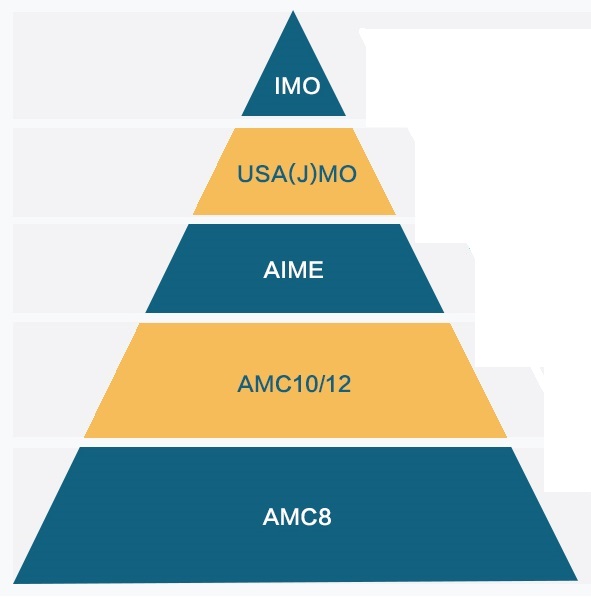
There are many math competitions in the United States. Of those, only

AMC → AIME → USAMO sequence

would take you to the IMO (International Math Olympiad), the highest level math competition for high school students in the world!

AMC-AIME-USAMO-IMO

AMC-General

Featured Math Instructors

All of our sessions are taught by highly qualified instructors who are excellent experts on preparing students for the exam. We distinguish ourselves by the high quality of our instructors. Finding top-quality instructors is no easy task. We’ve hand-picked some of the best, including graduates of Ivy League institutions.

Our instructors are dedicated to teaching and student success. They are very knowledgeable, patient, available, and willing to help our students. Our students receive a quality education that goes beyond the classroom.

Meet some of them here:

IMG_2563_0

Bronze_medal

Our Students

In 2022, we had 3 students qualified for the Math Olympiad Summer ProgramRead more at: Brendon J., Kyle S., and Isabella Z. Qualified for the 2022 Math Olympiad Summer Program

In 2022, we had 1 student Competes in International Girls’ Math OlympiadRead more at: Isabella Z. Competes in International Girls’ Math Olympiad

In 2022, we had 7 students qualified for the USAMO andstudents for the USAJMO. Read more at: 2022 USAMO and USAJMO Qualifiers Announced — Seven Students Qualified for the USAMO and Seven Students for the USAJMO.

In 2022, we had 88 students who obtained top scores on the AMC 8 contest!

  • 10 of our students were among the top 131 worldwide winners (Perfect Scorers), as shown in Table 1. Click Here see a full list of the 131 worldwide winners.
  • 52 students received National Distinguished Honor Roll Certificates awarded to top 1% test takers. They were among the 1,010 worldwide winners. Click Here see a full list.
  • 26 students received National Honor Roll Certificates awarded to top 5% test takers. They were among the 2,449 worldwide winners. Click Here see a full list.
  • 88 out of our 91 students (96.7%) received National Awards for the AMC 8 from the Mathematical Association of America

Read more at: 022 AMC 8 Results Just Announced — Ten Students Received Perfect Scores

In Fall 2021, we had 93 students who are qualified to take the AIME either through the AMC 10A/12A or AMC 10B/12B. One of our students was among the 5 Perfect Scorers worldwide on the AMC 10A: Nina L. and one of our students was among the 2 Perfect Scorers worldwide on the AMC 10B: Ming Y. Read more at: 93 Students Qualified for the 2021 Fall AIME and 2 Students Received Perfect Scores on the 2021 Fall AMC 10/12

In 2021, we had 6 students qualified for the USAMO and 6 students for the USAJMO. Read more at: 2021 USAMO and USAJMO Qualifiers Announced — Six Students Qualified for the USAMO and Six Students for the USAJMO

In 2021, we had 8 students who got into the MathCounts state-level top 10. Yunyi L. won 9th Place in the 2021 MathCounts National Competition!

In Spring 2021, we had 91 students who are qualified to take the AIME either through the AMC 10A/12A or AMC 10B/12B. Two of our students was among the 17 Perfect Scorers worldwide on the AMC 12A: Evan L. and Suraj O. and one of our students was among the 27 Perfect Scorers worldwide on the AMC 10A: Xinchen L. Read more at: 91 Students Qualified for the 2021 AIME and 3 Students Received Perfect Scores on the 2021 AMC 10/12

In 2020, we had 79 students who obtained top scores on the AMC 8 contest!

  • 5 of our students were among the top 57 worldwide winners (Perfect Scorers).
  • 49 students received National Distinguished Honor Roll Certificates awarded to top 1% test takers.
  • 25 students received National Honor Roll Certificates awarded to top 5% test takers.
  • 79 out of our 81 students (97.5%) received National Awards for the AMC 8 from the Mathematical Association of America.

Read more at: 2020 AMC 8 Results Just Announced — Five Students Received Perfect Scores

In 2020, we had 2 students, Isabella Z. and Sameer P., who were among the 61 students selected nationwide to attend. Read more at: Warmest congratulations to Isabella Z. and Sameer P. for being accepted into the Math Olympiad Program!

In 2020, we had 82 students who are qualified to take the AIME either through the AMC 10A/12A or AMC 10B/12B. One of our students was among the 11 Perfect Scorers worldwide on the AMC 12A: Yiyang X, and one of our students was among the 13 Perfect Scorers worldwide on the AMC 10A: Jason W.. 43 middle schoolers and 9 elementary schoolers qualified for the AIME!

Read more at: 2020 AIME Qualifiers Announced — 82 Students Qualified for the AIME

In 2019, we had 71 students who obtained top scores on the AMC 8 contest!

  • 8 of our students were among the top 151 National Winners (Perfect Scorers), including 2 sixth graders.
  • 36 students received National Distinguished Honor Roll Certificates awarded to top 1% test takers, as shown in Table 2.
  • 27 students received National Honor Roll Certificates awarded to top 5% test takers, as shown in Table 3.
  • 71 out of our 73 students (97.3%) received National Awards for the AMC 8 from the Mathematical Association of America

Read more at: 2019 AMC 8 Results Just Announced — Eight Students Received Perfect Scores

In 2019, we had 4 students qualified for the USAMO and 4 Students for the USAJMO.

  • Of the 280 USA Math Olympiad national qualifiers, 4 are our students: Luke C., Zipeng L., Sameer P., and Peter P.
  • Of the 235 USA Junior Math Olympiad national qualifiers, 4 are our students: Michael H., Noah W., Holden W., and Isabella Z.

Read more at: 2019 USAMO and USAJMO Qualifiers Announced — Four Students Qualified for the USAMO and Four Students for the USAJMO

In 2019, we had 76 students who are qualified to take the AIME either through the AMC 10A/12A or AMC 10B/12B. One of our students was among the 22 Perfect Scorers worldwide on the AMC 10A: Noah W.and one of our students were among the 10 Perfect Scorers worldwide on the AMC 12B: Kenneth WVery impressively, 32 middle schoolers and 7 elementary schoolers qualified for the AIME!

In 2018, we had 64 students who obtained top scores on the AMC 8 contest!

  • of our students were among the top 44 National Winners (Perfect Scorers): Eric B., Kevin Y., and Isabella Z.
  • 40 students received National Distinguished Honor Roll Certificates awarded to top 1% test takers.
  • 21 students received National Honor Roll Certificates awarded to top 5% test takers.
  • 64 out of our 66 students (96.5%) received National Awards for the AMC 8 from the Mathematical Association of America

Read more at: 2018 AMC 8 Results Just Announced — Three Students Received Perfect Scores

In 2018, we had 73 students who are qualified to take the AIME either through the AMC 10A/12A or AMC 10B/12B. Two of our students were among the 35 Perfect Scorers worldwide on the AMC 10A: Austen M. and Jason W.  and two of our students were among the 21 Perfect Scorers worldwide on the AMC 12B: Kaan D. and Edward W. Remarkably, 11 middle schoolers and 2 elementary schoolers qualified for the AIME!

In 2017, we had 63 students who earned top scores on the AMC 8 contest!

  • of our students were among the top 75 National Winners (Perfect Scorers).
  • 34 students received National Distinguished Honor Roll Certificates awarded to top 1% test takers.
  • 22 students received National Honor Roll Certificates awarded to top 5% test takers.
  • 63 out of our 65 students (97%) received National Awards for the AMC 8 from the Mathematical Association of America

Read more at: 2017 AMC 8 Results Just Announced — Seven Students Received Perfect Scores

In 2017, we had 61 students who are qualified to take the AIME either through the AMC 10A/12A or AMC 10B/12B. One of our students was among the 28 Perfect Scorers worldwide on the AMC 10A: Austen M., and two of our students were among the 65 Perfect Scorers worldwide on the AMC 10B: Ashwin A. and Brad Z. Remarkably, eight middle schoolers and one elementary schooler qualified for the AIME, which is geared toward high school students. Very impressively, Bryan Z., a 6th grader, gained a score of 132 out of 150 on the AMC 10B.Read more at: 2017 AIME Qualifiers Announced — 61 Students Qualified for the AIME

In 2016, we had 36 students who are qualified to take AIME either through AMC 10A/12A or AMC 10B/12B. One of our students was among the 23 Perfect Scorers worldwide on the AMC 10A: Joel (Junyao) T. Particularly, seven middle schoolers and one elementary schooler qualified for the AIME, which is geared toward high school students. Pravalika P., a 6th grader, got a 115.5 out of 150 on the AMC10B, which is very impressive. Read more at: 2016 AIME Qualifiers Announced — 36 Students Qualified for AIME

2011 – 2015: In total, 37 students scored above 120 on the American Mathematics Contest 10 (AMC 10) and qualified for the American Invitational Mathematics Examination (AIME); 26 students scored above 100 on the American Mathematics Contest 12 (AMC 12) and qualified for the American Invitational Mathematics Examination (AIME); 3 students qualified for the USA Mathematical Olympiad (USAMO), the highest level of math competition for high school students in the USA

2011 – 2015: In total, 23 students achieved perfect scores of 28 on the AMC 8

Read more at: Notable Achievements of Our Students

AAEAAQAAAAAAAAKeAAAAJDkzYTk2ZjE5LTk1YWQtNDBkNy1hZDhjLTVjOTA2YWQ2NmQ2Mw

Our Uniqueness

We have a long history of close collaboration with the MAA‘s American Mathematics Competitions (AMC), which are dedicated to strengthening the mathematical capabilities of our nation’s youth, and are the first of a series of competitions in high school mathematics that determine the United States team for the International Mathematical Olympiad (IMO).

We are only one in the Washington DC metropolitan area to offer elementary, middle, and high-school level competition math courses. Our students have received top scores and awards at prestigious national math competitions.

Great Benefits of Math Competitions

In an increasingly competitive college application pool, the process of mastering math skills through our courses and participating in the American Math Competitions will help students strengthen and diversify their extracurricular activities. These contests can motivate students’ interest and passion in math, and they can discover their talent through solving challenging problems different from those in the school classes. Many top colleges also request AMC scores as part of the college application process. Both MIT and Caltech have entry blanks on their official admission application forms for the applicant to enter their best AMC and AIME scores. Ivy League Colleges, Caltech, and Stanford ask for to the AMC and AIME scores in their Supplement to the Common Application Forms. Your children deserve the chance to list these scores on their applications! Good AMC scores will greatly enhance admission opportunities for students to elite colleges.

Read more:

Contact Information:

Ivy League Education Center
Tel:  301-922-9508     or        240-780-8828
Email:  chiefmathtutor@gmail.com

education priceless treasure

2014124135627709

Click HERE find out more about Math Competitions!sat-logo-3

Click HERE to find out more about SAT Prep!

1090007ad4f9061d818

%e6%95%b0%e5%ad%a6%e5%a4%a7%e6%9c%89%e4%bd%9c%e4%b8%ba

AIME_RGB

%e6%95%b0%e4%b8%ad%e8%87%aa%e6%9c%89%e9%bb%84%e9%87%91%e5%b1%8bAMCAMC_Airlines_logo_svg

education priceless treasure

3

mathis_1IMOLogos-gudder-quote-the-essence-of-mathematics-is-not-to-make-simple-things

Online Intensive AMC 8/Mathcounts Prep (for 4th to 8th Graders) Fall Weekend Course (Algebra) Starting Sept. 10

Fall is the golden time to prepare for the American Math Competitions!

The period of time between 4th-8th grade is most critical to the development of students’ mathematical fascinations, interests, and skills!

Fall Session (Algebra)
10 Classes (Eastern Time: 6:00 – 8:00 pm), Total: 20 Hours
9/10, 9/17, 9/24, 10/1, 10/8 (Monthly Mock Test/Review), 10/15, 10/22, 10/29, 11/5, 11/12 (Mock Test/Review)

Course Outline

Online Registration is now open! Click HERE to register and pay.

  • This is a live class, not a pre-recorded one. Instructors will ask students questions, and students can also ask questions during the class or email their questions to instructors after class.
  • We record all of our lessons so that our students can watch them after class for review and self-study.

Tuition (including all materials)

New Student: $700  Buy Now Button

Returning Student: $680  Buy Now Button

Click HERE to see payment and refund policy.

You are very welcome to sign up for our online course which offers a quick, efficient way for students to interact with teachers over long distance. We use the Google Meet to video chat and easily connect with students to teach them our tricks and shortcuts to getting an amazing score on their contests, as well as offer them our guidance and support. Students can ask questions face-to-face, and can complete problems with the supervision of our teachers/coaches. Click HERE to see detailed instruction.

commitment to the whole course can maximize the benefit of learning all the math ideas, methods, strategies, tactics, skills, and techniques.

  • We will help students gain a deeper understanding of the fundamental math concepts, build a solid foundation in math, and develop the critical thinking and problem-solving skills different from those in the school classes, motivation, and perseverance for reaching their full potential.
  • We will focus on efficient tricks, shortcuts, and strategies to solve competitive math problems as well as test-taking tactics.
  • The emphasis of this class will be on comprehensive problem-solving in mental math and algebra. Particularly, we will help students use mental math for accurately and quickly solving contest questions in their heads. 
  • We will utilize a highly effective teaching model as described in the article: Small-sized Class Instruction-focused Model.

Instructor: Dr. Henry Wan

mathequalsawesomelogo

Purpose: To prepare for math competitions, such as

Contact Information:
Ivy League Education Center
Tel:  301-922-9508
Email:  chiefmathtutor@gmail.com

Math-Competitions

Specific Goal of the 2023 AMC 8:

To become part of the top 5% of scorers on the AMC 8, and then receive National Honor Roll Certificates.

Specific Goal of the 2023 AMC 10:

To earn a score of 90 or more out of 150 on the AMC 10, and then receive National Achievement Honor Roll Certificates.

Specific Goal of the MathCounts:

To become one of the top winners in the individual competition at the chapter level and then advance to the state competition.

AMC-General

There are many math competitions in the United States. Of those, only

AMC → AIME → USAMO sequence

would take you to the IMO (International Math Olympiad), the highest level math competition for high school students in the world!

amc8

Click here to read more!

1519880981742

Description:
Our curriculum focuses on advancing the mathematical skills of 5th-8th graders to prepare them for math competitions, such as AMC 8, AMC 10, Mathcounts, Math Olympiads for Elementary and Middle Schools (MOEMS), Math Kangaroo, and Math League. A variety of contest questions, including all past official AMC 8 problems, the first 15 problems on each old AMC 10 tests, and MathCounts Competition problems at the school, chapter, state, and national level, are used to teach students strategies to solve problems and help students prepare for the competitions. These problems stimulate their interest and enthusiasm for critical thinking and problem solving, broaden their mathematical intuition, and develop their brainpower. The topics taught in this class are not covered in regular school math classes, allowing our students to stay one step ahead.

Benefits:

Grade Levels: Grades 4-8

AMC Logo

Class Outline:

This class focuses on efficient tricks, shortcuts, and strategies to solve competitive math problems as well as test-taking tactics. The emphasis of this class will be on comprehensively problem-solving in mental math and algebra, which is the most important to competitive math. In particular, we will help students use mental math for accurately and quickly solving contest questions in their heads. 

We reserve the right to adjust the teaching content and pace according to the actual performance of students .

Session I (Systematic Problem Solving)

Class Date Topic
1 9/10, Sat Arithmetic Ratio and Proportional Reasoning
2 9/17, Sat

Fractional Exponents, Radicals, and Variables

3 9/24, Sat

Quick Tricks for Rationalizing the Denominator and Simplifying Radicals

4 10/1, Sat

Variables and Expressions

5 10/8, Sat

One-Variable Linear Equations

6 10/15, Sat

Two-Variable Linear Equations

7 10/22, Sat Algebraic Manipulations
8 10/29, Sat Special Factorizations
9 11/5, Sat Using Difference of Squares to Mentally Square Numbers and Multiply Numbers
10 11/12, Sat Quick Tricks for Special Multiplications, Fractions, Decimals, and Percent

Homework:

The focus will be on the final 15 problems on the AMC 8, and the first 15 problems on the AMC 10, as well as those Those medium and hard-level difficulty questions on the MathCounts. We will provide students with 500 brand new problems, extracted from the licensed AMC Database, having similar difficulty and style as the hard real AMC 8 problems.

On average, at least 6 hours per week, as described in the article: Homework assignments are a fundamental part of our courses. Click HERE to see a typical homework sample we developed. Each week, we will carefully review and check 3 students’ homework, and correct any mistakes. The next week, we will check another 3 students’ homework, and this will continue on a rotational basis until all students have had their homework checked at least once and the cycle will start again. Based on the work of the 3 students that week, we will provide the those 3 students with individualized proposal and support. More details can be found in the article: Homework Correction is very Important — We Give an Extensive Correction of the Incorrect Answers of All Homework.

do-math

We have to face the simple truth that to do well on these grueling contests, we will need to practice. Just like it is for sports and music, the key to success is repetition and practice. We strongly believe in effort and the malleability of intelligence. Intelligence can be enhanced through effort. People can develop impressive levels of expertise through hard work and practice. Effort and persistence are the keys to success. Hard work always pays off: practice makes perfect!

All problems from past AMC 8 exams (1985-2022),  AMC 10 exams (2000-2021), and MathCounts (1990–2022) form our “big data” system. Based on artificial intelligence (AI), machine learning, and deep learning, we devised a data mining and predictive analytics tool for math problem similarity searching. Using this powerful tool, we examined the types, styles, frequencies, characteristics, and traits of questions in all these materials, and then completely “decoded” the AMC, and MathCounts. We always completely show all the “secret code” cracked from the above big data to our students, and teach them to totally grasp and “control” the AMC and MathCounts. For all questions on the recent AMC/MathCounts contests, we can find their “ancestors” and “roots” from the old AMC/MathCounts problems. Therefore, the best way to prepare for the contest is to practice by solving old AMC/MathCounts problems.

https___img_evbuc_com_https%253A%252F%252Fcdn_evbuc_com%252Fimages%252F14806251%252F149172474682%252F1%252Foriginal

Main Purpose:

Our main purpose is to help our students gain deeper understanding of the fundamental math concepts, build a solid foundation in math, and develop the critical thinking and problem-solving skills that are so valuable to success in any career. We are big believers in the FUNDAMENTALS! Our students will receive the LIFELONG BENEFITS from learning math.

Regardless of his/her math level, each student will have the opportunity to learn math in a fun, friendly, cooperative, supportive learning environment. The most important thing is to have fun.

Bronze_medal

Our Students

In 2022, we had 3 students qualified for the Math Olympiad Summer ProgramRead more at: Brendon J., Kyle S., and Isabella Z. Qualified for the 2022 Math Olympiad Summer Program

In 2022, we had 1 student Competes in International Girls’ Math OlympiadRead more at: sabella Z. Competes in International Girls’ Math Olympiad

In 2022, we had 7 students qualified for the USAMO andstudents for the USAJMO. Read more at: 2022 USAMO and USAJMO Qualifiers Announced — Seven Students Qualified for the USAMO and Seven Students for the USAJMO.

In 2022, we had 88 students who obtained top scores on the AMC 8 contest!

  • 10 of our students were among the top 131 worldwide winners (Perfect Scorers), as shown in Table 1. Click Here see a full list of the 131 worldwide winners.
  • 52 students received National Distinguished Honor Roll Certificates awarded to top 1% test takers. They were among the 1,010 worldwide winners. Click Here see a full list.
  • 26 students received National Honor Roll Certificates awarded to top 5% test takers. They were among the 2,449 worldwide winners. Click Here see a full list.
  • 88 out of our 91 students (96.7%) received National Awards for the AMC 8 from the Mathematical Association of America

Read more at: 022 AMC 8 Results Just Announced — Ten Students Received Perfect Scores

In Fall 2021, we had 93 students who are qualified to take the AIME either through the AMC 10A/12A or AMC 10B/12B. One of our students was among the 5 Perfect Scorers worldwide on the AMC 10A: Nina L. and one of our students was among the 2 Perfect Scorers worldwide on the AMC 10B: Ming Y. Read more at: 93 Students Qualified for the 2021 Fall AIME and 2 Students Received Perfect Scores on the 2021 Fall AMC 10/12

In 2021, we had 6 students qualified for the USAMO and 6 students for the USAJMO. Read more at: 2021 USAMO and USAJMO Qualifiers Announced — Six Students Qualified for the USAMO and Six Students for the USAJMO

In 2021, we had 8 students who got into the MathCounts state-level top 10. Yunyi L. won 9th Place in the 2021 MathCounts National Competition!

In Spring 2021, we had 91 students who are qualified to take the AIME either through the AMC 10A/12A or AMC 10B/12B. Two of our students was among the 17 Perfect Scorers worldwide on the AMC 12A: Evan L. and Suraj O. and one of our students was among the 27 Perfect Scorers worldwide on the AMC 10A: Xinchen L. Read more at: 91 Students Qualified for the 2021 AIME and 3 Students Received Perfect Scores on the 2021 AMC 10/12

In 2020, we had 79 students who obtained top scores on the AMC 8 contest!

  • 5 of our students were among the top 57 worldwide winners (Perfect Scorers).
  • 49 students received National Distinguished Honor Roll Certificates awarded to top 1% test takers.
  • 25 students received National Honor Roll Certificates awarded to top 5% test takers.
  • 79 out of our 81 students (97.5%) received National Awards for the AMC 8 from the Mathematical Association of America.

Read more at: 2020 AMC 8 Results Just Announced — Five Students Received Perfect Scores

In 2020, we had 82 students who are qualified to take the AIME either through the AMC 10A/12A or AMC 10B/12B. One of our students was among the 11 Perfect Scorers worldwide on the AMC 12A: Yiyang X, and one of our students was among the 13 Perfect Scorers worldwide on the AMC 10A: Jason W.. 43 middle schoolers and 9 elementary schoolers qualified for the AIME!

In 2019, we had 71 students who obtained top scores on the AMC 8 contest!

  • 8 of our students were among the top 151 National Winners (Perfect Scorers), including 2 sixth graders.
  • 36 students received National Distinguished Honor Roll Certificates awarded to top 1% test takers, as shown in Table 2.
  • 27 students received National Honor Roll Certificates awarded to top 5% test takers, as shown in Table 3.
  • 71 out of our 73 students (97.3%) received National Awards for the AMC 8 from the Mathematical Association of America

Read more at: 2019 AMC 8 Results Just Announced — Eight Students Received Perfect Scores

In 2019, we had 4 Students Qualified for the USAMO and 4 Students for the USJMO.

  • Of the 280 USA Math Olympiad national qualifiers, 4 are our students: Luke C., Zipeng L., Sameer P., and Peter P.
  • Of the 235 USA Junior Math Olympiad national qualifiers, 4 are our students: Michael H., Noah W., Holden W., and Isabella Z.

Read more at: 2019 USAMO and USAJMO Qualifiers Announced — Four Students Qualified for the USAMO and Four Students for the USAJMO

In 2019, we had 76 students who are qualified to take the AIME either through the AMC 10A/12A or AMC 10B/12B. One of our students was among the 22 Perfect Scorers worldwide on the AMC 10A: Noah W. and one of our students were among the 10 Perfect Scorers worldwide on the AMC 12B: Kenneth WVery impressively, 32 middle schoolers and 7 elementary schoolers qualified for the AIME!

In 2018, we had 64 students who obtained top scores on the AMC 8 contest!

  • of our students were among the top 44 National Winners (Perfect Scorers): Eric B., Kevin Y., and Isabella Z.
  • 40 students received National Distinguished Honor Roll Certificates awarded to top 1% test takers.
  • 21 students received National Honor Roll Certificates awarded to top 5% test takers.
  • 64 out of our 66 students (96.5%) received National Awards for the AMC 8 from the Mathematical Association of America

Read more at: 2018 AMC 8 Results Just Announced — Three Students Received Perfect Scores

In 2018, we had 73 students who are qualified to take the AIME either through the AMC 10A/12A or AMC 10B/12B. Two of our students were among the 35 Perfect Scorers worldwide on the AMC 10A: Austen M. and Jason W.  and two of our students were among the 21 Perfect Scorers worldwide on the AMC 12B: Kaan D. and Edward W. Remarkably, 11 middle schoolers and 2 elementary schoolers qualified for the AIME!

In 2017, we had 63 students who earned top scores on the AMC 8 contest!

  • of our students were among the top 75 National Winners (Perfect Scorers).
  • 34 students received National Distinguished Honor Roll Certificates awarded to top 1% test takers.
  • 22 students received National Honor Roll Certificates awarded to top 5% test takers.
  • 63 out of our 65 students (97%) received National Awards for the AMC 8 from the Mathematical Association of America

Read more at: 2017 AMC 8 Results Just Announced — Seven Students Received Perfect Scores

In 2017, we had 61 students who are qualified to take the AIME either through the AMC 10A/12A or AMC 10B/12B. One of our students was among the 28 Perfect Scorers worldwide on the AMC 10A: Austen M., and two of our students were among the 65 Perfect Scorers worldwide on the AMC 10B: Ashwin A. and Brad Z. Remarkably, eight middle schoolers and one elementary schooler qualified for the AIME, which is geared toward high school students. Very impressively, Bryan Z., a 6th grader, gained a score of 132 out of 150 on the AMC 10B.Read more at: 2017 AIME Qualifiers Announced — 61 Students Qualified for the AIME

In 2016, we had 36 students who are qualified to take AIME either through AMC 10A/12A or AMC 10B/12B. One of our students was among the 23 Perfect Scorers worldwide on the AMC 10A: Joel (Junyao) T. Particularly, seven middle schoolers and one elementary schooler qualified for the AIME, which is geared toward high school students. Pravalika P., a 6th grader, got a 115.5 out of 150 on the AMC10B, which is very impressive. Read more at: 2016 AIME Qualifiers Announced — 36 Students Qualified for AIME

2011 – 2015: In total, 37 students scored above 120 on the American Mathematics Contest 10 (AMC 10) and qualified for the American Invitational Mathematics Examination (AIME); 26 students scored above 100 on the American Mathematics Contest 12 (AMC 12) and qualified for the American Invitational Mathematics Examination (AIME); 3 students qualified for the USA Mathematical Olympiad (USAMO), the highest level of math competition for high school students in the USA

2011 – 2015: In total, 23 students achieved perfect scores of 28 on the AMC 8

Read more at: Notable Achievements of Our Students

AAEAAQAAAAAAAAKeAAAAJDkzYTk2ZjE5LTk1YWQtNDBkNy1hZDhjLTVjOTA2YWQ2NmQ2Mw

Our Uniqueness

We have a long history of close collaboration with the MAA’American Mathematics Competitions (AMC), which are dedicated to strengthening the mathematical capabilities of our nation’s youth, and are the first of a series of competitions in high school mathematics that determine the United States team for the International Mathematical Olympiad (IMO).

We are only one in the Washington DC metropolitan area to offer elementary, middle, and high-school level competition math courses. Our students have received top scores and awards at prestigious national and math competitions.

Great Benefits of Math Competitions

In an increasingly competitive college application pool, the process of mastering math skills through our courses and participating in the American Math Competitions will help students strengthen and diversify their extracurricular activities. These contests can motivate students’ interest and passion in math, and they can discover their talent through solving challenging problems different from those in the school classes. Many top colleges also request AMC scores as part of the college application process. Both MIT and Caltech have entry blanks on their official admission application forms for the applicant to enter their best AMC and AIME scores. Ivy League Colleges and Stanford ask for to the AMC and AIME scores in their Supplement to the Common Application Forms. Your children deserve the chance to list these scores on their applications! Good AMC scores will greatly enhance admission opportunities for students to elite colleges.

Read more at::

2014124135627709

Click HERE find out more about Math Competitions!sat-logo-3

Click HERE to find out more about SAT Prep!

AMC 8-New

1090007ad4f9061d818

AMCAMC_Airlines_logo_svg

education priceless treasure

3.jpgMathCompetition4

tumblr_o0ejoktVY91u80xalo1_500

Online Intensive AMC 10/12 Prep (for 7th to 12th Graders) Fall Weekend Course Starting Sept. 11

Fall is the best time to prepare for the AMC 10/12 Contests! Success is doing ordinary things EXTRAordinarily well!

Purpose: To prepare for the AMC 10/12A —Thursday, November 10, 2022 and AMC 10/12B — Wednesday, November 16, 2022.

BANNER_Top_Mathletics
Course Outline

Fall Session I (Comprehensive Problem-Solving)
5 Weekends (EASTERN Time: 6:00 – 8:30 pm), Total: 12.5 Hours
9/11, 9/18, 9/25, 10/2, 10/9 (Midterm Mock Test/Review)
Fall Session II (Continuation of Session I)
5 Weekends (EASTERN Time: 6:00 – 8:30 pm), Total: 12.5 Hours
10/16, 10/23, 10/30,  11/6,  11/13 (Final Mock Test/Review)

Online Registration is now open! Click HERE to register and pay. (Three spots are available!)

  • This is a live class, not a pre-recorded one. Instructors will ask students questions, and students can also ask questions during the class or email their questions to instructors after class.
  • We record all of our lessons as a big bonus so that our students can watch class videos after class for review and self-study.
Tuition (including all materials)
Session I: New Student: $560   Buy Now Button
Returning Student: $545   Buy Now Button
Session II: New Student: $560   Buy Now Button
Returning Student: $545  Buy Now Button
Sessions I & II: New Student: $1,100   Buy Now Button
Returning Student: $1,075  Buy Now Button
Click HERE to see payment and refund policy.

You are very welcome to sign up for our online course which offers a quick, efficient way for students to interact with teachers over long distance. We use Google Meet to video chat and easily connect with students to teach them our tricks and shortcuts to getting an amazing score on their contests, as well as offer them our guidance and support. Students can ask questions face-to-face, and can complete problems with the supervision of our teachers/coaches. Click HERE to see detailed instruction.

A commitment to the whole course can maximize the benefit of learning all the math ideas, methods, strategies, tactics, skills, and techniques.

  • We will help students gain a deeper understanding of the fundamental math concepts, build a solid foundation in math, and develop the critical thinking and problem-solving skills different from those in the school classes, motivation, and perseverance for reaching their full potential.
  • We will focus on efficient tricks, shortcuts, and strategies to solve competitive math problems, especially those hard problems on the AMC 10/12 and easy problems on the AIME, as well as test-taking tactics.
  • The emphasis of this class will be on systematic, comprehensive, and in-depth problem-solving, which is extremely common in competitive math, but is not included in school curriculum.
  • We will utilize a highly effective teaching model as described in the article: Small-sized Class Instruction-focused Model.

Instructors:

Contact Information:
Ivy League Education Center
Tel:  301-922-9508     or        240-406-3402
Email:  chiefmathtutor@gmail.com

math-olympiad-web

Specific Goal: 

To earn a score of 120 or more out of 150 on the American Mathematics Contest 10 (AMC 10), or a score of 100 or more out of 150 on the American Mathematics Contest 12 (AMC 12), and then qualify for the American Invitational Mathematics Examination (AIME), which is used to determine qualification for the United States of America Mathematical Olympiad (USAMO). See for more details: Optimal Strategies to Solve Hard AMC Problems

AMC-General

There are many math competitions in the United States. Of those, only

AMC → AIME → USAMO sequence

would take you to the IMO (International Math Olympiad), the highest level math competition for high school students in the world!

AMC 10-12-New
Click here to read more!

imagesFX9CEY3L

Who should take this class: 

This class is very appropriate for 7th-12th grade students who are hoping to qualify for the AIME.

Benefits:

  • 10 tutorial handouts (>500 pages) developed by Dr. Henry Wan and 500 new problems similar to AMC 10/12 level from the licensed AMC Database.
  • 2 FREE mock tests that are intended to mimic an actual math competition exam, each of which has 25 questions similar to AMC 10/12 level taken from the licensed AMC Database. These simulated tests help students assess their level of preparation for the Math Competitions. After attempting the test, students get answers, explanations, and a detailed score report and wise performance summary.
  • FREE registration for the AMC 10/12A — Wednesday, November 9, 2022 and AMC 10/12B — Tuesday, November 15, 2022. Please see: The 2022 AMC 10/12 Contests at the Ivy League Center on Nov. 10, 2022, and Nov. 16, 2022

Weekly Homework:

At least 3 hours per week. Problem sets include all problems from 82 past real AMC 10/12 test booklets, and 500 brand new problems having similar difficulty and style as the real AMC 10/12 problems, extracted from the licensed AMC Database.

The focus will on the final 15 problems on the AMC 10/12, and the first 5 problems on the AIME, as well as those hard problems on the ARML. Note that some hard problems on the recent AMC 10 and 12 are exactly the same as previous ARML Problems.

Read More at:

Each week, we will carefully review and check 2 students’ homework, and correct any mistakes. The next week, we will check another 2 students’ homework, and this will continue on a rotational basis until all students have had their homework checked at least once and the cycle will start again. Based on the work of the 2 students that week, we will provide the those 2 students with individualized proposal and support.

Qualifying AIME

Class Outline:
In the final sprint of AMC 10/12 preparation, we will focus on efficient tricks, shortcuts, and strategies to solve AMC problems as well as test-taking tactics. The emphasis of this class will be on systematic, comprehensive, in-depth problem-solving, which is very common in competitive math. We will also help students develop quick problem solving strategies and effective time management skills.

Session I (Comprehensive Problem-Solving)

Class Date Topic
1 9/11, Sun Efficient Strategies to Solve Hard AMC Algebraic Manipulations Problems
29 9/18, Sun Using Sophisticated Algebraic Approaches to Solving Polynomials and Functions Problems on the AMC
3 9/25, Sun In-depth Problem-solving Techniques in Sequences, Series, and Patterns
4 10/2, Sun The Comprehensive Geometry Toolkit with Significant Applications to the AMC
5 10/9, Sun Systematic Problem Solving in Triangle and Circle Geometry

Session II (Continuation of Session I)

Class Date Topic
6 10/16, Sun Tricks and Shortcuts for Solving AMC Counting Problems
7 10/23, Sun Advanced Topics in Combinatorics
8 10/30, Sun The Art and Craft for Solving AMC Discrete Probability Problems
9 11/6, Sun The Comprehensive Art of Solving Hard Number Theory Problems on the AMC
10 11/13, Sun Using the Number Theory Toolkit to Solve the AMC Problems

AMC Logo

Small-sized Class Teaching Model: 

We utilize the highly effective small-sized class teaching model. Smaller classes lead to pupils receiving more individual attention from teachers, and having more active interactions with them. We focus on every individual, not the whole class. Students will thrive from the smaller class sizes that allow them to reach their full potential. Particularly, students can benefit tremendously from high-frequent individualized student-teacher interactions leading to establishment of a stronger foundation for lifelong learning.

Our main purpose is to help our students gain deeper understanding of the fundamental math concepts, build a solid foundation in math, and develop the critical thinking and problem-solving skills that are so valuable to success in any career. We are big believers in the FUNDAMENTALS! Our students will receive the LIFELONG BENEFITS from learning math.

IMG_2563_0

Regardless of his/her math level, each student will have the opportunity to learn math in a fun, friendly, cooperative, supportive learning environment. The most important thing is to have fun.

Bronze_medal

Our Students

In 2022, we had 3 students qualified for the Math Olympiad Summer ProgramRead more at: Brendon J., Kyle S., and Isabella Z. Qualified for the 2022 Math Olympiad Summer Program

In 2022, we had 1 student competed in International Girls’ Math OlympiadRead more at: sabella Z. Competes in International Girls’ Math Olympiad

In 2022, we had 7 students qualified for the USAMO andstudents for the USAJMO. Read more at: 2022 USAMO and USAJMO Qualifiers Announced — Seven Students Qualified for the USAMO and Seven Students for the USAJMO.

In 2022, we had 88 students who obtained top scores on the AMC 8 contest!

  • 10 of our students were among the top 131 worldwide winners (Perfect Scorers), as shown in Table 1. Click Here see a full list of the 131 worldwide winners.
  • 52 students received National Distinguished Honor Roll Certificates awarded to top 1% test takers. They were among the 1,010 worldwide winners. Click Here see a full list.
  • 26 students received National Honor Roll Certificates awarded to top 5% test takers. They were among the 2,449 worldwide winners. Click Here see a full list.
  • 88 out of our 91 students (96.7%) received National Awards for the AMC 8 from the Mathematical Association of America

Read more at: 022 AMC 8 Results Just Announced — Ten Students Received Perfect Scores

In Fall 2021, we had 93 students who are qualified to take the AIME either through the AMC 10A/12A or AMC 10B/12B. One of our students was among the 5 Perfect Scorers worldwide on the AMC 10A: Nina L. and one of our students was among the 2 Perfect Scorers worldwide on the AMC 10B: Ming Y. Read more at: 93 Students Qualified for the 2021 Fall AIME and 2 Students Received Perfect Scores on the 2021 Fall AMC 10/12

In 2021, we had 6 students qualified for the USAMO and 6 students for the USAJMO. Read more at: 2021 USAMO and USAJMO Qualifiers Announced — Six Students Qualified for the USAMO and Six Students for the USAJMO

In 2021, we had 8 students who got into the MathCounts state-level top 10. Yunyi L. won 9th Place in the 2021 MathCounts National Competition!

In Spring 2021, we had 91 students who are qualified to take the AIME either through the AMC 10A/12A or AMC 10B/12B. Two of our students was among the 17 Perfect Scorers worldwide on the AMC 12A: Evan L. and Suraj O. and one of our students was among the 27 Perfect Scorers worldwide on the AMC 10A: Xinchen L. Read more at: 91 Students Qualified for the 2021 AIME and 3 Students Received Perfect Scores on the 2021 AMC 10/12

In 2020, we had 79 students who obtained top scores on the AMC 8 contest!

  • 5 of our students were among the top 57 worldwide winners (Perfect Scorers).
  • 49 students received National Distinguished Honor Roll Certificates awarded to top 1% test takers.
  • 25 students received National Honor Roll Certificates awarded to top 5% test takers.
  • 79 out of our 81 students (97.5%) received National Awards for the AMC 8 from the Mathematical Association of America.

Read more at: 2020 AMC 8 Results Just Announced — Five Students Received Perfect Scores

In 2020, we had 82 students who are qualified to take the AIME either through the AMC 10A/12A or AMC 10B/12B. One of our students was among the 11 Perfect Scorers worldwide on the AMC 12A: Yiyang X, and one of our students was among the 13 Perfect Scorers worldwide on the AMC 10A: Jason W.. 43 middle schoolers and 9 elementary schoolers qualified for the AIME! Read more at: 2020 AIME Qualifiers Announced — 82 Students Qualified for the AIME

In 2019, we had 71 students who obtained top scores on the AMC 8 contest!

  • 8 of our students were among the top 151 National Winners (Perfect Scorers), including 2 sixth graders.
  • 36 students received National Distinguished Honor Roll Certificates awarded to top 1% test takers.
  • 27 students received National Honor Roll Certificates awarded to top 5% test takers.
  • 71 out of our 73 students (97.3%) received National Awards for the AMC 8 from the Mathematical Association of America.

Read more at: 2019 AMC 8 Results Just Announced — Eight Students Received Perfect Scores

In 2019, we had 4 Students Qualified for the USAMO and 4 Students for the USJMO.

  • Of the 280 USA Math Olympiad national qualifiers, 4 are our students: Luke C., Zipeng L., Sameer P., and Peter P.
  • Of the 235 USA Junior Math Olympiad national qualifiers, 4 are our students: Michael H., Noah W., Holden W., and Isabella Z.

Read more at: 2019 USAMO and USAJMO Qualifiers Announced — Four Students Qualified for the USAMO and Four Students for the USAJMO

In 2019, we had 76 students who are qualified to take the AIME either through the AMC 10A/12A or AMC 10B/12B. One of our students was among the 22 Perfect Scorers worldwide on the AMC 10A: Noah W. and one of our students were among the 10 Perfect Scorers worldwide on the AMC 12B: Kenneth WVery impressively, 32 middle schoolers and 7 elementary schoolers qualified for the AIME!

In 2018, we had 64 students who obtained top scores on the AMC 8 contest!

  • of our students were among the top 44 National Winners (Perfect Scorers): Eric B., Kevin Y., and Isabella Z.
  • 40 students received National Distinguished Honor Roll Certificates awarded to top 1% test takers.
  • 21 students received National Honor Roll Certificates awarded to top 5% test takers.
  • 64 out of our 66 students (96.5%) received National Awards for the AMC 8 from the Mathematical Association of America

Read more at: 2018 AMC 8 Results Just Announced — Three Students Received Perfect Scores

In 2018, we had 73 students who are qualified to take the AIME either through the AMC 10A/12A or AMC 10B/12B. Two of our students were among the 35 Perfect Scorers worldwide on the AMC 10A: Austen M. and Jason W.  and two of our students were among the 21 Perfect Scorers worldwide on the AMC 12B: Kaan D. and Edward W. Remarkably, 11 middle schoolers and 2 elementary schoolers qualified for the AIME!

In 2017, we had 63 students who earned top scores on the AMC 8 contest!

  • of our students were among the top 75 National Winners (Perfect Scorers).
  • 34 students received National Distinguished Honor Roll Certificates awarded to top 1% test takers.
  • 22 students received National Honor Roll Certificates awarded to top 5% test takers.
  • 63 out of our 65 students (97%) received National Awards for the AMC 8 from the Mathematical Association of America

Read more at: 2017 AMC 8 Results Just Announced — Seven Students Received Perfect Scores

In 2017, we had 61 students who are qualified to take the AIME either through the AMC 10A/12A or AMC 10B/12B. One of our students was among the 28 Perfect Scorers worldwide on the AMC 10A: Austen M., and two of our students were among the 65 Perfect Scorers worldwide on the AMC 10B: Ashwin A. and Brad Z. Remarkably, eight middle schoolers and one elementary schooler qualified for the AIME, which is geared toward high school students. Very impressively, Bryan Z., a 6th grader, gained a score of 132 out of 150 on the AMC 10B.Read more at: 2017 AIME Qualifiers Announced — 61 Students Qualified for the AIME

In 2016, we had 36 students who are qualified to take AIME either through AMC 10A/12A or AMC 10B/12B. One of our students was among the 23 Perfect Scorers worldwide on the AMC 10A: Joel (Junyao) T. Particularly, seven middle schoolers and one elementary schooler qualified for the AIME, which is geared toward high school students. Pravalika P., a 6th grader, got a 115.5 out of 150 on the AMC10B, which is very impressive. Read more at: 2016 AIME Qualifiers Announced — 36 Students Qualified for AIME

2011 – 2015: In total, 37 students scored above 120 on the American Mathematics Contest 10 (AMC 10) and qualified for the American Invitational Mathematics Examination (AIME); 26 students scored above 100 on the American Mathematics Contest 12 (AMC 12) and qualified for the American Invitational Mathematics Examination (AIME); 3 students qualified for the USA Mathematical Olympiad (USAMO), the highest level of math competition for high school students in the USA

2011 – 2015: In total, 23 students achieved perfect scores of 28 on the AMC 8

Read more at: Notable Achievements of Our Students
AAEAAQAAAAAAAAKeAAAAJDkzYTk2ZjE5LTk1YWQtNDBkNy1hZDhjLTVjOTA2YWQ2NmQ2Mw

Our Uniqueness

We have a long history of close collaboration with the MAA’American Mathematics Competitions (AMC), which are dedicated to strengthening the mathematical capabilities of our nation’s youth, and are the first of a series of competitions in high school mathematics that determine the United States team for the International Mathematical Olympiad (IMO).

We are only one in the Washington DC metropolitan area to offer elementary, middle, and high-school level competition math courses. Our students have received top scores and awards at prestigious national and math competitions.

Great Benefits of Math Competitions

In an increasingly competitive college application pool, the process of mastering math skills through our courses and participating in the American Math Competitions will help students strengthen and diversify their extracurricular activities. These contests can motivate students’ interest and passion in math, and they can discover their talent through solving challenging problems different from those in the school classes. Many top colleges also request AMC scores as part of the college application process. Both MIT and Caltech have entry blanks on their official admission application forms for the applicant to enter their best AMC and AIME scores. Ivy League Colleges and Stanford ask for to the AMC and AIME scores in their Supplement to the Common Application Forms. Your children deserve the chance to list these scores on their applications! Good AMC scores will greatly enhance admission opportunities for students to elite colleges.

Read more at::

education priceless treasure

2014124135627709

Click HERE find out more about Math Competitions!sat-logo-3

Click HERE to find out more about SAT Prep!

amc

testa005

1090007ad4f9061d818

AIME_RGBAMCAMC_Airlines_logo_svg

education priceless treasure

31eaba7d8a4376fedc290c94d5702d429

6e2ad27c20314a60cdd086927f15b524

001YIeUmgy6X1ziaAW4d0&amp;690

0

rosie_the_riveter_poster